Blender Texture Paint: A Practical, Step-by-Step Guide
Learn Blender texture paint to create, refine, and export textures directly on 3D models. This educational guide covers setup, workflow, brushes, UVs, exports, a hands-on wood grain example, and pro tips for faster, higher-quality results.


In Blender texture paint, you paint textures directly on a 3D model using brushes, masks, and layers. You’ll set up an image texture, switch to Texture Paint mode, and build color, roughness, and normal details while referencing UVs. The result is a production-ready texture set for shaders.
What Blender Texture Paint Is and When to Use It
Blender texture paint is a workflow that lets you directly apply color, roughness, and normal data to a 3D model's surface by painting on top of an image texture. It is especially powerful for concepting, character clothing, or environment textures where you want to iterate quickly without switching back and forth between external image editors. The technique integrates with Blender’s UV layout, brush presets, and masking systems, making it possible to paint across multiple UV islands with precision. According to BlendHowTo, texture painting in Blender is a flexible, approachable method for both beginners and professionals to craft textures in a 3D space rather than relying solely on 2D images. Understanding how painting interacts with UVs, texture maps, and materials helps you plan a non-destructive workflow that can scale from a simple prop to a full scene. The big takeaway is that texture painting is not a stand-alone trick; it works best when you align your brushwork with your shader setup and your UV map.
Quick Context: Where texture paint fits in a modern workflow
Texture paint sits at the intersection of 3D sculpting, UV mapping, and shader authoring. It’s ideal for adding surface variation in real time, testing color palettes, and quickly iterating on material ideas. While it’s common to paint diffuse color, you can also paint masks, roughness, metallic, and normal maps to drive a PBR shader. The ability to layer different passes lets you control details non-destructively, meaning you can refine or revert changes without starting over.
Performance and precision considerations
As you paint, you’re juggling resolution, brush size, and texture channel density. Higher-resolution textures deliver more detail but demand more memory. Blender’s texture paint tools support brushes with custom textures, clone painting, and symmetry, which speeds up workflow when painting architectural wood, stone, fabric, or metal surfaces. For best results, start with a well-organized texture atlas and a clear plan for which channels you’ll paint first, then build additional layers for detail passes.
Tools & Materials
- Blender (latest stable or LTS release)(Install a version that supports UDIMs and multi-layer texture painting)
- A texture image per channel (diffuse/base color, roughness, normal, etc.)(Create a high-quality base image to paint on)
- Reference images or material swatches(Helpful for color and texture direction)
- Graphics tablet (optional)(Improves brush control for detailed textures)
- External image editor (optional: e.g., GIMP/Photoshop)(Useful for advanced editing or seamless texture stitching)
- UV map for your model(Ensure UVs are clean and well laid out before painting)
- Texture atlas or UDIM set(Helps with tiling and consistency across large assets)
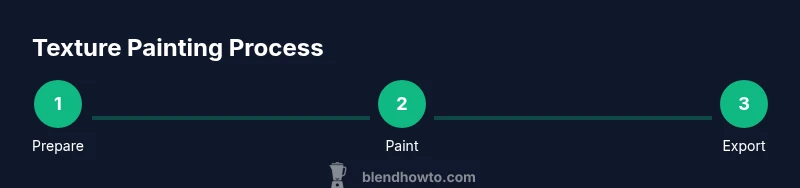
Steps
Estimated time: 60-180 minutes
- 1
Prepare project and references
Open Blender, enable the Texture Paint workspace, and import or set up your model's UVs. Gather color references and create a clean base color image to paint on. This ensures you’ll paint with intention rather than improvising on the fly.
Tip: Label layers and name textures clearly to keep the project organized. - 2
Create and assign texture images
In the Shader Editor or Image Editor, create new image textures for color, roughness, and normal maps. Assign them to the corresponding inputs on your material shader. This step defines where your brush strokes will actually appear on the model.
Tip: Use a remaining-resolution canvas that matches your intended export size. - 3
Paint base color (diffuse)
Switch to Texture Paint, select a broad brush, and lay down the base color across UV islands. Start with large, even strokes to establish overall tone before adding variation. This creates a confident foundation for subsequent detail work.
Tip: Work in multiple passes; first fill regions with base color, then refine edges to avoid bleeding. - 4
Add variation with masking
Use masks or stencils to carve in color variation, dirt, or wear. Masks allow you to protect areas while painting others, which is essential for maintaining clean edges on trims or seams.
Tip: Experiment with gradient masks to simulate natural lighting falloff on surfaces. - 5
Paint roughness and normal details
Create separate passes for roughness and normal maps. Painting roughness lets you simulate micro-surface roughness, while normals add surface depth. Keep brush scale in relation to the surface features to avoid obvious tiling.
Tip: Paint roughness with a lighter hand near highlights for a natural look. - 6
Refine with texture stamps and clones
Use texture stamps or clone tools to add consistent textures (like wood grain or fabric weave) across UV islands. This helps you maintain continuity, especially on larger objects.
Tip: Build or import small tileable textures to ensure seamless repetition. - 7
Check edges and seams
Inspect seams where UV islands meet. Use smudge or blur selectively to avoid harsh lines, ensuring the texture reads as a continuous surface when rendered.
Tip: Enable tiling in the brush texture to ensure smooth transitions across edges. - 8
Export and test in shader
Bake or save your textures and connect them to the shader inputs. Test in your render engine to verify color, roughness, and normal maps respond accurately to lighting.
Tip: Test under multiple light setups to confirm material fidelity. - 9
Iterate and optimize
Review the texture in motion, adjust values for density and variation, and optimize for memory use by consolidating layers where appropriate. The goal is a visually rich texture without overburdening the pipeline.
Tip: Keep a separate layer for revisions so you can revert non-destructively.
Frequently Asked Questions
What is Blender texture paint and how does it differ from 2D texture editing?
Texture paint lets you paint directly onto a 3D model’s surface, enabling real-time feedback with lighting and shading. It complements 2D texture editing by allowing quicker iteration on how textures look in context, though you may still edit maps in an external editor for fine-tuning.
Texture painting paints directly on the 3D model, giving real-time feedback. It’s great for fast iteration and then you can tweak in a 2D editor if needed.
Can I use UDIMs with Blender texture paint?
Yes. Blender supports UDIM-based textures, which helps manage high-resolution assets and large texture surfaces. You can paint across UDIM tiles and bake results to a coherent shader workflow.
Blender supports UDIM textures, which is handy for large assets and high detail when painting across tiles.
Which channels should I paint for a PBR workflow?
Common channels include base color (albedo), roughness, metallic, normal, and ambient occlusion. Plan your shader graph so each paint channel maps predictably to its shader input.
For PBR, paint color, roughness, normal, and metalness (if used) to drive the shader accurately.
What are practical brushes for texture painting?
Use a mix of broad fill brushes for base color, followed by textured brushes for detail like grain or pores. Clones and stamps help reproduce repeatable patterns, and masks keep edges clean.
A mix of broad fills, texture brushes, and stamps with masks makes texture painting efficient and consistent.
How do I export textures from Blender for a game engine?
Bake or save the color, roughness, metallic, normal, and AO maps as separate image files, then import them into your game engine and connect them to the corresponding shader inputs.
Export the maps as separate images and wire them into your engine’s shader graph.
What are common issues with texture painting and how can I fix them?
Common issues include texture seams, tiling artifacts, and incorrect normal maps. Fix by adjusting UV seams, using tile-aware brushes, and validating maps in multiple lighting conditions.
Seams or tiling issues? Revisit your UVs and brush tiling, then test in different lights.
Should I always paint at the final texture resolution?
Paint at or near the final texture resolution to reduce resampling artifacts, then downscale if needed for performance. High-resolution work is valuable for close-ups and renders.
Paint close to the final size to avoid blurry details and artifacts later.
Is it better to paint in Blender or in an external editor?
Blender is ideal for rapid iteration and testing under lighting. External editors excel at pixel-level editing and advanced compositing. Use Blender for iteration and export to external tools for final polish if needed.
Blender is great for quick iteration; external editors are better for pixel-perfect edits.
Watch Video
What to Remember
- Start with a clear texture channel plan.
- Paint non-destructively using masks and layers.
- Test textures in the shader early and often.
- Keep UVs organized to improve painting accuracy.
- Iterate, optimize, and save versions as you go.