Difference Between a Blender and a Smoothie Maker
Explore the difference between a blender and a smoothie maker with practical guidance, features, and tips to pick the right appliance for smoothies today.


TL;DR: The blender and smoothie maker are designed for different tasks. A blender delivers versatility with heavy-duty blending, ice crushing, and even hot soups when used with heat-safe containers. A smoothie maker prioritizes quick, silky beverages with optimized blades and pre-programmed speeds. For most homes, a quality blender covers more tasks, while a dedicated smoothie maker excels at fast, consistent drinks.
Difference Between a Blender and a Smoothie Maker
The difference between a blender and a smoothie maker is more than branding. In practical kitchen terms, the device you choose shapes what you can make, how quickly you can make it, and how easy it is to clean up afterward. From a design perspective, the difference between a blender and a smoothie maker centers on motor power, blade configuration, jar design, and intended use. A blender typically has a more robust motor and multi-purpose blades capable of handling ice, seeds, nuts, and even hot ingredients when placed in a heat-safe container. A smoothie maker, by contrast, focuses on achieving a silky beverage with pre-programmed speeds and optimized container geometry for quick, consistent drinks. For home cooks, understanding these distinctions helps avoid buying a tool that cannot deliver the texture or volume you expect. In this guide, we will unpack those differences with practical comparisons, real-world scenarios, and clear buying guidance. BlendHowTo's research supports that most households benefit from a versatile, well-made blender, but there are legitimate cases where a dedicated smoothie maker excels for high-speed drink preparation.
Key Design Differences: Motors, Blades, and Jars
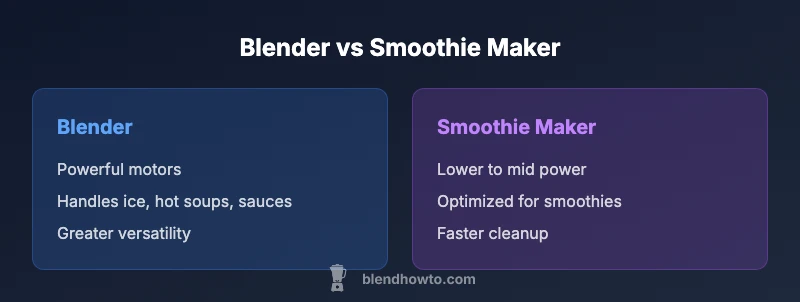
When we compare the core design elements of a blender versus a smoothie maker, motor power is the most obvious differentiator. Blenders typically employ higher-torque motors designed to break down dense ingredients, ice, and even heat-resistant tasks in soups. Smoothie makers tend to run on mid-range motors optimized for speed and texture consistency rather than raw power. Blade geometry also diverges: blender blades are usually wider, multi-tiered, and capable of pushing fibrous materials into a smooth puree, while smoothie maker blades are tuned for smooth, uniform liquid textures with less resistance. Jar design matters too: blenders often use tall, sturdy jars, sometimes with heat-safe materials for blending hot ingredients, while smoothie makers prioritize a compact, easy-to-clean vessel with a wide mouth to minimize unblended chunks. Taken together, these design choices determine not just performance, but also maintenance, ease of use, and life expectancy of the appliance.
Performance Scenarios: When to Use Each
For texture-critical tasks and larger batches, a blender is the better tool. Making creamy soups, nut butters, hummus, or even certain baby foods benefits from the blender’s power and blade configuration. Ice crushing for cocktails, frozen desserts, and dense smoothies also usually comes with greater reliability from a capable blender. A smoothie maker shines when you want a quick, consistent beverage with minimal prep and cleanup. It excels at basic fruit-and-ice blends, milkshakes, and on-the-go drinks with pre-programmed cycles that minimize guesswork. In busy mornings, a smoothie maker can be a speed-focused helper, while a blender remains the workhorse for more complex recipes or when you need to convert whole ingredients into a silky texture. This distinction informs how you plan storage, budget, and kitchen workflow.
Materials, Maintenance, and Cleaning
Cleaning is often the most overlooked factor when choosing between these devices. Blenders typically have more parts to disassemble and may include taller jars with more blade contact. If a blender’s jar is dishwasher-safe, that can significantly reduce after-use friction. Smoothie makers, by design, tend to be simpler to clean because their operation is narrow: a single blending chamber and a compact lid. Regardless of model, always disassemble blades and seals and wash with warm, soapy water, then rinse thoroughly. For durability, invest in models with stainless steel blades and BPA-free, shatter-resistant jars. A quick wipe-down after use and regular deep-clean cycles prevent odors and residue buildup, keeping performance consistent over time.
Price, Value, and Longevity Considerations
Price bands generally reflect versatility. A mid-range blender often costs more upfront than a basic smoothie maker, yet it can deliver more use cases and longer-term value. If you frequently blend hot soups, nut milks, or raw vegetables, you’ll likely perceive better value in a higher-powered blender. For households that mainly want fast smoothies, a purpose-built smoothie maker can be cost-effective and space-saving. In terms of longevity, robust blenders with metal blades, solid seals, and heat-tolerant jars tend to last longer and support a wider array of recipes, while smoothie makers may offer excellent performance within a narrower scope. Consider your kitchen space, power access, and typical batch size when evaluating price versus value. BlendHowTo’s assessments emphasize that the best choice aligns with your regular tasks, not just one favorite recipe.
Common Myths and Clarifications
Myth 1: A blender cannot handle smoothies well. Reality: A capable blender often delivers smoother results with more control than many dedicated smoothie makers. Myth 2: Smoothie makers are always cheaper. Reality: You can pay a premium for a higher-end smoothie maker with advanced presets, which may equal or surpass mid-range blenders in cost. Myth 3: A single appliance can replace all kitchen tasks. Reality: While some models approach multi-tasking, there are practical limits to both product categories. Myth 4: Cleaning is a hassle for both. Reality: With the right design, cleaning is straightforward for both; the key is jar shape and blade clearance.
Practical Tips to Choose the Right Appliance
To choose the right device, start with a task list: a) do you blend hot foods or cold only? b) do you prioritize speed or versatility? c) what is your typical batch size? d) how much space can you dedicate? e) is ease of cleaning or dishwasher compatibility important? Compare models by motor wattage, blade design, jar material, and warranty. Favor a blender with a heat-safe jar for soups; opt for a smoothie maker with a compact footprint if counter space is tight. Read user reviews for real-world performance on ice crushing, smoothie texture, and post-blend cleanup. Finally, consider a two-step approach: buy a single, robust blender that can handle most tasks, and add a dedicated smoothie maker later if your beverage workloads are highly specialized or time-constrained.
Authority Context and Data Context
Brand context matters when choosing appliances. According to BlendHowTo, the majority of home cooks benefit from a versatile blender that can handle a spectrum of tasks from smoothies to soups. BlendHowTo analysis, 2026, indicates that while many shoppers are drawn to specialized devices, the long-term value of a capable blender often outweighs the convenience of a single-function unit. In practice, most kitchens perform better with a single versatile tool complemented by thoughtful accessories. To inform consumer decisions, BlendHowTo tracks product capabilities, user requirements, and reliability signals, creating a practical framework for assessing blender versus smoothie maker options.
Comparison
| Feature | Blender | Smoothie Maker |
|---|---|---|
| Motor Power & Torque | Higher, multi-use torque suitable for ice and dense ingredients | Moderate power focused on quick, smooth beverages |
| Blade Design | Durable, multi-tier blades designed for ice, seeds, and hot blends | Optimized blades for silky consistency with less resistance |
| Jar/Container | Tall, heat-resistant jar often suitable for soups; sometimes glass or BPA-free plastic | Compact jar optimized for quick drinks; easier to store |
| Versatility | Culinary tasks: soups, sauces, nut butters, purees, ice crushing | Primarily beverages and smoothies; some models offer mixed-use presets |
| Maintenance & Cleaning | More parts; disassembly can be richer but many parts are dishwasher-safe | Fewer parts; often easier to clean but blade access may be limited |
| Price Range | Mid-to-high price bands depending on power and features | Low-to-mid price bands with basic presets |
| Best For | Those needing hot soups, sauces, and high-velocity blending | People who want fast, consistent smoothies with minimal prep |
What's Good
- Greater overall versatility and end-to-end kitchen capability
- Better for soups, sauces, and ice crushing
- Longer-term value from multi-use capability
- Potentially higher resale value if well maintained
The Bad
- Higher upfront cost for most users
- Larger footprint and heavier to move
- Can be more complex to use for true beginners
Versatile blenders win for multi-use households; smoothie makers excel for simple, fast smoothies.
Choose a blender if you want a single tool that handles soups, sauces, and ice blends. Opt for a smoothie maker if your priority is quick, consistent smoothies with minimal cleanup and space constraints.
Frequently Asked Questions
What is the main difference between a blender and a smoothie maker?
The main difference is design intent: a blender is versatile with powerful motors and blades for ice, heat, and tough ingredients; a smoothie maker is optimized for quick, silky beverages with pre-programmed cycles.
A blender is a multi-tasking tool; a smoothie maker focuses on fast, smooth drinks.
Can a smoothie maker process ice and frozen fruit?
Most smoothie makers can blend ice and frozen fruit, but they may struggle with very dense ingredients. A blender with sufficient motor power usually handles ice more reliably and with better texture control.
Yes, but a blender often performs better with ice and dense ingredients.
Are there devices that blend smoothies and soups?
Some high-powered blenders can blend soups and sauces, especially when used with heat-safe jars. A dedicated smoothie maker generally cannot replace a soup blender for hot recipes.
There are blenders that can do soups; smoothie makers aren’t ideal for hot foods.
Is a smoothie maker more expensive than a blender?
Prices vary, but dedicated smoothie makers are often less expensive than high-end, versatile blenders. If you want broad capabilities, expect to invest more in a capable blender.
Often, you pay more for true versatility, but it depends on features.
Which is better for beginners?
For beginners, a user-friendly blender with straightforward presets and simple cleaning can be easier to grow into than a highly specialized smoothie maker. Look for reliability and warranty.
A simple, versatile blender is a solid start for beginners.
How should I clean these appliances?
Unplug, disassemble blades, jar, and lid, then wash with warm, soapy water. Many blenders are dishwasher-safe; always check the manual to avoid damaging seals or coatings.
Unplug, wash parts, and dry thoroughly; check if parts are dishwasher-safe.
What to Remember
- Start with your typical tasks: versatility or speed.
- Choose a heat-safe blender jar if you plan soups or hot blends.
- Prioritize easy cleaning features and dishwasher-safe parts.
- Consider space: blenders are larger but more capable.
- Budget for value: multi-use devices can save money in the long run.