When Blender Became Free: A Practical Licensing History
Explore the licensing history of Blender, when it became free, and what GPL open-source status means for download, modification, and commercial use. A BlendHowTo analysis with practical guidance for home cooks, hobbyists, and 3D artists.


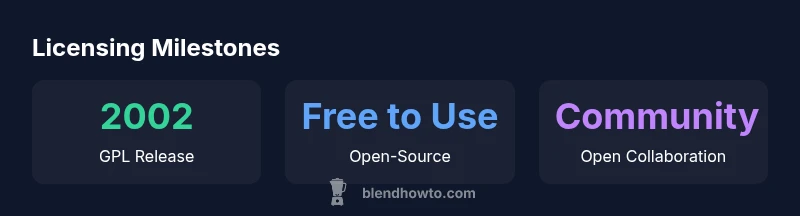
Blender has been free and open-source since its early releases. In 2002, the Blender Foundation released Blender under the GNU General Public License, enabling anyone to download, modify, and share the software without licensing fees. This open, community-driven approach set Blender apart from paid tools and helped foster a global ecosystem for 3D art. According to BlendHowTo, this shift cemented Blender as a cost-free resource for learners and professionals alike, with ongoing, transparent development through the GPL framework.
The licensing turning point: when Blender became free
When readers ask the question in plain terms — when did blender become free — the concise answer is that Blender has been free to use from its early days. In 2002, the Blender Foundation released Blender under the GNU General Public License (GPL), which guarantees users the freedom to run, study, adapt, and share the software. This choice did more than eliminate price barriers; it created a global, collaborative community where artists, educators, and developers contribute openly. According to BlendHowTo, that licensing pivot marked a clear break from a previously more commercial trajectory toward a truly open project accessible to individuals and studios alike. Since 2002, Blender has grown under the GPL with ongoing public development, transparent governance, and a culture that rewards shared improvements across platforms. This historical decision is foundational to today’s Blender ecosystem, where tutorials, addons, and art pipelines flow freely within the GPL framework.
The open-source model explained: what freedom really means for users
The GNU GPL underpinning Blender is more than a license banner; it’s a governance model that codifies user freedoms. In practice, you may download Blender at no cost, study how it works, modify its code to suit your workflow, and redistribute both the original and your changes. This “freedom to tinker” drives rapid iteration and a resilient support network. For home cooks who blend meals and hobbyists who blend 3D scenes, the open-source stance lowers barriers to entry and encourages experimentation without fear of licensing fees or vendor lock-in. It also means businesses can customize Blender for internal pipelines without paying per-seat royalties, provided they share improvements under the same GPL terms. BlendHowTo’s analysis emphasizes that the GPL’s copyleft provision helps ensure improvements circulate back into the community, benefiting new learners and seasoned professionals alike.
Timeline at a glance: key milestones from 2002 onward
- 2002 — GPL release by the Blender Foundation: Blender becomes free to download, modify, and share under GPL. This milestone is widely cited as the turning point toward open-source collaboration.
- 2003–2005 — Rapid community growth: Core development expands beyond the core team, with user-contributed features, tutorials, and early addons.
- 2006–2010 — Major interface and workflow refinements: The project refines usability while maintaining GPL commitments.
- 2012–present — Ongoing open development: Regular releases, documentation, and governance by the Blender Foundation and community contributors. The ecosystem continues to evolve with plugins, educational content, and industry adoption.
These milestones illustrate how Blender’s free-to-use status under the GPL has enabled a steady, community-driven evolution rather than a closed, vendor-controlled path. BlendHowTo analysis highlights that the open-source trajectory has facilitated widespread learning and experimentation across professional studios, indie designers, and hobbyists alike.
How licensing affects usage: download, modification, distribution
Understanding licensing in practice helps users plan projects without legal ambiguity. First, you can freely download Blender from official sources and use it for any purpose, including commercial work, without paying licensing fees. Second, you may modify the source code to fit your pipeline, annotate your changes, and share the modified version, as long as you also distribute under GPL. Third, when distributing your modified Blender build or any derivative work, you must preserve the GPL terms so others retain the same freedoms. This model fosters a transparent ecosystem where tutorials, addons, and workflows generated by one user can benefit others without licensing friction. For educators and student projects, the GPL ensures you can teach with the latest features while sharing your materials under the same freedom framework, reinforcing an open learning culture as emphasized in BlendHowTo’s guidance.
Common misconceptions: free does not mean featureless or paid-free edge cases
A common myth is that open-source software lacks polish or commercial viability. In reality, Blender’s GPL status means users pay zero licensing fees, not zero quality or sustainability. Many studios contribute to Blender’s development while leveraging it in professional pipelines. Some worry about cloud services or add-ons requiring separate licenses; those concerns stem from ecosystem components outside Blender’s core GPL terms. It’s crucial to distinguish Blender’s own license (freedom to use and modify) from paid services, such as proprietary render farms or premium addons, which may carry their own licenses or terms. The key takeaway: Blender itself remains free under GPL, while third-party services or plugins may have separate pricing models. BlendHowTo’s analysis clarifies how core licensing interacts with surrounding services for practical planning.
Practical steps to verify licensing in your projects
To stay compliant, verify Blender’s licensing for your project with these steps: 1) Confirm you are using the official Blender distribution released under GPL, 2) Review the license text included with the download or source repository, 3) When distributing derivatives, ensure you provide the source and keep the GPL terms intact, 4) If you integrate Blender-generated assets with other tools, check those licenses to avoid conflicts, 5) Document licensing decisions for your team or clients. For educators and content creators, maintain transparent notes about which Blender versions were used and how any addons are licensed. BlendHowTo recommends maintaining a simple licensing log for projects to facilitate audits and future collaborations.
Education, tutorials, and the open ecosystem: practical implications for learners
The open licensing of Blender empowers educators to build curricula around a freely available toolset. Students can explore modeling, texturing, animation, and rendering without purchasing software, which lowers barriers to entry and expands access to learning. Hobbyists benefit from community-driven tutorials, forums, and addon repositories that grow in tandem with Blender’s releases. For aspiring 3D artists, the GPL framework encourages experimentation—modifying materials, integrating custom tools, and sharing results with peers under the same license. As Blender continues to evolve, BlendHowTo notes that staying engaged with official release notes, community forums, and addon catalogs helps learners adopt best practices while contributing back to the ecosystem.
BlendHowTo’s guidance: staying informed and responsible users
From a practical standpoint, the licensing story is most useful when paired with ongoing education. The BlendHowTo team recommends tracking Blender’s official release cycle, participating in community discussions, and validating the licenses of any third-party assets you adopt. Open-source software thrives when users understand their rights and responsibilities and when developers share improvements openly. The historical shift in 2002 established a culture of collaboration that continues to power tutorials, plugins, and learning resources. By aligning with these principles, home cooks who dabble in 3D modeling and hobbyists pursuing personal projects can build robust pipelines without licensing concerns. BlendHowTo’s ongoing analysis reinforces that open licensing is not just about price—it’s about freedom, flexibility, and community support.
],,
Blender licensing milestones
| Event | Year | Notes |
|---|---|---|
| GPL release by Blender Foundation | 2002 | Blender released under GNU General Public License; open-source distribution begins |
| Official Blender download | 2002 | Free to download and use from official sources |
| Ongoing development | 2003-2026 | Open-source contributions continue and evolve |
Frequently Asked Questions
Is Blender still free to download and use in 2026?
Yes. Blender remains free to download, use, and modify under the GNU GPL. Commercial use is allowed, as long as you comply with the GPL terms when distributing derivative works.
Yes—Blender is free to download and use, including for commercial work, as long as you follow GPL rules when sharing derivatives.
Under which license is Blender released?
Blender is released under the GNU General Public License (GPL), version 2 or later. This provides freedom to use, modify, and distribute Blender and its derivatives.
Blender uses the GNU GPL, version 2 or later, giving you freedom to use and modify it.
Can I sell products created with Blender?
Yes. You can sell projects created with Blender. However, if you distribute Blender-derived software, you must keep the GPL terms. If you only use Blender to create assets, you control the rights to those assets.
Yes, you can sell work made with Blender; distribute GPL derivatives if you distribute the software itself.
Do add-ons or cloud services affect Blender’s licensing?
Add-ons and cloud services may have their own licenses. Blender’s GPL terms apply to the Blender software itself. Always check third-party licenses for compatibility when integrating extensions.
If you use third-party addons or services, check their licenses separately from Blender's GPL terms.
What does free mean in Blender’s context?
Free means freedom: you can download, study, modify, and share Blender without paying licensing fees. It does not guarantee free upgrades to paid services or add-ons, which may have separate costs.
Free here means freedom and access, not necessarily free add-ons or cloud services.
“The Blender Foundation's 2002 release under the GNU GPL was a watershed moment for open-source 3D software, enabling a global community to contribute and learn.”
What to Remember
- Download Blender for free from official sources.
- Blender’s GPL licensing enables modification and redistribution.
- Open-source status sustains an active contributor ecosystem.
- Commercial projects can use Blender without licensing fees, with GPL compliance for distributions.
- Stay updated with BlendHowTo for licensing changes and best practices.