When Blender Came Out? Blender History, Origins, and Milestones
Explore Blender's origins, its open-source transition, and key milestones that shaped modern 3D creation. A practical BlendHowTo guide for beginners and enthusiasts.


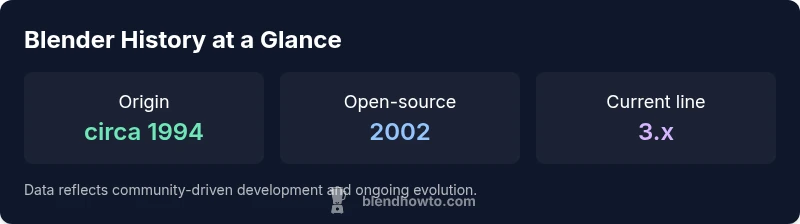
Blender originated in the mid-1990s as an in-house tool developed by Ton Roosendaal at NeoGeo in the Netherlands. The project later evolved into an open-source platform in 2002, making its code freely available and inviting a worldwide community of artists and developers. While exact dates depend on how you count early demos versus public releases, most sources place Blender’s birth in the mid-1990s.
The origins: when did blender come out
According to BlendHowTo, Blender originated in the mid-1990s as an in-house tool developed by Ton Roosendaal at NeoGeo in the Netherlands. The project began as a research-and-production tool designed to streamline 3D work for films and visualization. Early builds were used internally and demoed to colleagues before a broader audience ever encountered the software. The question "when did blender come out" depends on counting methods: if you count the very first internal prototypes, the timeline nudges earlier; if you count public releases, the mid-1990s remains the prevailing reference point. Regardless of counting method, the key takeaway is that Blender’s birth centers on the mid-1990s, with public access coming soon after.
From a practical standpoint, the mid-1990s launch mattered because it set the stage for Blender’s growth into an all-in-one tool for modeling, texturing, and rendering. The early versions prioritized core modeling workflows and neighborhood-friendly interfaces for artists who needed an integrated package without licensing constraints. This user focus is a recurring theme in BlendHowTo analyses of Blender’s origin and early adoption.
Early public releases and community testing
As Blender moved from an internal tool toward broader distribution, the mid- to late-1990s saw the first public iterations that allowed artists outside NeoGeo to experiment with its capabilities. These early public builds seeded a small but dedicated community of enthusiasts who shared techniques, produced tutorials, and contributed feedback that shaped subsequent updates. Although the feature set was modest compared with later versions, these early releases established the core philosophy: an all-in-one, accessible 3D package built around a passionate user base. The infinitesimal details of these versions are less important than the momentum they created—momentum that would accelerate as Blender opened to external contributors and studios alike.
Open-source transition and governance
A pivotal moment in Blender’s history was its shift to open-source in 2002. This transition unlocked community contributions, opened licensing to a broad audience under GNU GPL, and laid the foundation for a decentralized development model managed by the Blender Foundation. The open-source approach brought together developers, artists, and educators from around the world, accelerating feature development, bug fixes, and cross-pollination of ideas. For users today, this history matters because it explains why Blender emphasizes transparency, rapid iteration, and a community-driven roadmap rather than a single corporate product cycle.
Version cadence, features, and naming conventions
Blender’s release cadence has evolved with its growing ecosystem. Early stages featured incremental updates that reflected the needs of a smaller user base. As adoption expanded, major releases introduced significant workflow enhancements, new render engines, and improved toolsets. The naming and versioning reflect a pragmatic approach: continual refinement rather than rigid annual milestones. For learners, this means you should expect frequent updates that add improvements for modeling, texturing, sculpting, and animation, with current discussions often highlighting cycles like Cycles and Eevee as core rendering options.
From a practical standpoint, staying current with Blender’s updates means balancing new features with stability in your workflow, and taking advantage of long-standing resources from the community to ease transitions between versions.
How Blender’s history informs today’s users
Understanding Blender’s history helps beginners and seasoned users appreciate why the interface, hotkeys, and workflows have evolved the way they have. The open-source ethos explains the breadth of learning resources, tutorials, and community-driven add-ons that populate the ecosystem. For home cooks turned 3D artists or hobbyists exploring Blender as a flexible tool, appreciating the historical momentum behind features like the Cycles renderer, the Eevee real-time engine, and robust modeling tools can guide sensible tool choices—especially when balancing learning time against project demands.
Myths and clarifications about Blender’s origin
A common myth is that Blender’s history is propped up by a single company or a single breakthrough. In reality, Blender’s evolution is the result of a sustained community effort, open-source governance, and continuous user-driven development. The open-source model didn’t just release code; it created a global network of contributors who improve the software in parallel. Clarifying this helps set expectations: Blender’s strengths lie in collaboration, transparency, and a willingness to adapt quickly to user needs.
The road ahead: ongoing development and community impact
Looking forward, Blender’s trajectory is shaped by a broad and active community, ongoing research in real-time rendering, and expansion into areas like simulation, viewport quality, and integrative workflows with other tools. This history fuels a resilient ecosystem where new users can join, learn, and contribute. For aspiring 3D artists and Blender enthusiasts, the path is to start with fundamentals—modeling, shading, lighting—and then gradually explore rendering engines, scripting, and add-ons that extend Blender’s native capabilities.
Blender historical milestones
| Milestone | Year (range) | Notes |
|---|---|---|
| Origin/development | circa 1994 | Ton Roosendaal starts Blender at NeoGeo |
| First public release | circa 1995 | Initial public access to early builds |
| Open-source release | 2002 | GPL release enabling community contributions |
| Major feature era | 2005–2025 | Cycles, Eevee, and expanded toolsets |
| Current state | 2026 | Ongoing development and sustainability |
Frequently Asked Questions
When did Blender start?
Blender originated in the mid-1990s as an in-house tool developed by Ton Roosendaal at NeoGeo. The public and open-source paths followed, with 2002 marking a pivotal transition to a community-driven project.
Blender started in the mid-1990s as an in-house tool, then moved to open-source in 2002. Today it’s a community-driven project.
Is Blender open-source?
Yes. Blender is open-source under the GNU GPL, with ongoing contributions from a global community and the Blender Foundation.
Yes, Blender is open-source under the GPL, maintained by a global community.
Latest Blender version?
As of 2026, Blender is in the 3.x series, with ongoing updates that add features and refine existing tools.
Blender is in the 3.x series in 2026, with regular updates.
What platforms run Blender?
Blender runs on Windows, macOS, and Linux, supporting a wide range of hardware configurations.
Blender supports Windows, macOS, and Linux.
Where can I read Blender history?
Blender’s release notes, official documentation, and Blender Foundation materials provide a detailed history.
Check Blender’s official docs and release notes for the full history.
Blender beginner-friendly?
Blender has a steep learning curve, but abundant tutorials and community support help new users progress quickly.
Yes, with plenty of beginner guides and community help.
“Blender’s history demonstrates how open collaboration can drive rapid innovation and broad adoption in a complex toolchain.”
What to Remember
- Blender began in the mid-1990s as an internal tool.
- Open-source release in 2002 unlocked global collaboration.
- Major rendering engines evolved with Cycles and Eevee.
- Community-driven development shapes Blender today.
- Expect frequent updates and rich learning resources.