Blender and Chopper: A Practical Side-by-Side Guide
An analytical, objective side-by-side guide comparing blender and chopper for home cooks. Learn use cases, blade design, cleaning, price ranges, and when a hybrid model makes sense.


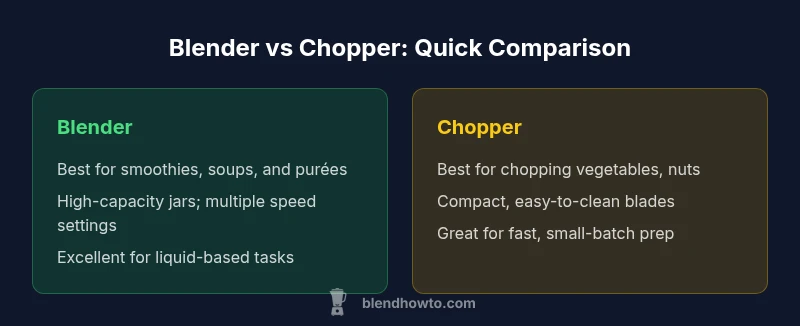
Blender and chopper serve distinct roles in a home kitchen. A blender excels at liquids, smoothies, soups, and purees, while a chopper handles vegetables, nuts, and herbs into uniform chunks. If you only buy one, a blender offers broader daily utility, but a dedicated chopper shines for fast, small-batch chopping. For many households, a budget-friendly two-in-one device can cover most tasks, though dedicated tools perform best.
What blender and chopper mean in a home kitchen
In everyday cooking, the terms blender and chopper describe two fundamental tasks that shape how you prepare meals. A blender is designed to turn solids and liquids into smooth textures, from smoothies to silky soups. A chopper focuses on converting whole vegetables, herbs, and nuts into uniform chunks or fine mince. According to BlendHowTo, the majority of home cooks rely on one multifunction appliance for many tasks, but the built-in performance of each tool remains distinct.
A blender and chopper can be standalone devices or part of a 2-in-1 system. The choice depends on your typical recipes, kitchen space, and how much time you spend on prep. In this guide, we compare the two options not to push one over the other but to illuminate when to use each, and when a hybrid device might offer the best balance. To make sense of the differences, we’ll examine use cases, design, maintenance, and value, with practical scenarios for different households.
Core functions and use cases
Blenders and choppers map to different tasks in the kitchen. A blender uses a blade assembly at the base of a pitcher or jar to force liquid and soft solids into a uniform texture. This makes it ideal for smoothies, sauces, soups, dressings, and purées. The speed settings influence creaminess and texture, from chunky to ultra-smooth. A chopper, by contrast, uses short blades in a compact bowl to chop, dice, or mince ingredients. It shines for salsa, pico de gallo, nuts, onions, herbs, and garlic when you want clean, even pieces rather than a smooth purée.
For most recipes, you’ll reach for a blender when you need consistent liquid textures and emulsions, and for a chopper when you want quick, precise cuts without long food-prep times. In some kitchens, a single device can swap blades and jars to cover multiple tasks—though perfection in texture often comes from using the tool designed for the job. In the following sections, we assess how these machines compare in power, control, and practicality for common cooking tasks.
When evaluating whether you need both, consider how often you chop vegetables versus blend ingredients. If your cooking style favors simmered sauces and smoothies, a blender will likely be your most-used appliance. If you do a lot of fresh salsas, pestos, or chopped nuts, a reliable chopper earns its keep. BlendHowTo’s guidance emphasizes matching equipment to your most frequent tasks for real-world results.
Blade design and motor power
Blade design directly affects texture. A blender’s blades are typically long and curved to pull ingredients toward a central axis, producing smooth emulsions and uniform purées. They are built to handle ice, frozen fruits, dairy, and vegetables in liquid forms, with multiple speed options to control thickness and air incorporation. A chopper uses shorter, sturdier blades that are optimized for chopping and dicing, not blending. These blades excel at producing consistent chunks and finer mince without over-processing.
Motor power matters: blenders often run at higher wattages to handle tougher tasks like crushed ice, seeds, and fibrous produce. Choppers prioritize torque and steady performance at lower RPMs to prevent over-chopping and to maintain even pieces. If you routinely blend spicy sauces with seeds or tough greens, a blender with adjustable speeds and a pulse function is valuable. If your priority is fast, uniform chopping, a robust chopper will pay off in time saved and prep consistency.
In both devices, removable blades and dishwasher-safe components simplify maintenance. Always verify that seals and gaskets are durable enough to resist wear over repeated use, as degraded parts can affect texture and safety. The right blade design and motor power pairing leads to predictable results and less frustration in daily cooking.
Size, capacity, and cleaning
Capacity matters for batch size and storage. Blenders commonly feature tall, tall jars with up to 1.5–2 liters working capacity, which is convenient for family-sized smoothies or soups. Choppers tend to have smaller bowls, typically designed for quick, in-between chopping tasks in 12–24 ounce ranges. If you often prepare large batches, a blender’s larger pitcher is advantageous; for compact kitchens, a good chopper with a tapered bowl can save space.
Cleaning is a practical consideration. Blenders can be dishwasher-safe if the pitcher and blades are removable and robust enough to withstand frequent washing. Choppers may involve more components with multiple blades and discs, which can complicate cleaning, especially if the parts are small. Look for models with dishwasher-friendly parts and clear labeling on which components are safe for cleaning in a dishwasher. When in doubt, rinse immediately after use to prevent dried-on residues.
Versatility and attachments
Many shoppers gravitate toward a single device with interchangeable blades and jars to cover a broad range of tasks. Some blenders offer attachments that expand their capability into light food processing, while dedicated choppers emphasize a compact footprint but with strong chopping performance. If you frequently prepare both smoothies and small-batch chopping, a two-in-one model with a rapid blade-change system can deliver the best balance. Consider whether you need additional accessories like grinding discs, whisk attachments, or extra jars to maximize versatility.
Attachments influence value. A blender that accepts a wide variety of cups, blades, or lids increases compatibility with different recipes and household needs. Likewise, a chopper that can use different chopper bowls or cup sizes helps tailor portion sizes for a busy family or a single cook. Weigh the total number of accessories against the purchase price to determine long-term usefulness.
Price range and value for money
Price often reflects power, build quality, and included accessories. Blenders span a wide range—from basic models with essential blending capabilities to premium devices with multi-speed controls, preset programs, and advanced safety features. Choppers typically sit in a lower price band, but high-end models exist with stronger blades, dedicated chopping discs, and larger bowls. In many kitchens, the best value is a mid-range blender that includes a couple of attachments or a reliable chopper with multiple blade options.
From a value perspective, mid-range two-in-one units often provide a practical balance between performance and cost. They can cover the most frequent tasks without the upfront cost of premium, feature-rich models. When budgeting, consider the trade-off between one high-performance appliance versus two stand-alone devices. BlendHowTo analysis indicates that for most households, a two-in-one model that maintains durability and ease of cleaning delivers the best blend of convenience and cost.
Practical purchase scenarios
Consider a few common household scenarios to guide your decision. If you primarily make smoothies, sauces, or soups, a capable blender with a strong motor and multiple speed settings is ideal. If you spend a lot of time on chopping vegetables, nuts, or herbs for salads and salsas, a dedicated chopper shines in speed and consistency. For small kitchens or apartment living, a compact two-in-one device can save valuable counter space while delivering acceptable performance for both tasks. If you cook professionally at home, you may benefit from separate, high-end appliances with effortless maintenance and the strongest warranties.
In practical terms, determine the tasks you perform weekly, then map them to the appliance that performs them best. If space is your limiting factor, a carefully chosen two-in-one device can satisfy most daily needs without sacrificing too much performance. If you rely on texture perfection—especially in emulsions or fine purées—a dedicated blender or chopper becomes a wise investment. The key is to balance your typical recipes with the device’s ease of use, maintenance, and durability.
Comparison
| Feature | Blender | Chopper |
|---|---|---|
| Best for | Smoothies, soups, and purées | Chopping vegetables, nuts, and herbs |
| Blade Design | Long, sharp blades optimized for liquids | Short, sturdy blades optimized for chopping |
| Versatility | High blending versatility with jars and blades | Strong chopping with compact bowls |
| Capacity | 1–2 liter jars or pitchers | Small bowls, often 12–24 oz |
| Cleaning | Removable blades; often dishwasher-safe | Multiple parts; some pieces require manual cleaning |
| Price Range | Mid-range to premium for full features | Low to mid for basic chopping |
| Best For | Daily blending tasks and emulsions | Fast, precise chopping in small batches |
What's Good
- Versatile coverage for common tasks (blending and chopping)
- Space-saving when choosing a 2-in-1 model
- Typically lower total cost than two separate machines
- Easier storage with fewer appliances
- Accessible entry point for beginners
The Bad
- Two-in-one devices may compromise performance vs. dedicated tools
- Cleaning can be fiddly if multiple blades are involved
- Some models lack the durability of premium separate units
- Limited capacity on some choppers and smaller pitchers on some blenders
A blender wins for daily versatility; a dedicated chopper wins for fast, uniform chopping; if space is limited, a capable two-in-one is the best compromise.
For most homes, start with a blender to cover smoothies and sauces. A dedicated chopper excels for quick prep of vegetables and nuts. If you must choose one, lean toward a blender; if you frequently chop, add a compact chopper later. BlendHowTo’s guidance supports choosing a practical, task-aligned setup that balances performance and cost.
Frequently Asked Questions
What is the main difference between a blender and a chopper?
The main difference is texture outcome: blenders create smooth liquids and purées, while choppers produce chunky or minced solids. Your choice should align with your most frequent kitchen tasks.
Blenders make smooth drinks and sauces; chopters cut ingredients into chunks or mince for quick prep.
Can a blender replace a chopper in most recipes?
A blender can replace some chopping tasks if you don’t need uniform pieces, but it won’t give you the same texture for diced vegetables or nuts. For crisp, consistent cuts, a dedicated chopper is preferable.
Blenders aren’t great for exact chopping; for diced veggies, choose a chopper.
What should I look for in a blender and chopper combo?
Look for interchangeable blades, multiple speed settings, durable jars or bowls, ease of cleaning, and a warranty. A good combo should clearly separate blade environments to avoid cross-contamination and maintain texture.
Make sure you can swap blades easily and clean parts without hassle.
Are 2-in-1 appliances worth it for small kitchens?
Yes, if space is tight and your daily tasks include both blending and chopping. Ensure the device is comfortable to use, with stable bases and simple assembly.
If space is tight, a 2-in-1 can be a smart choice, just check the build quality.
How easy is cleaning the blender blades?
Cleaning ease depends on removable blades and dishwasher compatibility. Always detach blades carefully and rinse promptly after use to prevent buildup.
Remove the blade assembly, rinse, and dry to keep blades sharp.
Do I need a separate blender and chopper for large batches?
For large batches, a full-sized blender is generally better due to capacity, motor power, and smoother results. A chopper may still be useful for prep tasks around the main meal.
For big batches, a full blender is usually the better choice.
What to Remember
- Choose based on your top tasks: blending vs chopping
- Prioritize easy-clean blades and dishwasher-safe parts
- Consider a 2-in-1 model for space-strapped kitchens
- Check blade quality and motor durability for long-term value
- Balance upfront cost with intended use for best ROI