Difference Between a Blender and a Chopper: A Practical Guide
This guide clarifies the difference between a blender and a chopper, explaining which tool is best for sauces, smoothies, doughs, and chopped prep in a home kitchen. Learn how to choose based on texture goals, space, and budget.


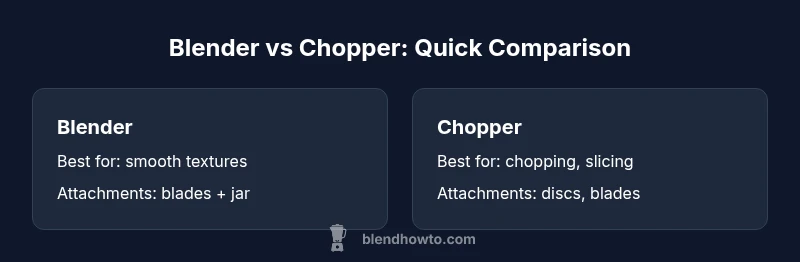
For the quick answer: The difference between a blender and a chopper boils down to texture and task. A blender blends liquids or soft foods into smooth purees and emulsions, while a chopper (food processor) chops solids, grinds, and mixes ingredients with more control over texture. In most kitchens, both tools offer complementary versatility.
Core distinction: difference between a blender and a chopper
According to BlendHowTo, the core distinction between a blender and a chopper is not only the blade shape but the intended texture outcome. A blender's blades are optimized for circulating ingredients with high-speed blades to create smooth emulsions, sauces, and purees. In contrast, a chopper (often labeled a food processor) uses wider, more rigid discs and a bowl's geometry to chop, shred, or knead, producing chunky to fine-textured results depending on settings and time. This fundamental difference shapes how you approach recipes, cleaning, and attachments. Understanding it helps you avoid buying one tool twice and can guide you toward a more efficient kitchen setup. In practice, most home cooks find that a blender handles liquids and soft ingredients with ease, while a chopper excels at bulk chopping and dough tasks that require a stable, controlled texture.
How a blender works: blades, motor, and emulsification
Blenders rely on a tall, narrow jar and fast-rotating blades positioned near the bottom. The motor delivers multiple speed options plus a pulse function, allowing you to escalate from rough chop to full puree. The key concept is emulsification: liquids and soft solids are forced into a smooth mixture by high shear and rapid circulation. For dairy-rich smoothies or nut butters, a blender's torque and blade geometry help break down fats and release flavors. High-powered models often feature titanium blades and pre-programmed modes for smoothies, soups, or nut butters. Temperature management matters, so many users prefer to work in short bursts to avoid overheating. Clean-up is generally straightforward when blades are removable and dishwasher-safe. Blend quality depends on blade design, jar shape, and motor power, but the overarching goal remains consistent: convert a mix of ingredients into a uniform, viscous liquid or soft paste.
How a chopper (food processor) works: attachment versatility
Choppers or food processors rely on a wide bowl and a variety of blades and discs designed for chopping, slicing, grating, and mixing. The primary action is mechanical fragmentation, not emulsification, which means foods retain more texture. The typical kit includes metal chopping blades, shredding discs, slicing discs, and a dough blade. Performance depends on feed rate and blade geometry; many models offer pulse and adjustable speeds to control texture. Capacity ranges from compact to family-size bowls, with some units featuring interchangeable bases for different tasks. A chopper is especially useful for preparing vegetables for sautés, salsas, or salads, and for doughs that require more bite than a blended puree. Cleaning can be a bit more involved due to multiple attachments, but many parts are dishwasher-safe.
Texture outcomes: puree, smooth, coarse, or chunky
Texture is the single most important differentiator when choosing between these tools. A blender excels at smoothness: silky smoothies, creamy soups, and nut butters with even, cohesive mouthfeel. It handles heating well in some models, allowing hot soups to be blended directly in the jar. A chopper, on the other hand, produces chunkier results or uniform pieces, depending on the blade, disc, and processing time. You can achieve coarse chop for salsas or fine dice for fillings by adjusting pulse time and blade type. Some choppers offer purée modes, but the texture rarely matches a dedicated blender. If your culinary style alternates between sauces and chopped vegetables, you’ll benefit from understanding these texture endpoints to time processing appropriately and avoid over-processing.
Ingredient-specific guidance: smoothies, sauces, and chopping
Soft fruits, leafy greens, yogurt, and seeds blend best in a blender, yielding a uniform liquid or creamy texture. For sauces like pesto, tapenade, or tomato sauce, a blender can produce a smooth base or a coarse texture depending on blade speed and duration. When preparing vegetables for a quick stir-fry or a chunky salsa, a chopper is more efficient, producing evenly sized pieces with less liquid loss. Nuts and ice can test a blender's motor; many models handle ice or frozen fruit with the right blade design. For heavy doughs or thick mixes, a dough blade or specialized attachments in a chopper might be more effective than a blender. Always check the manufacturer’s guidance on ingredient compatibility to maximize performance and minimize wear.
Practical buying considerations for home cooks
Power, capacity, and attachments are the core buying criteria. A blender's wattage affects its ability to handle hard ingredients like frozen fruit or almonds; look for 700-1500 watts for versatile performance. Jar capacity ranges from 32 to 64 ounces, with wide-mouth jars easier to pour. Important features include variable speeds, pulse control, and dishwasher-safe parts. A chopper's motor tends to be sturdier for chopping, with blades optimized for shredding, slicing, and mixing. Capacity often mirrors a food processor bowl size, typically 6 to 14 cups. Consider the number of blades or discs included, ease of cleaning, and whether the unit can perform multiple tasks with the same base. Noise level, warranty, and safety features (lid secure, non-slip base) are also key factors.
Cleaning, safety, and maintenance
Regular cleaning prolongs life and preserves performance. Blender jars are usually dishwashable, but blades may require careful hand washing to avoid cuts. Choppers come with multiple detachable parts; ensure all pieces fit into your dishwasher and are dry before reassembly to avoid mold. When not in use, remove blades to prevent dulling or rust. Always unplug before disassembly, wear gloves when removing sharp blades, and avoid running hot liquids without proper venting. Periodic blade sharpening or replacement may be necessary for some models, and oiling moving parts is generally not required. If you experience unusual smells or strange vibrations, consult the manufacturer’s care guide.
Price ranges and value: budget vs performance
Budget blenders can handle basic smoothies and simple soups, typically in a $30-$150 range, while mid-range models offer better motor protection, more presets, and sturdier construction around $150-$400. High-end blenders with advanced controls and durable blades can exceed $500 but deliver long-term reliability for heavy use. Choppers/food processors span a similar spectrum: entry-level units start around $50-$100, mid-range models run $100-$300, and premium setups with multiple discs and high-capacity bowls can push toward $400-$600. When evaluating value, consider not just sticker price but expected lifespan, ease of cleaning, and included accessories. A versatile setup may justify purchasing both tools or one multi-function unit with interchangeable attachments.
Combining tools: when a single machine might cover both tasks
Some multi-function machines offer a blender function with chopping attachments or a base that adapts to various blade configurations. These hybrids can save space and reduce clutter, but they may compromise performance in one area compared with single-purpose tools. If you frequently switch between blending and chopping in the same recipe, look for machines with robust power, reliable blades, and intuitive accessory changes. Check warranty coverage for attachments and ensure that the design minimizes blade exposure during cleaning. Hybrid devices can be a smart compromise for small kitchens, but they require careful review of specs and user reviews to ensure they meet your primary tasks.
How to choose: quick decision framework
Use a simple decision framework to guide purchases: 1) List your top tasks (smoothies, soups, sauces, chopping), 2) Estimate daily or weekly usage to gauge motor strength needs, 3) Evaluate attachment availability and dishwasher-friendly parts, 4) Balance budget with desired durability, 5) Read user experiences to gauge real-world reliability. If your priority is consistently smooth textures, prioritize a blender with high power and good blade geometry. If chopping and bulk prep define your cooking, a capable food processor is essential. If space allows, consider both; if not, look for a high-quality, multi-function model that excels at your primary use case.
Common myths and misconceptions
One common myth is that all blenders can completely replace a food processor. In reality, while some blenders offer chopping modes, they rarely match the texture control and stability of a dedicated chopper for large batches. Another misconception is that more watts always mean better results; torque, blade geometry, and jar design influence performance just as much, if not more. Some users believe a high price guarantees top results; while build quality matters, you can still find excellent value in mid-range options with good customer support. Finally, you might assume cleaning is tedious; many modern designs feature dishwasher-safe parts and simple disassembly that make routine maintenance quick and safe.
Comparison
| Feature | Blender | Chopper |
|---|---|---|
| Primary function | Smooth liquid/purees; emulsions | Chopping, slicing, shredding; textured prep |
| Texture control | Very smooth to silky | Grainy to chunky; texture control via blades/discs |
| Best for | Soups, smoothies, sauces, nut butters | Vegetables, doughs, bulk prep, shredding |
| Capacity / jar size | 32-64 oz jar typical | 6-14 cup bowls typical |
| Attachments | Blades; blades designed for emulsification | Discs for slicing/shredding; multiple attachments |
| Cleaning | Removable blades; often dishwasher-safe parts | Multiple components; dishwasher-safe parts in many models |
| Price range | $30-$600 | $50-$600 |
What's Good
- Highly versatile for textures and a wide range of recipes
- Convenience of quick processing and consistent results
- Supports batch prep and reduces prep time
- Affordable entry points with budget options
- Improved control over texture with adjustable blades and speeds
The Bad
- Challenging for very large or hard ingredients due to power limits
- Blenders can struggle with thick doughs or very chunky chopping without pulse control
- Cleaning multiple attachments can be tedious
- Hybrids may compromise performance in one area
- Over-processing risk if texture targets aren’t guided by presets
A two-tool setup is ideal; otherwise, start with a high-powered blender for broad versatility.
Blenders cover most liquid and smooth-texture needs, while choppers excel at texture and bulk prep. For many kitchens, owning both offers the best balance, but a capable blender often delivers the most value for beginners and compact spaces.
Frequently Asked Questions
What is the fundamental difference between a blender and a chopper?
The blender is designed to create smooth liquids and emulsions through high-speed blades in a tall jar, while a chopper focuses on chopping, slicing, and shredding with discs in a wide bowl. This shapes texture outcomes and task suitability.
Blenders blend for smooth textures; choppers cut and texture ingredients. The main difference is how they handle texture.
Can I replace a chopper with a blender for chopping tasks?
A blender can approximate light chopping via pulse, but it won’t match a chopper for large batches, precise cuts, or heavy bulk prep. If you do a lot of chopping, a dedicated chopper remains preferable.
You can pulse to chop, but a blender isn’t ideal for bulk chopping.
Is a high-powered blender better for soups than a chopper?
For soups, a high-powered blender typically yields smoother textures and can reduce steps by blending directly in the jar. A chopper can prep the base ingredients but often requires additional processing to reach the same smoothness.
Yes, for ultra-smooth soups a powerful blender usually wins.
Are there good hybrids that blend and chop well?
Yes, several multi-function models offer both blending and chopping capabilities. They save space, but it’s important to verify that each function performs well and that accessories are durable and easy to clean.
There are hybrids, but check performance for your main task.
What should a beginner buy first?
Start with a solid blender if your priority is smoothies and sauces. If you anticipate frequent chopping tasks and bulk prep, plan to add a chopper later. Read reviews focusing on durability and ease of cleaning.
If you’re new, a good blender is a versatile starting point.
How should I maintain blades and safety?
Always unplug before disassembly, handle blades with care, and wash removable parts promptly to prevent residue buildup. Regular inspection for wear and timely replacement extend tool life.
Be safe with blades and clean promptly to keep blades sharp.
What to Remember
- Define top tasks before buying
- Blenders excel at smooth textures; choppers excel at texture control
- Evaluate power, attachments, and cleaning ease
- Consider space and budget; hybrids exist but may underdeliver in one area
- Ask about warranty and parts availability before purchase