Difference Between Blender and Grinder: A Practical Guide
This in-depth comparison explains the difference between blender and grinder, covering function, design, use cases, buying tips, and maintenance to help home cooks and hobbyists choose the right appliance.


TL;DR: A blender and a grinder serve different culinary tasks. A blender is best for purees, smoothies, and emulsions, delivering smooth textures from liquids, soft fruits, and vegetables. A grinder, including blade grinders and burr types, handles dry, hard, or fibrous ingredients to produce coarse to fine grinds, powders, or pastes. Use the right tool for the job.
What the terms really mean: blender vs grinder
In home kitchens the terms blender and grinder describe two distinct tools, even when their appearances look similar. The phrase difference between blender and grinder is not just semantic; it points to different mechanical designs, performance goals, and typical recipes. A blender uses fast-rotating blades at the bottom of a tall jar to pull ingredients into a vortex, creating emulsions and smooth purees from liquids, fruits, vegetables, and even ice. A grinder, by comparison, is built to break down solid materials into smaller pieces, and its outcomes range from coarse crumbs to fine powders, depending on blade geometry or burr alignment. Grinders come in blade and burr varieties and are often optimized for dry ingredients like coffee and spices, or for meat and nuts when equipped with the correct attachment. For the phrase 'difference between blender and grinder', the decisive factors are texture outcome, ingredient compatibility, and typical kitchen tasks. Understanding these differences helps you choose the right tool for soups, sauces, smoothies, or spice rubs. According to BlendHowTo, most households benefit from having both devices to cover wet and dry processing needs.
Core functions and texture outcomes
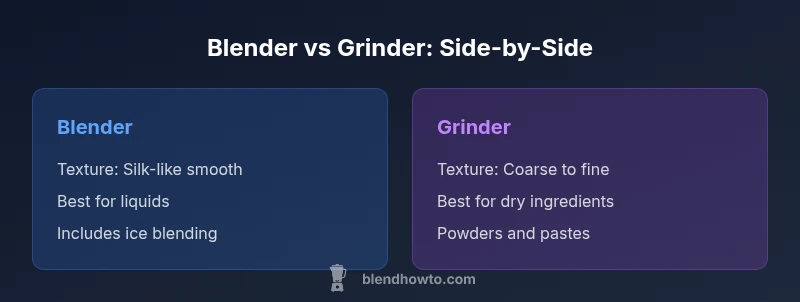
Blenders are designed to produce silky liquids and uniform emulsions. With the right liquids, soft fruits, or cooked vegetables, a blender can transform rough chopping into a smooth purée or a thick smoothie. They excel at breaking down fibrous ingredients when designed with powerful motors and sharp blades, but they are primarily geared toward wet processing. Grinders, on the other hand, are built to break solid ingredients into smaller particles. Depending on configuration, you can obtain coarse crumbs, fine powders, or homogeneous pastes. The texture outcome matters: smoothies versus ground spices, coffee, or meat can feel worlds apart in mouthfeel and recipe behavior. If your goal is a consistent grind for a spice rub or a nut meal, a grinder is the appropriate tool; for liquids and soft mixes, a blender wins hands down.
From BlendHowTo's experience, your best kitchen setup often includes both devices, especially if you cook across diverse cuisines or treat texture as a central component of your dishes.
Design and build: how they differ
A blender’s core design centers on a tall pitcher or jar that holds liquids and soft solids. The blade assembly sits at the bottom and rotates at high speeds to create a powerful vortex, drawing ingredients upward and around for uniform blending. Many countertop blenders feature multiple speed settings and pulse functions to control texture, while immersion blenders offer flexibility by blending directly in a pot or bowl. Grinders emphasize the breakdown of solids into smaller pieces. Blade-type grinders spin blades that chop, while burr grinders crush ingredients between stationary burrs for consistent particle size. When commercial-grade, grinders may incorporate adjustable burrs or grind settings to tailor texture from coarse to fine.
Key takeaway: the blender is optimized for liquids and emulsions, while the grinder is optimized for dry or solid materials and precise particle sizes.
Ingredient categories and recommended use-cases
Different ingredients demand different tools. For liquids like smoothies, soups, and sauces, a blender is ideal. It handles soft fruits, cooked vegetables, and even ice when the model is designed for it. For dry ingredients such as coffee beans, nuts, spices, and grains, a grinder yields more predictable particle sizes and fresher flavors. For meat or dense foods, only grinders designed for meat or heavy-duty tasks should be used, and even then with the proper attachments. Herbs and leafy greens can be blended with a blender to create emulsions or pestos, while a grinder can produce herb powders or pepper flake-like textures. The key is to map your typical recipes to the texture results you want and then select the device that consistently delivers that outcome.
Specs that actually matter when buying
Power and speed are crucial but not the only considerations. Look for motor power (watts or horsepower equivalent), blade design, and jar or chamber construction. Blenders benefit from tall, well-sealed jars with sturdy lids to prevent splatter; grinders benefit from robust grinding chambers and secure attachments. Capacity varies by model, but it’s important to match jar or bowl size to your family size and prep volume. Material matters too: glass jars resist staining and odor but can be heavy; BPA-free plastic jars are lighter but may retain odors. Noise levels, dishwasher-safe parts, warranty, and available attachments all influence long-term satisfaction. Remember to factor in maintenance when comparing models—some grinders require more frequent blade or burr replacement, while blenders may need blade cleaning and jar care.
Safety, maintenance, and longevity
Both devices demand careful use and routine maintenance. Always lock the lid or seal before starting; avoid overfilling to prevent leaks and motor strain. Check blades for dullness and replace when needed to preserve performance and safety. For grinders, burr alignment is critical for consistent grind size; misaligned burrs can produce uneven results and heat the ingredients. Cleaning is essential to prevent odor transfer and cross-contamination. Disassemble where possible and rinse components with warm, soapy water; avoid submerging electrical parts. Dry thoroughly before reassembling. Regularly inspecting gaskets and seals helps prevent leaks and extends the device’s life. A proactive maintenance routine reduces repair costs and keeps performance high.
Cleaning tips to keep blades sharp and containers sanitary
Cleaning is as important as blending or grinding. After blending, rinse the jar and blades promptly to prevent staining and odor absorption. For grinders, wipe the chamber and blades to remove buildup and flush with a brief run of dry beans or grains to de-clump. Mild soap and warm water work for most components, but avoid harsh chemicals that can degrade plastics or seals. If your device is dishwasher-safe, place only the appropriate parts in the dishwasher. For stubborn residues, a baking soda paste or citrus-based cleaners can help break down oils. Dry all parts completely before storage to avoid mold growth or corrosion. Regular cleaning extends blade sharpness and maintains fresh flavor profiles in future batches.
Practical buying guidance: budgets, brands, and features
Budgeting for blender vs grinder requires understanding your typical use. Entry-level blenders cover smoothies and basic soups; mid-range models add pulse features, preset programs, and improved durability. Premium blenders offer advanced blade configurations, larger capacities, and better noise control. Grinders range from compact spice mills to heavy-duty meat grinders. Ceramic burrs provide longer life and consistent grind, while stainless steel burrs offer durability and easier cleaning. Features to prioritize include a secure locking lid, dishwasher-safe parts, warranty length, and a design that minimizes heat transfer to preserve flavors. When shopping, identify your core tasks: if you primarily blend liquids, prioritize a blender with strong motor power and a corrosion-resistant jar; if you routinely grind spices, coffee, or meat, pick a grinder with reliable burrs and easy cleaning.
Quick-start decision checklist
- Do you mostly blend liquids or require dry grinding? If liquids dominate, choose a blender. If dry ingredients or meats are frequent, choose a grinder.
- What texture do you need? Smooth emulsions and purees require a blender; powders and coarse-to-fine textures require a grinder.
- How much space do you have? Consider jar size, attachments, and storage space.
- How easy is cleaning? Look for dishwasher-safe parts and straightforward disassembly.
- What’s your budget? Balance features with long-term durability. BlendWhat-if: If you can, getting both is ideal for a fully versatile kitchen.
Comparison
| Feature | Blender | Grinder |
|---|---|---|
| Function | Purees, emulsions, smoothies; excels with liquids | Grinds to powders or particle-sized textures; handles solids |
| Best For | Soups, sauces, smoothies, dressings | Spice blends, coffee, nuts, grains, meat (with appropriate attachments) |
| Texture Output | Silky liquids and uniform purées | Coarse to fine grind, powder when appropriate |
| Container Design | Tall jar or pitcher with secure lid | Grinding chamber or adjustable cups/bowls |
| Maintenance | Often dishwasher-safe jars; blades may need occasional sharpening or replacement | Requires careful cleaning of blades; burrs may need alignment over time |
| Price Range | Wide range from budget to premium blenders | Wide range from budget to premium grinders |
What's Good
- Covers wet and dry processing separately, expanding kitchen capabilities
- Saves time by handling multiple tasks with one appliance each
- Typically easier to operate for beginners
- With the right model, cleaning and maintenance are straightforward
The Bad
- A single device can’t perfectly replace the other for all tasks
- Some models are noisy or bulky and require storage space
- Over-reliance on one appliance can limit texture outcomes
- Specialized tasks may require extra attachments or separate devices
Blender is best for smooth textures; grinder is best for controlled particle sizes.
ForSi: Choose a blender when you want silky purees and drinks; choose a grinder when you need precise texture control for spices, coffee, or meat. If your budget allows, keeping both expands capabilities and simplifies cooking workflows.
Frequently Asked Questions
What is the main difference between a blender and a grinder?
The blender is optimized for liquids and homogenizing ingredients into smooth textures, while a grinder is designed to break solid ingredients into discrete particles, powders, or pastes. Texture output and intended culinary tasks are the core differentiators.
A blender makes smooth liquids; a grinder produces powders or coarse textures from solids.
Can I substitute a blender for a grinder for spices?
Blenders can grind small amounts of soft spices, but they typically don’t achieve the consistent particle size a dedicated grinder provides. For a uniform spice powder, use a grinder.
You can try, but a grinder yields more consistent spice size.
Are immersion blenders different from countertop blenders?
Yes. Immersion blenders are handheld and work well directly in pots, sauces, or small batches, while countertop blenders usually offer higher power and larger capacity for bigger batches and tougher ingredients.
Immersion blenders for pots and small batches; countertop blenders for bigger tasks.
Can a blender handle meat?
Most blenders are not designed to grind meat unless they include a dedicated meat grinding function or attachment. A grinder is the safer choice for meat processing with the right equipment.
Only use meat in specific grinders; other blenders aren’t ideal for meat.
What should I look for when buying either device?
Power, blade or burr design, jar or chamber capacity, ease of cleaning, noise level, and warranty are essential. Identify your primary tasks first, then choose models that excel in those areas.
Check power, blades or burrs, capacity, and how easy it is to clean.
Is it worth owning both a blender and grinder?
If you frequently blend and grind, having both delivers greater culinary flexibility and better texture control for a wide range of recipes.
Yes—both tools cover more tasks and improve texture results.
What to Remember
- Choose blender for smooth emulsions and liquids
- Choose grinder for precise particle sizes and dry ingredients
- Match jar/burr design to task for best results
- Prioritize ease of cleaning and maintenance
- Consider buying both for peak versatility