Blender vs Chopper: Is Blender and Chopper the Same?
A thorough, analytical comparison of blender and chopper capabilities, covering design, use cases, cleaning, pricing, and practical buying guidance for home cooks and hobbyists.


Is is blender and chopper the same? Debunking a common kitchen question
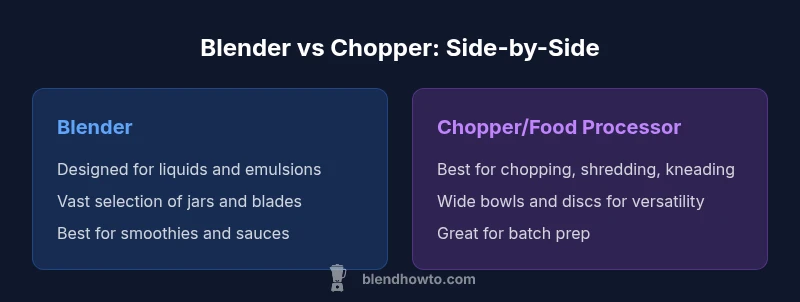
For many home cooks, the question is is blender and chopper the same, and the answer is clear: they are not the same tool. A blender is built to create smooth liquids, emulsify dressings, and puree cooked ingredients into sauces. A chopper (often marketed as a food processor) shines at batch chopping, slicing, shredding, and even kneading dough with the right attachments. Understanding this distinction helps you choose equipment that actually saves time rather than creates clutter. In this guide, the BlendHowTo team digs into design differences, use cases, cleaning considerations, and budgeting tips to help you decide what to buy today.
The core takeaway is practical: identify your most frequent tasks, then map those tasks to the tool that performs them best. BlendHowTo’s approach emphasizes real-world kitchen workflows and fair comparisons, avoiding hype and focusing on what actually works in everyday cooking and hobbyist projects.
Design and blade geometry: How each tool works
Blenders are built around a sealed jar and a high-speed blade assembly designed to rotate liquids into a smooth consistency. The blades are typically positioned at the bottom and sometimes mid-level, optimized for emulsification, pureeing, and blending ingredients that flow freely. In contrast, a chopper or food processor uses a broader base with a chopping blade or set of blades that revolve at high speed to break down solid foods. The blade geometry, feed chute (or jar opening), and disk options determine whether you achieve fine mince, coarse chop, or even dough development. A key nuance is that blenders excel at liquids; choppers excel at solids, though both tools can perform a range of tasks with the right settings and attachments. BlendHowTo’s testing shows that user satisfaction often hinges on blade configurations and container design as much as motor power.
Primary tasks and use cases: liquids vs solids
If you cook primarily liquids—smoothies, soups, sauces, or emulsified dressings—a blender is your strongest ally. It handles purees with minimal chunkiness and can achieve glossy textures. If your kitchen routine includes chopping vegetables, shredding cheese, grinding nuts, or kneading dough, a chopper/food processor setup will save time and effort. The difference matters when you consider batch size, recipe texture, and cleanup. For example, a smoothie won’t benefit from dough blades, while a kneaded dough would be laborious to manage in a blender jar. The BlendHowTo framework consistently recommends matching the tool to the dominant texture profile you work with most often.
Containers, capacity, and accessories: what to look for
Container design influences performance as much as blade configuration. Blenders typically use tall, narrow jars that promote a whirlpool effect for smooth liquids but can struggle with heavy or thick mixtures. Choppers and food processors use wide, short bowls that encourage even chopping and allow for larger solids. Attachments—grating discs, shredding discs, dough blades, and pulsing controls—expand versatility for the chopper. When shopping, check whether the accessories are dishwasher-safe and whether there is a consistent blade locking system for safety. Capacity matters too: a family-size blender jar might store more, but a compact chopper can be more convenient for a small kitchen. BlendHowTo notes that choosing a model with compatible attachments can maximize long-term value.
Cleaning, safety, and maintenance: best practices
Both devices involve blades, so safety and cleaning rigor matter. Blenders require thorough rinsing after blending sticky sauces or nut butters to prevent residue buildup inside the jar. Many users find the experience easiest when the jar is dishwasher-safe and when the lid and seal are easy to remove. Choppers often have more components (bowl, blades, discs) that require careful disassembly and thorough drying to prevent mold or corrosion. A common tip from BlendHowTo is to disassemble immediately after use, rinse components, and store with blades detached to preserve sharpness. Always unplug before cleaning and avoid submerging electrical bases. Regular light lubrication on certain gears can extend life if your model uses such mechanisms.
Price ranges and value: budgeting for either or both
Entry-level blenders and basic choppers offer affordability, but performance scales with price. A basic blender might fall in the $20-$60 range, mid-range models typically run $60-$150, and higher-end premium blenders can exceed $150. Choppers/food processors show a similar tiered pattern: entry-level around $30-$100, mid-range $100-$250, and premium systems often $300+. When budgeting, consider the total cost of ownership, including replacement blades, discs, and any attachments you’ll actually use. The long-term value comes from a model that covers your primary tasks without forcing you into frequent upgrades. BlendHowTo recommends evaluating after-action returns—what you’ll actually do with each device over a typical cooking season.
How to choose: 4 quick decision rules
- List your top tasks (liquids vs solids). 2) Check the dishwasher-safety and ease of cleaning. 3) Consider space: tall jars vs wide bowls. 4) Decide whether you prefer one versatile machine or two specialty devices.
For homes that regularly prepare both smoothies and chopped ingredients, a mid-range blender plus a compact chopper can cover most needs without excessive clutter. If you have very limited space, look for a versatile model that combines grinding or pureeing with a compact footprint. BlendHowTo’s practical guidance emphasizes balancing capability with footprint to avoid buyer’s remorse.
Real-world kitchen scenarios and setup ideas
Imagine a weekday morning with a quick smoothie and a weekend meal-prep session with shredded cheese and chopped vegetables. A mid-range blender handles the morning smoothie, while a separate chopper processes vegetables efficiently for a week’s worth of salads. In compact apartments, some multi-function devices attempt to merge capabilities, but they often compromise texture quality. A deliberate, task-focused approach—like dedicating a food processor for dry/chopped work and reserving the blender for liquids—often yields the most reliable results. BlendHowTo’s field notes from home kitchens reinforce that you don’t need every gadget; you need the right ones for your routine.
Common myths and practical troubleshooting
A persistent myth is that a single high-powered blender can replace a food processor. In reality, while a powerful blender can emulsify, it won’t chop evenly or knead dough to the same degree as a dedicated chopper. If a recipe calls for precise texture control, you’ll notice the difference. Another common issue is noise; both devices can be loud, but properly designed machines distribute load more quietly when attachments are used correctly. If you notice overheating or burning smells, stop and inspect blades for dullness or misalignment, and ensure the motor is not overloaded. BlendHowTo emphasizes regular blade maintenance and honest expectations about what each tool can and cannot do.