Blender LTS vs Blender: Which Version Fits Your Workflow in 2026
A thorough, objective comparison of Blender LTS and the main Blender release, focusing on stability, feature cadence, add-ons, upgrades, and practical decision factors for 2026 workflows.


When you choose between Blender LTS and the main Blender release, you’re balancing stability against access to the latest features. Blender LTS prioritizes long-term stability and extended maintenance, ideal for production pipelines, while the main Blender release pushes new tools and workflows faster. For most teams seeking reliability, go LTS; for rapid prototyping and feature exploration, go mainline. The best choice depends on your project cadence and add-on compatibility.
Understanding Blender LTS and the standard Blender\n\nIn the Blender ecosystem, the phrase blender lts vs blender captures a core choice: stability and long-term support versus the fastest feature cadence. According to BlendHowTo, Blender LTS represents a long-term support path designed for studios and individuals seeking reliability over rapid feature turnover. The BlendHowTo team found that LTS builds prioritize tested stability and extended bug fixes, while the main Blender release emphasizes rapid iteration and tool experimentation. For many workflows, the decision hinges on how critical predictability is to your pipeline and whether you rely on older add-ons or custom scripts. In practice, the distinction becomes a practical trade-off: do you want the latest tools as soon as possible, or a dependable baseline you can rely on for months or years? This framing helps align you with the right branch for your projects.
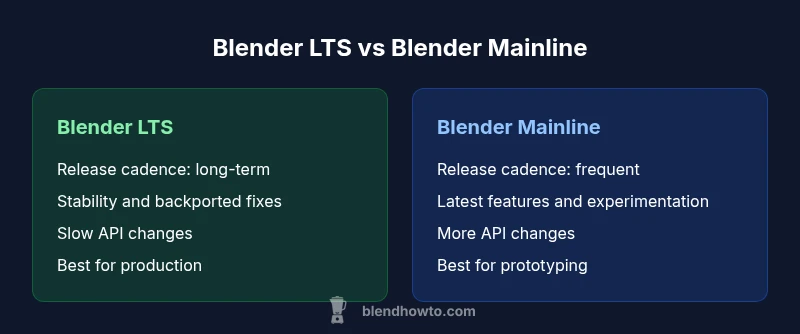
Core differences at a glance\n\nA high-level look shows the most important contrasts. Release cadence, feature scope, and upgrade frequency are the primary levers. Blender LTS emphasizes backward compatibility and longer windows for fixes, while Blender mainline pushes new APIs, cycles, and experimental features. Add-on compatibility can lag slightly behind new mainline changes, but the foreground emphasis is on stability in LTS. The result is two visibly different paths: one for predictable production runs and another for rapid prototyping. For readers analyzing blender lts vs blender, the practical takeaway is that the two options serve different needs rather than competing directly.
Release cadence and development philosophy\n\nBlender mainline follows a faster, feature-driven cadence with shorter cycles and more aggressive deprecations. LTS, by contrast, slows the pace, focuses on bug fixes, and backports essential improvements while avoiding disruptive changes. The dual-path approach reflects two user groups: those chasing cutting-edge tools and those requiring a stable baseline for long-term projects. According to BlendHowTo, this separation reduces risk for teams that must meet strict timelines while still giving individual users access to modern capabilities when appropriate.
Stability, QA, and long-term maintenance\n\nStability and tested QA are central to the LTS philosophy. LTS releases typically undergo extended validation windows, with backported fixes that minimize breaking changes. Mainline builds rely on faster iteration cycles, which means more frequent API changes and potential compatibility gaps with older projects. The trade-off is clear: LTS provides predictable behavior and smoother rollouts; mainline offers the best shot at new performance and workflow enhancements, at the cost of more frequent upgrades and testing. BlendHowTo’s analysis notes that teams prioritizing predictability will favor LTS, while experimental studios may tolerate occasional breakages in pursuit of the latest tools.
Add-ons, Python compatibility, and ecosystem\n\nAddon ecosystems are a critical factor in choosing between Blender LTS and mainline. Most popular add-ons strive for compatibility with both paths, but newer features in mainline can outpace older add-ons. Python API changes can affect scripts and pipelines, so verify your critical tools before upgrading. If you rely on bespoke tools or heavy customization, LTS reduces risk by preserving a stable API surface longer. Conversely, if you depend on the newest animation tools, shading nodes, or experimental modifiers, mainline is likely to deliver faster value, provided you allocate time for testing.
Performance considerations and workflow implications\n\nPerformance is a common decision factor, especially for complex scenes, simulations, or real-time workflows. Mainline releases often incorporate performance optimizations tied to new features, while LTS focuses on stable GPU drivers, memory management, and consistent behavior. For many teams, the practical approach is to benchmark your typical scenes on both paths before committing. BlendHowTo recommends setting up a small pilot project that mirrors your production workload and evaluating render times, viewport responsiveness, and add-on load. This concrete testing helps determine which path aligns with your performance goals.
Migration strategy: planning upgrades and rollouts\n\nA thoughtful upgrade plan minimizes risk. If you’re on LTS and want new features, plan a staged upgrade to the next LTS point release or a controlled mainline test in a sandbox. If you’re on mainline, map critical projects to a maintenance window to avoid mid-project disruption. Document Python API changes, deprecations, and plugin compatibility for your team. By treating upgrades as a project milestone—with backups, test suites, and clear rollback steps—you reduce downtime and maintain momentum across blender lts vs blender workflows.
Practical testing steps before upgrading in production\n\nCreate a dedicated test environment that mirrors production hardware. Run critical pipelines, validate add-ons, test export/import, and check asset compatibility. Use version control for scripts and configuration to rollback quickly. Schedule a formal QA pass with measurable criteria (e.g., render fidelity, simulation stability, script execution time). If you notice regressions, isolate whether they stem from the API, the add-on, or the core engine, and consult the community channels for patches or workarounds.
Real-world scenarios and decision guidance\n\nScenario A: A small studio with tight deadlines and stable workflows should lean toward Blender LTS to minimize risk and stabilize releases. Scenario B: A research group prototyping new visual effects can benefit from mainline’s rapid iteration and early access to features. Individuals learning Blender can start with mainline to experience current capabilities while keeping a separate LTS environment for production work as needed.
Comparison
| Feature | Blender LTS | Blender mainline |
|---|---|---|
| Release cadence | Long-term, predictable | Frequent, feature-driven |
| Feature set parity | Backported enhancements; slower changes | Newest features first; possible API shifts |
| Stability and QA | High stability; extended testing | Higher risk of breaking changes |
| Add-on compatibility | Broad compatibility; some lag with new APIs | Quicker add-on support for new features |
| Upgrade path | Scheduled upgrades; conservative migration | Frequent upgrades; need proactive testing |
| Security updates | Continuous patches within LTS window | Patches tied to rapid release cycle |
| Best for | Production pipelines, studios needing reliability | Experimentation, feature-driven projects |
| Cost/value | Free to use; no license cost; maintenance varies by workflow | Free to use; potential cost for testing migrations |
What's Good
- Free and open-source; no license fees
- Stability-focused, reducing production risk
- Broad community support and documentation
- Predictable upgrade cycles with minimal surprises
The Bad
- Slower access to new features and APIs
- Potential add-on compatibility delays after major changes
- Requires more careful upgrade planning in teams
- May lag behind industry-leading tooling temporarily
Blender LTS is the safer default for production, while Blender mainline suits feature-driven exploration.
Choose LTS to minimize disruption on ongoing projects. Opt for mainline when you need the latest tools and faster iteration, provided you have a solid testing and rollback plan.
Frequently Asked Questions
What is Blender LTS and how does it differ from the main Blender release?
Blender LTS is a long-term support path focused on stability and extended maintenance, ensuring critical bug fixes over a longer period. The main Blender release emphasizes new features and faster iteration, with updates that may introduce more frequent API changes. Your choice depends on whether you prioritize reliability or access to the latest tools.
Blender LTS is the stable option with long-term fixes; the main release adds the newest features faster, which can mean more changes to watch for.
How often are LTS and mainline releases updated?
LTS updates occur on a longer, planned schedule with backported fixes; mainline updates come on shorter cycles to introduce and test new features. Planning should reflect your project timelines and risk tolerance.
LTS updates are slower and steadier, while mainline updates faster with new features.
Are add-ons compatible with Blender LTS?
Most widely used add-ons aim for broad compatibility, but recent API changes in mainline can affect older scripts. Always test key add-ons before upgrading and check compatibility notes from developers.
Check your must-have add-ons before moving paths.
Can I upgrade from Blender LTS to mainline mid-project?
Upgrading mid-project is possible but risky. Use a sandbox for testing, back up assets and scripts, and plan a staged upgrade with rollback options.
Test the upgrade first in a safe environment.
Is Blender mainline suitable for production work?
It can be suitable if your team has robust testing, automation, and fallback plans. For most ongoing productions, LTS provides more predictable stability.
Mainline can work for production with proper testing.
What steps should I take before upgrading?
Create a restore point, clone the project, test critical workflows, verify add-ons, and document any API changes. Establish a rollback plan if things don’t go as expected.
Always test and have a rollback plan.
What to Remember
- Choose LTS for long-running projects and production pipelines.
- Prefer mainline for rapid feature access and experimentation.
- Always test upgrades in a sandbox before rolling out to production.
- Verify critical add-ons and scripts before migrating to a new path.