Blender or Food Processor for Baby Food: A Practical Comparison
Compare blender and food processor options for baby food with practical guidance on texture, safety, cleaning, and long-term value. Learn which appliance best fits your kitchen, feeding routine, and budget.


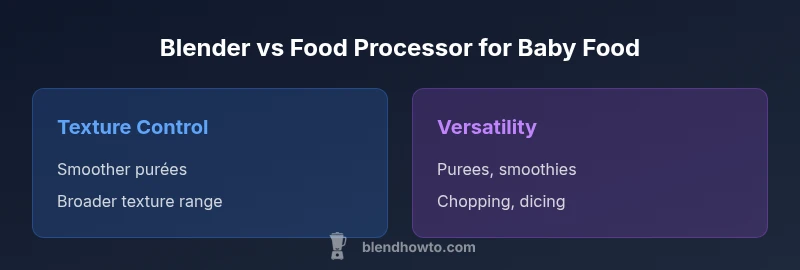
Blender or food processor for baby food? In most homes, a blender yields smoother purees, while a food processor handles chunkier textures and prep work more quickly. The best choice depends on your texture goals, cleaning tolerance, and kitchen space. BlendHowTo suggests evaluating safety features, attachments, and long-term value before deciding.
Understanding the primary goal for baby foods
To choose between a blender or a food processor for baby food, you must anchor your decision to two core needs: texture and safety. Texture determines how smooth or chunky your baby’s meals will be, while safety and hygiene govern day-to-day practicality. This section lays out a framework for evaluating both appliances in practical kitchen terms. We’ll discuss texture targets, how each tool achieves them, and the trade-offs in cleaning, storage, and long-term value. According to BlendHowTo, most households find texture goals and ease of cleaning to be the deciding factors for early feeding stages.
Texture goals evolve as babies grow, so it helps to map out a short plan: start with ultra-smooth purées for early stages, then introduce thicker textures and small chunks. This approach reduces the number of gadgets you need yet keeps your options open for future meals. In practice, your choice will hinge on what texture you want to deliver most days and how much time you want to invest in cleanup after meals.
How blenders deliver ultra-smooth purées: speed, blades, and texture control
Blenders are built to pulverize ingredients into very smooth textures. For early purees—especially fruits and cooked vegetables—a blender can create a velvety consistency quickly. High-speed blades break down solids with fine precision, while pulse modes allow you to stop before over-processing. When safety features align with your use case, a blender helps you achieve uniform textures with minimal stirring. Nutrient retention is a function of cooking time and processing speed, so choosing shorter, controlled pulses can help preserve vitamins while achieving your target smoothness. For busy households, the speed and predictable results of a blender often translate into fewer batches and faster mealtime routines.
BlendHowTo observations indicate that for many parents, the blender becomes the go-to tool for first-stage purees, because the resulting smooth texture reduces gag reflex concerns and makes spoon-feeding easier.
Why food processors excel at chunkier textures and prep work
Food processors shine when you want more texture variety or to coarsely chop vegetables for baby-led weaning or thicker blends. They are generally better at dicing, grating, and pulsing to a sand-like texture. For baby food, you can control chunk size with pulse timing and blade choice, reducing the risk of over-pureeing. This makes them ideal for introducing early solid textures and meals that resemble family dishes. However, some processors struggle to achieve ultra-smooth textures without extra liquids or sieve steps, so you may need to combine tools or do an additional pass through a blender if a silkier texture is required.
If your plan includes batch cooking or multi-texture meals, a processor’s chopping and dicing capabilities can save time by producing more components in a single session.
Safety considerations for baby-food appliances
Safety is paramount when feeding a baby. Always choose appliances with BPA-free jars and seals, secure lids, and simple locking mechanisms. Look for cool-touch surfaces to prevent burns and a stable base to avoid tip-overs. If possible, select dishwasher-safe parts to minimize cross-contamination risks. Remember to use fresh, cooked ingredients and to monitor the texture during processing to ensure there are no large air pockets or lumps. For younger babies, avoid overheating during blending by using short pulses and letting the jar cool between sessions. Proper sanitation—washing all parts immediately after use and sterilizing accessories as needed—helps reduce contamination risk.
Additionally, consider models with auto-shutoff features if you’re multitasking during meal prep. These safety practices, combined with guardrails on texture and temperature, create a safer feeding environment for your child.
Cleaning and maintenance: keeping things hygienic
Hygiene is non-negotiable with baby foods. Disassemble all removable parts and wash with warm, soapy water after each use. Soaking stubborn residues in warm water before scrubbing makes cleaning easier. Use a bottle brush for hard-to-reach nooks. Check the user manual for which parts are dishwasher-safe, and always dry thoroughly before reassembling. Regularly inspect seals for wear and replace as needed to maintain food safety. For devices used frequently, establish a routine: rinse, wash, sanitize weekly, and air-dry upside-down to prevent water pooling. A clean appliance not only improves taste but also ensures safety across multiple feeding sessions.
Practical buying guide: what to look for
When evaluating blender or food processor options for baby food, prioritize safety features, material quality, and ease of cleaning. Key criteria include BPA-free plastics or glass containers, dishwasher-safe parts, and reliable pulse or speed controls. A compact footprint saves space in small kitchens, while a generous jar capacity helps batch prep. Consider accessories such as dedicated puree blades, tamper tools, and compatibility with baby-food pouches or jars. If you anticipate frequent batch cooking, look for a model with a sturdy motor and easily replaceable parts rather than a disposable unit. Such features extend product life and reduce waste.
Real-world scenarios: sample weekly prep plan
For families starting with smooth purées, plan two or three batches of fruit or vegetable purées per week and adjust texture by adding liquid or steam puree. If you prefer chunkier textures, designate a couple of meals each week for spoon-feedable blends and use pulse chopping for diced vegetables. By alternating between the blender for smooth beets or apples and the food processor for carrots or avocado chunks, you can expand your baby’s palate while keeping cleanup manageable. Keep a simple log of textures achieved and ingredients used to refine your routine over time.
Budget and value: weighing upfront cost vs long-term use
Budgeting for a blender or food processor involves comparing upfront price with potential long-term value. In many households, a mid-range model covers both purees and basic chopping, offering the best trade-off between cost and versatility. If you anticipate frequent batch cooking, a slightly higher investment might pay off through durability, accessory options, and the ability to replace parts rather than entire units. Balance initial bucks with expected usage and consider whether you will benefit from a compact option that stores easily or a larger unit with more attachments.
Quick-start guide: how to run small-batch experiments
Begin with a small test batch to determine texture targets. Start with cooked pears or sweet potatoes and adjust by adding water, breast milk, or formula as needed for smoothness. Use short pulses to monitor texture, stopping before the mixture becomes overly smooth. Record your results to refine future batches. Always prioritize food safety and thermostat checks when reheating leftovers. A simple method is to create texture benchmarks for purees (smooth), gravies (semi-smooth), and chunky blends (small chunks) to guide future prep.
Texture progression as baby grows: from puree to family-friendly textures
As babies develop, texture needs change. Start with smooth purées and gradually introduce thicker textures and small soft chunks. A blender's fine puree capability and a processor's chopping ability can be used in sequence to introduce variety. This progressive approach reduces the number of appliances needed over time while teaching babies to accept different textures. Pair textures with age-appropriate foods and always monitor chewing development under parental supervision to ensure safe swallowing and digestion.
Final tips: safety first and smart storage
Store leftovers promptly in labeled, airtight containers. Freeze portions in ice-cube trays for easy portioning and thaw slowly in the fridge. Clean as you go to avoid buildup, and label batches with dates. With mindful use, the choice between blender and food processor becomes a tool-based decision aligned with your family’s feeding plan. Keeping a simple routine helps families stay consistent and reduces stress during busy weeks. BlendHowTo recommends documenting texture results and sharing practical tips with other parents to improve outcomes.
Comparison
| Feature | Blender | Food Processor |
|---|---|---|
| Texture control | Excellent ultra-smooth purées | Strong control over chunk size and texture variety |
| Ease of cleaning | Fewer parts, quicker cleanup | More components to wash, but many models are dishwasher-safe |
| Versatility | Best for purees and smoothies | Best for chopping, dicing, and multi-texture prep |
| Safety features | Cool-touch design, secure lids | Secure lids, pulse controls; ensure safe attachment for baby use |
| Size and storage | Compact options common | Often larger footprint but more capacity |
| Price range | Generally mid-range with fewer accessories | Mid-to-high range; depends on attachments |
What's Good
- Delivers ultra-smooth purées quickly
- Typically easier to sanitize due to simpler parts
- Quick setup and cleanup for daily use
- Versatile for future family meals
- Lower risk of overheating with short bursts
The Bad
- Over-reliance on blender can limit chunky textures
- Some models require extra steps to achieve chunkiness
- More parts to manage in some food processors
- Long-term durability depends on model and maintenance
Texture goals dictate the winner: blender for smooth purées, processor for chunkier textures and prep versatility.
If you want ultra-smooth baby foods with quick cleanup, choose a blender. If you need more texture options and batch prep versatility, a food processor is the better fit. For many families, a mixed approach—using both at different feeding stages—offers the most flexibility and value.
Frequently Asked Questions
Is a blender better than a food processor for baby food?
Both appliances can produce baby-friendly textures. A blender excels at ultra-smooth purées, while a food processor can handle chunkier textures and prep versatility. Your choice depends on texture goals, cleanup willingness, and budget.
Both tools work; choose based on texture goals and how much cleanup you’re willing to do.
What safety features should I look for in baby-food appliances?
Look for BPA-free jars, sealed lids, and reliable locking mechanisms. Cool-touch surfaces, non-slip bases, and dishwasher-safe parts add convenience and safety for daily use.
Choose models with BPA-free parts and safe, easy-to-clean design.
Can I use a blender to chop vegetables for baby food?
A blender can puree or chop only to a point; for chunkier textures, pulse on a processor or use a dedicated chopping setting if available. You may need to mix in small amounts of liquid to avoid over-puréeing.
Blender can puree; for chunks, pulse on a processor or blend with short bursts.
How do I clean these appliances after making baby food?
Disassemble parts and wash with warm, soapy water. Soak stubborn residues, use a bottle brush, and let parts air-dry. Check dishwasher compatibility and sanitize regularly to prevent contamination.
Wash parts separately, air-dry, and follow the manual for dishwasher safety.
What textures should I introduce first as my baby grows?
Start with smooth purées, then gradually add small soft chunks as swallowing improves. Use a blender for smoothness and a processor for controlled texture progression, coordinating with feeding milestones.
Progress textures gradually as your baby develops.
What to Remember
- Define target textures early (smooth vs chunky)
- Prioritize safety features and ease of cleaning
- Consider future needs; plan for texture progression
- Balance upfront cost with long-term versatility
- Test small batches before large-scale use