Blender vs Food Processor for Salsa: A Practical Guide
In this practical, data-driven comparison, we evaluate blender vs food processor for salsa. We cover texture, batch size, cleanup, noise, and long-term value to help home cooks choose the right tool for salsa prep.


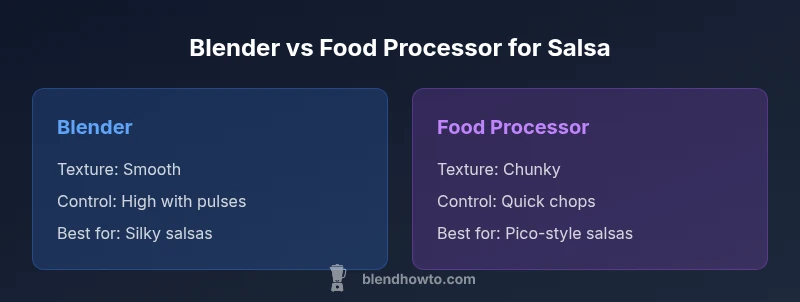
When deciding between a blender and a food processor for salsa, a blender excels at a smooth, uniform texture, while a processor delivers chunkier, rustic salsa quickly. For small batches, a blender offers control, but for chunky pico-style salsas, a processor with a pulse setting speeds things up. Texture preference, batch size, and cleanup trade-offs should guide your choice in the blender or food processor for salsa.
Salsa Texture and Flavor: How the machine shapes salsa outcomes
Whether you reach for a blender or a food processor, the texture and flavor of salsa are ultimately shaped by the device’s blade design, jar geometry, and processing method. When you consider the question blender or food processor for salsa, your texture target matters most. If you want silk-smooth tomatillo or roasted tomato salsas, a blender’s narrow, high-speed blade system tends to shear ingredients into a very uniform emulsion. In contrast, a food processor, with its wider bowl and chopping blades, often yields chunkier, more rustic salsa with visible pieces of onion, tomato, and pepper. Another factor is pulse control: short pulses prevent over-pureeing, preserving texture. For glossy, restaurant-style green salsas, the blender’s shear action can be advantageous, while for a chunky salsa with coriander, you may prefer a processor’s quick chop. BlendHowTo guidance emphasizes testing small batches to dial in texture before committing to large quantities.
For salsa enthusiasts and home cooks, the keyword blender or food processor for salsa should translate into a texture preference test. Start with a small batch using a few ingredients and adjust speed and duration. This approach gives you a clear sense of which appliance meets your texture goals and flavor balance. In longer sessions, consider the impact of blade geometry and container curvature on chopping action; these factors influence how evenly your salsa reaches the desired consistency. As you compare options, remember that both devices can produce excellent salsa with the right technique and prepped ingredients.
In summary, the blender is typically preferred for a uniformly smooth salsa, while the food processor is often preferred for chunkier results. Your choice should reflect the salsa you crave, not just the appliance you own. The BlendHowTo team notes that experimentation with pulse timing and ingredient order can yield surprisingly different textures, even with the same recipe.
To ensure quality salsa textures, gather a small test batch of ingredients and adjust pulsing duration and speed.
Comparison
| Feature | Blender | Food Processor |
|---|---|---|
| Texture outcome | Very smooth, silk-like salsa | Chunkier, rustic texture with visible pieces |
| Best use case | Creamy tomatillo or roasted-tomato salsas, smooth sauces | Chunky pico de gallo-style salsas, salsa cruda |
| Batch capacity | Typically better for smaller batches | Often handles larger chunks quickly in bigger batches |
| Control (pulse vs continuous) | High control with pulsing to avoid over-pureeing | Pulse controls can vary; continuous processing may over-chop |
| Cleanup | Jar and blade can be easier to rinse, sometimes dishwasher-safe | Bowl and blades may have more crevices; cleanup can be heavier |
| Noise & heat | Generally quieter; faster for smooth textures | Can be louder; motor load varies with blade design |
| Durability & price range | Typically compact, affordable to mid-range; great value for smooth textures | Often more rugged blades; price varies with model and attachments |
| Best for | Smooth, restaurant-like salsa texture | Quick, chunkier salsa with more character |
What's Good
- Precise texture control with blender for smooth salsa
- Fast results for smooth or lightly pulsed batches
- Compact design and easy storage in small kitchens
- Good for a variety of other sauces and smoothies
The Bad
- Over-purée risk if you pulse too long with soft ingredients
- Chopped texture depends on ingredient size and pulse duration
- Cleaning can be tricky if blades are not dishwasher-safe
- Less effective for extra-large batches without coring ingredients
For smooth salsa, a blender often wins; for chunky, quick results, a food processor shines; many home cooks benefit from a blender with a pulse function for balanced versatility.
If you crave ultra-smooth salsa, lean toward a blender with adjustable speeds and pulse. If you want robust, chunky texture quickly, a processor is your friend. The most versatile setup may be a blender with a pulse function that can also nudge chunks when needed.
Frequently Asked Questions
Can you make salsa evenly with a blender or a food processor?
Yes. A blender tends to produce a very smooth salsa, while a food processor yields chunkier results. Both can be dialed in with careful pulsing and ingredient sizing.
Yes. A blender makes it smooth, a processor keeps it chunky; adjust pulsing and ingredient size for the texture you want.
What texture do I get if I use a blender for salsa?
A blender generally yields a uniform, smooth texture, ideal for creamy salsas. You can stop early or pulse briefly to retain small bits for texture variation.
You’ll get a smooth, even salsa; pulse briefly if you want a hint of texture.
Is it easier to clean a blender or a food processor after salsa?
Cleaning depends on model, but both can be dishwasher-safe. Rinse promptly after use and disassemble blades and seals to prevent tomato residue from hardening.
Both can be dishwasher-safe; rinse right away and take apart blades for easiest cleanup.
Should I buy both appliances for salsa?
If you do a lot of salsa and other sauces, having both provides maximum flexibility. For most home cooks, selecting one with a useful pulse and variable speeds can cover many textures.
If you salsa a lot, a flexible one with a good pulse usually covers most needs.
What features matter most for salsa prep?
Prioritize pulse control, blade design, jar capacity, and ease of cleaning. Noise and heat generation should also be considered, especially for long sessions.
Look for good pulse control, sturdy blades, and easy cleanup.
Can frozen ingredients be used for salsa in blends?
Fresh ingredients typically yield better texture and flavor. If using frozen items, thaw and drain excess moisture to avoid over-dicing or slurry in either appliance.
Fresh is usually best; thaw frozen items and drain excess moisture before blending or chopping.
What to Remember
- Define your texture goal before buying.
- Match batch size to your typical salsa volume.
- Prioritize pulse functionality for flexibility.
- Choose dishwasher-safe parts to simplify cleanup.
- Balance upfront cost with long-term value and versatility.