Food Processor vs Blender for Salsa: Which Tool Wins?
A practical comparison of food processor vs blender for salsa, focusing on texture, ease of use, cleanup, and value to help you choose the right tool for pico de gallo or smooth salsa.


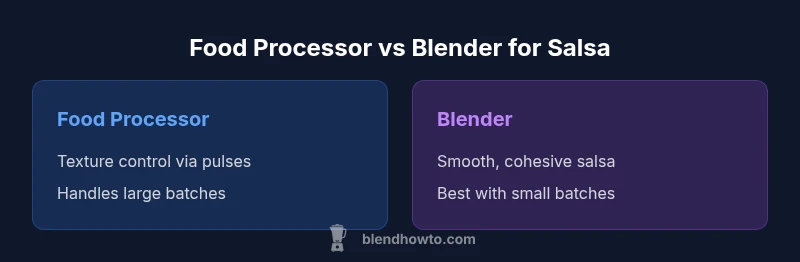
Bottom line: for chunky salsa, a food processor with short pulses offers quick, controlled texture; for smooth salsa, a blender with careful pulsing and small batches works best. In between, you can achieve medium texture by pulsing either appliance briefly and checking frequently. Your choice depends on texture preference, batch size, and cleanup tolerance.
Why the question matters for salsa texture
Choosing between a food processor and a blender for salsa isn't just about speed; it's about texture, control, and freshness. The topic of food processor vs blender for salsa matters because the two devices have fundamentally different blades, bowl shapes, and processing dynamics. For home cooks who crave pico de gallo with distinct pieces, or a silky salsa that clings to chips, the tool you pick sets the final mouthfeel. According to BlendHowTo, the right choice often comes down to the texture you want and how you manage batch size. In this guide, we compare the two common appliances, explain how each one handles salsa ingredients, and offer practical steps to achieve reliable results. By understanding their strengths and limits, you can decide which tool best fits your kitchen workflow, whether you’re whipping up a quick weekday snack or a party-worthy batch. The BlendHowTo team found that small differences in technique can yield noticeably different results in a salsa bowl.
Comparison
| Feature | Food Processor | Blender |
|---|---|---|
| Texture control | Chop/dice with pulses, variable chunk sizes | Blend to smooth, uniform texture with controlled pulsing |
| Processing time | Fast, short pulses to achieve chunky texture | Requires careful pulsing and small batches for even results |
| Best for | Chunky pico de gallo and salsa with visible pieces | Silky, sauce-like salsa and smooth blends |
| Handling seeds/skins | Pulsing can keep seeds/skins chunkier or pulpy | Seeds/skins often break down; may require straining if you want smoothness |
| Batch capacity | Large batches with shallow bowls; easier to manage volume | Typically smaller batches; may need multiple cycles for big quantities |
| Cleanup | Removable blades and bowls; usually dishwasher-safe | Blades are exposed in some models; cleaning can be fiddly |
What's Good
- Fast, batch-based texture control with pulsing
- Handles large ingredients and tougher produce well
- Removable parts simplify cleaning
- Offers versatile texture options for different salsa styles
The Bad
- Risk of over-processing into mush if not careful
- Can dull blades with hard ingredients over time
- Not ideal for very small quantities or delicate herbs
- Loud operation and bulkier cleanup compared to handheld methods
Both tools have a place; texture goals should drive the choice
If you want chunky, piece-filled salsa, a food processor is typically the better option for speed and control. For silky, sauce-like salsa, a blender excels when used with small batches and careful pulsing. The best approach is to match the tool to your preferred texture and batch size, then optimize technique accordingly.
Frequently Asked Questions
Can I make salsa with a blender?
Yes. A blender can produce smooth, sauce-like salsa or a medium texture depending on pulsing time and batch size. For chunkier textures, you’ll likely prefer a food processor or lighter pulsing in a blender with careful stops.
Yes—blenders can make salsa, especially smoother varieties; start with small batches and pulse to control texture.
Should I use a food processor or blender for pico de gallo?
For pico de gallo with distinct pieces, a food processor used in short pulses is usually preferable. A blender tends to puree more, which can reduce the chunkiness of the salsa.
For chunky pico de gallo, go with a food processor and quick pulses.
How can I prevent watery salsa when using a tomato-heavy mix?
Drain chopped tomatoes or sprinkle with a pinch of salt and let it sit briefly to draw out moisture. Pat the ingredients dry before mixing and avoid over-processing to prevent releasing excess liquid.
Salt and drain tomatoes, then pat dry to keep salsa from getting watery.
Is a food processor better for large batches?
A food processor handles larger volumes per cycle and can speed up prep, but you’ll often need to batch process to maintain texture consistency. A blender can handle large volumes if you blend in batches with care.
Yes, food processors handle larger batches more efficiently in many cases.
Can I seed peppers before blending salsa?
Yes. Seeding peppers or removing membranes will reduce heat and alter texture, especially if you want a milder, cleaner finish. If you want heat, you can leave the seeds.
Seeding peppers reduces heat and helps texture when blending.
What other tools can help with salsa prep?
Manual choppers or mortars can give you excellent control over texture. A sieve or strainer can help drain overly watery ingredients before blending. Consider a dedicated salsa maker for batch consistency.
You can use a manual chopper or mortar and pestle for more control.
What to Remember
- Define your salsa texture goal before choosing
- Use pulse to control texture and avoid mush
- Prepare ingredients uniformly for consistent results
- Consider batch size and cleanup when selecting the tool
- Experiment with small batches to dial in texture