How Much Is a Vitamix Blender? A 2026 Price Guide
Explore Vitamix blender price ranges, drivers, timing, and ownership costs. A data-driven guide by BlendHowTo for home cooks and hobbyists seeking practical guidance.


When people ask how much is a vitamix blender, the answer is that prices span a broad range: roughly $180–$800 depending on features. Entry-level models start closer to the low end, while larger containers, higher wattage, and smart presets push pricing upward. This quick snapshot sets the scene for a deeper, data-driven breakdown you’ll find below.
What drives Vitamix pricing
Understanding the sticker price requires looking beyond the label to several price drivers. When you start from first principles, you can predict where a Vitamix-style blender will fall on the price spectrum. How much is a vitamix blender depends on container size, motor power, build quality, and the presence of presets or smart features. In practice, higher wattage and a larger 64-ounce container commonly raise the price, while simpler models with standard blades stay on the lower end. Warranty length also matters; longer warranties are often bundled with premium lines, reinforcing perceived value and long-term ownership cost. Materials—such as a metal base, metal blades, and shatter-resistant jars—tend to influence durability and price. Finally, accessories like tamper tools, tumbler lids, and travel cups can add to the total upfront cost but may offer long-term savings if you use them regularly. The key takeaway: anticipate a price ladder rather than a single fixed price, and map your actual needs to the right tier. In practical terms, the price signal reflects a trade-off between durability, performance, and convenience, which is why two people with similar cooking habits can pay very different prices for a Vitamix-style blender. BlendHowTo’s approach is to help you quantify those trade-offs with clear tiers and real-world usage scenarios.
Price ranges by tier (illustrative)
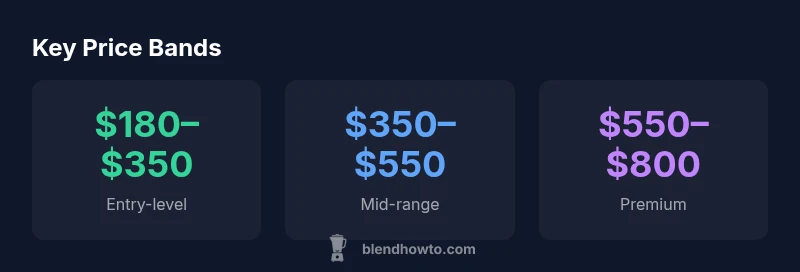
For consumers evaluating how much is a vitamix blender, it's helpful to categorize into three broad tiers. Entry-level, entry-to-mid features, and premium builds. Entry-level bands typically cover basic blending with smaller containers and fewer presets, often landing in the $180–$350 range. Mid-range models add larger capacity, more precise controls, and stronger motors, commonly priced around $350–$550. Premium or professional-style units push upward toward $550–$800 or more, featuring hefty motors, rugged construction, extended warranties, and extra accessories. Note that sales can widen these bands; during promotional events, you might see discounts that reduce effective cost by 10–20%. If you use the blender for smoothies, nut butter, or hot soups, investing in a mid-range or premium unit can offer reliability and performance that reduces frustrations and maintenance costs over time. Of course, the exact price will vary by retailer and any bundles included. BlendHowTo’s framework helps you map your needs to a tier, so you’re not overpaying for features you won’t use.
Total cost of ownership beyond the sticker price
Sticker price is only part of the story. Ownership costs include energy use, replacement blades every several years, and the cost of accessories you routinely use. A high-efficiency blender can reduce run time, which lowers electricity usage over time, albeit by a modest amount. If you frequently blend fibrous greens, seeds, or ice, blade wear and jar integrity matter; premium jars and blades tend to last longer, offering a lower per-use cost in the long run. Maintenance is usually minimal—self-cleaning cycles save time, but occasional deep cleans and seal checks are prudent. Warranty terms affect risk; longer protections reduce the effective cost of ownership when problems arise. Finally, consider resale value; a well-maintained unit can recoup some cost in the event you upgrade. In short, the true price of ownership includes upfront cost plus ongoing energy, accessories, maintenance, and potential resale value. BlendHowTo notes that a well-chosen blender often pays for itself over several years through reliability and saved time.
When to buy: timing and deals
Retail calendars shape Vitamix pricing. Historically, late-year sales and holiday promotions yield the deepest discounts, while summer promotions can offer smaller but meaningful savings. If you’re not in urgent need, waiting for a sale can lower your effective price by 10–20% or more, depending on the retailer and stock levels. Sign up for retailer newsletters, use price trackers, and compare bundles across official sites and authorized resellers. Consider refurbs or certified pre-owned options from reputable sellers; these can offer significant cost savings while maintaining warranty coverage. Before buying, verify return policies and included accessories to ensure you’re not paying for missing essentials. If you rely on warranties, check what’s covered and for how long. With careful timing and due diligence, you can secure a Vitamix-like blender at a more favorable price while preserving expected performance.
How to evaluate value: key questions to ask
Ask questions that reveal value rather than just sticker price. Do you need a large container and high-power motor? Will you use programmable presets or simple pulse blending? Are extra blades, tamper tools, or travel cups part of your daily routine? Compare energy usage, noise levels, and ease of cleaning. Consider the after-sales support and how easy it is to obtain replacement parts. In practice, the best value aligns performance with your budget and usage pattern. Use this framework: list must-haves, nice-to-haves, and non-essentials, then map to price bands. A thoughtful approach can prevent overpaying for features you won’t use and ensure you get durable, reliable performance that stands up to everyday blending tasks.
Practical buying checklist
Create a simple buying checklist to stay objective. Define your budget, target container size (e.g., 64 oz for family servings or smaller for single portions), and essential features (like self-cleaning or programmable timers). Research retailer reliability, check for bundled accessories, and review warranty terms. Compare price points across at least two reputable retailers and read customer reviews focused on long-term performance. Finally, establish a return window and test the blender on common tasks (ice crushing, smoothies, nut butters) to confirm it meets your expectations. By following this checklist, you’ll approach the purchase with clarity and confidence, ensuring you choose a Vitamix-like blender that really matches your needs.
Illustrative price bands for Vitamix-like blenders
| Model Type | Approx Price | Key Features |
|---|---|---|
| Entry-level (generic) | $180–$350 | Smaller container, basic blending, few presets |
| Mid-range (generic) | $350–$550 | Larger capacity, more presets, better durability |
| Premium (generic) | $550–$800 | High-end motor, premium materials, advanced controls |
Frequently Asked Questions
What is the typical price range for a Vitamix blender?
Vitamix blenders typically cost between $180 and $800, depending on container size, motor power, and features. Compare tiers to find the best balance of performance and value for your use case.
Vitamix blenders usually range from about $180 to $800, depending on size and features. Look at tiers to pick the best value for your needs.
Are Vitamix blenders worth the price for home cooks?
For frequent blenders who value durability and speed, a higher-quality Vitamix can be cost-effective over time. For casual use, a lower tier may suffice. Evaluate your typical tasks and budget.
If you blend often and value durability, a higher-tier Vitamix can be worth it. For casual use, a lower tier may be enough.
When do Vitamix blenders usually go on sale?
Sales tend to peak around holidays and major shopping events. Sign up for retailer alerts and price trackers to catch discounts, sometimes 10–20% off or more.
VitOnes sales usually happen during holidays. Set price alerts to snag discounts of 10 to 20 percent or more.
Do Vitamix blenders have refurbished options?
Refurbished or certified pre-owned Vitamix blenders can offer substantial savings with warranty protection from reputable sellers. Verify return windows and included parts.
Refurbished Vitamix blenders can save money and still come with warranties—just check the fine print.
How can I verify the price is legitimate?
Compare price points across official sites and authorized retailers. Watch for unusually low prices that may indicate gray-market goods or missing accessories.
Always compare prices at official sites and trusted retailers to avoid scams or missing parts.
What should I consider for total cost of ownership?
Think beyond sticker price: energy use, blade/jar wear, accessory costs, warranty length, and potential resale value all affect long-term cost.
Consider energy use, wear, accessories, and warranty beyond the sticker price.
“The most important factor in pricing is matching performance to your actual needs. A durable, well-supported blender often pays for itself through time saved and fewer replacements.”
What to Remember
- Know the price drivers to predict value
- Expect a tiered price ladder (entry to premium)
- Total cost of ownership matters, not just the sticker price
- Shop timing can unlock meaningful savings