How Much Do Blenders Cost? A Comprehensive Buying Guide
Explore blender price ranges, understand what drives costs, and learn how to buy smart. This BlendHowTo buying guide covers entry-level, mid-range, and premium models, with practical tips to maximize value for home cooks.


Blender prices span roughly $25 to $700, driven by motor power, blade quality, jar material, and added features like pre-programmed cycles or smart controls. Entry-level models usually cost around $25-$60, mid-range blenders $60-$150, and premium countertop blenders with high-torque motors and durable vessels can range from $200-$700, with some specialty or professional-grade units exceeding $1,000.
Price overview
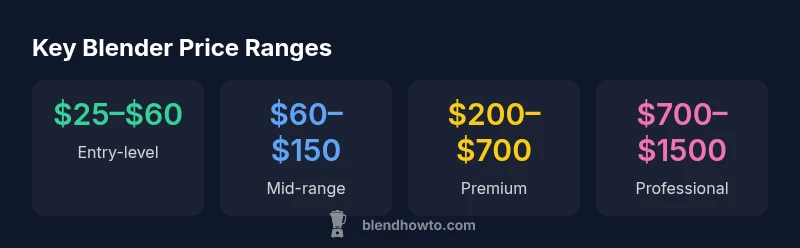
If you’re asking how much does blender cost, you should know that According to BlendHowTo, the price spectrum reflects intended use and build quality. Basic personal blenders are priced around $25–$60 and are suitable for smoothies and light blending. Mid-range machines typically fall in the $60–$150 bracket, offering more power, faster blades, and sturdier jars. Premium countertop models range from about $200 to $700, with some luxury or professional units rising higher, depending on materials, warranty, and advanced controls. In short, price tracks capability: the more you expect from your blender—crushing ice, grinding nuts, heating soups—the higher the price tag you’ll face. When planning a purchase, map out the tasks you’ll perform most, then align those needs with the appropriate price tier. This approach prevents overspending on features you won’t use and helps you extract maximum value for your budget. The BlendHowTo team found this alignment is a strong predictor of long-term satisfaction.
What drives price and value
Blender cost is a function of several interrelated factors. The motor power and torque dictate how effectively the blade can cut through ice and hard ingredients; higher wattage doesn't automatically mean better outcomes for all tasks but it correlates with performance in demanding jobs. Jar material matters: glass and steel jars are typically heavier and more durable than plastic, adding cost but improving longevity and heat resistance for hot soups. Blade quality and design affect efficiency and maintenance; fewer blades or poor edge retention may reduce performance and require replacement sooner. Additional features—pre-programmed cycles, built-in timers, variable speed control, and smart connectivity—add convenience but also raise price. Finally, brand reputation and warranty coverage influence perceived value; units with longer warranties and accessible parts tend to cost more upfront but offer improved long-term cost-of-ownership.
Budgeting by use case
Consider your typical cooking routines to estimate an appropriate price. Casual users focusing on smoothies and basic sauces can comfortably shop entry-to-mid-range units, balancing price and performance. Families or meal-preppers who blend several times weekly may benefit from a mid-range model with higher durability and more consistent results. If you frequently blend nuts, seeds, or perform hot blending, investing in a premium model with a robust motor and heat-resistant jar becomes worthwhile. For professionals or serious hobbyists, a professional-grade blender delivers reliability under heavy workloads and longer life, but it demands a larger upfront investment. Across all use cases, a pragmatic approach is to evaluate price per performance rather than chasing the highest horsepower or the most features.
Budgeting for long-term value
Think beyond the upfront price. Consider lifespan, maintenance, and replacement parts. Some models offer better warranties that reduce long-term costs if components fail. Evaluate blade replacement costs, jar replacements, and cleaning accessories. You may find that a slightly higher upfront price with a longer warranty translates into lower annual costs and fewer repairs. If you replace a blender every few years, a lower upfront price may be acceptable, but it could end up costing more in the long run due to recurring replacements.
Smart shopping: tips to save money
- Compare price per performance: look at wattage, blade geometry, jar material, and warranty alongside price. - Read user reviews about long-term reliability and noise levels. - Check for seasonal sales, refurbished units with warranties, or bundle deals (blade replacement packs, extra jars). - Consider whether you truly need premium features such as smart controls or ultra-high power; in many cases, mid-range options offer the best value.
Price ranges by blender category
| Category | Typical Price Range | Key Considerations |
|---|---|---|
| Entry-level blender | $25–$60 | Smoothies, basic sauces |
| Mid-range blender | $60–$150 | More power, durability, more speeds |
| Premium countertop blender | $200–$700 | High torque, durable jar, warranties |
| Professional-grade | $700–$1500 | Heavy use, commercial features |
Frequently Asked Questions
What factors most affect blender price?
Motor power, jar material, durability, and features like pre-programmed cycles drive cost. Higher-end models typically offer better long-term reliability.
The biggest price drivers are motor power, jar quality, durability, and extra features.
Is it better to buy a cheaper blender or save for a mid-range model?
Cheaper models work for light, infrequent use. For regular blending or tougher ingredients, a mid-range model offers better reliability and performance.
If you blend often or with tough ingredients, go for the mid-range for better value.
Do warranties affect total cost?
Yes, longer warranties can justify higher upfront costs by reducing long-term repair expenses and providing peace of mind.
A longer warranty can save money over time.
Are high-end blenders worth the price?
For frequent use and demanding tasks, high-end models provide consistency and durability. For casual use, mid-range often suffices.
It depends on how hard you use it.
What features should I prioritize to control cost?
Prioritize motor power, blade quality, jar material, and the number of speeds. Avoid unnecessary extras to stay within budget.
Stick to essential features to save money.
“Pricing reflects build quality and intended use; a higher upfront cost can translate into longer life and better performance.”
What to Remember
- Set a budget range before shopping
- Match motor power to your typical tasks
- Prioritize durability and jar quality for long-term value
- Factor in warranty and replacement parts to estimate true cost