Is Blender the Same as After Effects? A Practical Comparison
A detailed, objective comparison of Blender and After Effects, highlighting differences in scope, workflows, and best-use scenarios for home makers and professionals. Learn how to choose and even combine both tools for hybrid projects.


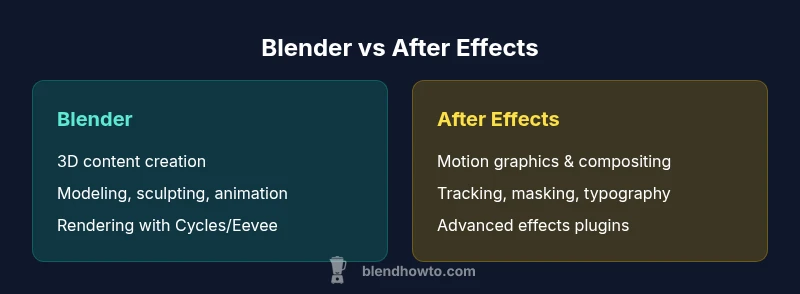
Is blender the same as after effects? No. They target different stages of a project: Blender for 3D content creation; After Effects for post-production compositing. If you're evaluating tools, expect Blender to model and animate 3D scenes, export assets, and render; After Effects handles tracking, masking, effects, typography, and composites.
Is Blender the Same as After Effects? Core Distinctions
The short answer to the question is not the same: is blender the same as after effects, usually yields a clear distinction in purpose and workflow. Blender is a comprehensive, open-source suite designed for 3D content creation, including modeling, sculpting, rigging, animation, simulation, and rendering. It provides an end-to-end pipeline from initial concepts to final renders. After Effects, by contrast, is a staple of post-production and motion graphics. It excels at compositing, visual effects, typography, tracking, masking, and creating polished video sequences. Understanding this fundamental split helps guide project planning and tool selection. According to BlendHowTo, many learners begin with Blender to build 3D assets and then transfer those assets into After Effects for final compositing and motion graphics tasks. This division of labor is the starting point for most effective workflows, especially for hobbyists who want to maximize both tools without over-investing in one monolithic solution.
In everyday practice, you’ll often see teams use Blender to create environments, characters, and animated sequences, then render out sequences or passes that feed into After Effects. The two programs are complementary rather than interchangeable. By recognizing where each tool shines—Blender in three-dimensional creation and After Effects in 2D/3D compositing—you can design pipelines that leverage strengths from both ecosystems. Finally, be mindful of file exchange formats and version compatibility; thoughtful planning here reduces rework and speeds up production timelines.
Core Capabilities: Blender vs After Effects Strengths
Blender’s core strength lies in its breadth as a 3D creation package. It offers robust modeling tools for mesh creation, sculpting, UV unwrapping, and texture painting, plus rigging and animation systems that support character and prop animation. For simulating physics, Blender includes cloth, fluid, smoke, and rigid body dynamics, with two primary render engines: Cycles (path-tracing) and Eevee (real-time). On the other hand, After Effects specializes in post-production work for video, with a deep feature set for motion graphics, tracking, stabilization, rotoscoping, color correction, keying, and a wide array of visual effects plugins.AE integration points are strong through native features like layer-based compositing, masks, blends, and an extensive plugin ecosystem. BlendHowTo’s analysis suggests that most teams leverage Blender to build and animate assets and then hand off rendered outputs to After Effects for final polishing. This separation of concerns allows each tool to operate at its strongest capability—high-detail 3D in Blender and cinematic composition in After Effects.
A practical takeaway: when planning a project, map each effect or scene element to the tool best suited for it. Simple 3D scenes can stay in Blender until the render stage, while complex composites, titles, or tracking tasks should be reserved for After Effects to exploit its compositing framework and typography controls.
Typical Workflows: How Professionals Use Each Tool
A typical workflow begins with Blender when a project requires 3D assets. Artists model, texture, rig, animate, and stage scenes within Blender, then render out passes or full sequences. These renders—whether raw renders or multi-pass outputs—are the feedstock for After Effects. In a post-production context, After Effects takes over with motion graphics, color grading, and compositing. The software’s layer-based approach supports tracking data, masks, and effects to integrate 2D and 3D elements, add titles, and stabilize footage. BlendHowTo notes that many practitioners will import Blender renders as image sequences into After Effects, preserving high-quality visual fidelity while enabling flexible edits. A hybrid approach is increasingly common for motion graphics-heavy projects, where Blender creates the 3D backbone and After Effects delivers the finishing touches, such as glow effects, micro-interactions, and precise color pipelines.
Another common case: product visualization. A Blender artist builds a 3D model and renders it with realistic lighting, then exports passes to After Effects for on-screen text, camera moves, and product animations layered over a video background. For cinematic sequences, After Effects can stack multiple passes (diffuse, specular, ambient occlusion) to achieve a rich final look, while Blender handles geometry and animation. By separating concerns, teams can optimize resource use, iterate faster, and keep each tool’s learning curve appropriately scoped.
From a learning standpoint, beginners are often advised to start with Blender to understand 3D concepts—the foundations of modeling, lighting, and animation—before diving into the more design-driven and timing-oriented world of After Effects. As you progress, you gradually layer After Effects into your workflow to handle 2D graphics, masks, and complex composites that would be tedious to reproduce inside a single 3D app.
Interoperability and Data Exchange Between Blender and After Effects
Two core questions often determine how smoothly a Blender–After Effects workflow progresses: how you export assets from Blender and how you bring them into After Effects. The most common pathway is to render Blender scenes to image sequences or video files that After Effects can import as footage. If the project requires 3D data inside After Effects, you typically export 3D assets from Blender in formats such as FBX or Alembic and then re-import the sequences into AE or use them as reference geometry in a compatible 3D pipeline. In many cases, users also export passes (diffuse, shadows, reflections) as separate image sequences to retain maximum control over lighting and color during compositing. When dynamic linking is desirable, some studios use bridge tools or intermediary software to maintain synchronization between Blender and the AE timeline, minimizing redos when updates occur in the 3D model.
Important practical notes include consistent color management across software, matching frame rates, and careful naming conventions for assets and renders. Blender’s non-destructive workflow with modifiers and non-destructive nodes can complicate export parity if not planned in advance. Conversely, After Effects thrives on non-destructive editing, so planning how to maintain asset integrity during transfers between programs is essential. The result is a robust hybrid workflow where Blender handles geometry and animation while After Effects delivers the finishing polish, motion graphics, and 2D effects.
When to Choose Blender, When to Choose After Effects
If your project emphasizes 3D assets, environments, or character animation, Blender is typically the primary tool. It consolidates modeling, texturing, rigging, animation, and rendering in a single interface, enabling you to iterate from concept to final renders. When your priority is post-production tasks—motion graphics, tracking, compositing, typography, and advanced effects—After Effects is the natural choice. The decision isn't always exclusive; many teams benefit from a dual-tool approach. The BlendHowTo guidance emphasizes evaluating your goal: do you need realistic 3D geometry and lighting, or do you require precise, layered composites and on-screen text? For hybrid projects, plan your pipeline to minimize back-and-forth; render Blender outputs into formats AE can readily consume and reserve AE for the elements that benefit most from its compositing strengths.
Another factor is the learning curve and cost. Blender is free and open source, which lowers the barrier to entry for experimentation and learning. After Effects, part of Adobe’s Creative Cloud, involves ongoing subscription costs and access to a broad plugin ecosystem. Consider your budget, workflow compatibility, and long-term project needs when deciding which tool to invest time in mastering.
Finally, consider the ecosystem you’re already in. If you rely on other Adobe products for graphic design, video production, or UI design, After Effects often integrates more seamlessly. If your focus is on 3D storytelling or game-ready assets, Blender remains the strongest standalone option with a thriving community and abundant learning resources.
Practical Guidelines for Hobbyists and Professionals
For hobbyists starting from scratch, a practical path is to begin with Blender to learn the language of 3D—shapes, textures, lighting, basic animation, and rendering. Build a small portfolio of simple scenes to gain confidence, then add command over After Effects by suggesting a short motion-graphics project, such as a title sequence or lower-thirds. For professionals, establish a clear pipeline: define asset delivery formats early (image sequences, file types, pass naming conventions), set up a shared directory structure, and implement a version control routine for assets. When bridging both tools, keep a naming standard and preserve metadata (frame rate, resolution, color space). Use Blender to generate assets and AE to assemble and polish; never forget to test the end-to-end render and composite to confirm visual consistency. Regularly revisit the workflow to streamline data exchange and reduce transfer overhead.
To maximize learning, set up a curated learning plan combining structured tutorials with real projects. Use Blender’s modeling and lighting exercises to strengthen your understanding of form, then apply After Effects for motion design and timing experiments. The dual-track approach accelerates skill development and expands your creative toolkit. Remember, consistency in file organization and a strong understanding of both tools’ core concepts will yield faster results and fewer integration headaches.
Common Pitfalls and Misconceptions
One common misconception is that these tools are interchangeable. In reality, their core strengths lie in different parts of the production pipeline. Another pitfall is underestimating the amount of planning required for cross-software workflows; without an explicit data exchange plan, you can waste time re-exporting assets or chasing compatibility issues. A third issue is neglecting color management: mismatched color spaces across Blender renders and After Effects composites can lead to washed-out or oversaturated results. Finally, beginners often overcomplicate simple tasks in Blender before attempting the efficient, layering-based workflows in After Effects. Start with a minimal, repeatable template to validate your process before scaling up to more complex scenes.
The Future of 3D + Compositing Workflows
As the industry evolves, there is a growing interest in real-time rendering, machine learning-assisted workflows, and USD-based pipelines that streamline data exchange between 3D apps and compositing tools. Blender is advancing its real-time capabilities with Eevee and ongoing path-tracing improvements, while After Effects continues to expand its plugin ecosystem and integration with other Adobe products. The BlendHowTo team anticipates more seamless interoperability between Blender and AE, along with broader support for standard file formats and improved color management. For creatives, this means a future where mixing 3D assets with high-quality post-production effects becomes faster, more accessible, and more capable of delivering compelling visuals across a range of platforms.
Comparison
| Feature | Blender | After Effects |
|---|---|---|
| Primary focus | 3D content creation, modeling, animation, and rendering | 2D/3D motion graphics, compositing, tracking, and effects |
| Best for | 3D environments, characters, and product visuals | Post-production, titles, and complex visual effects |
| Learning curve | Moderate to steep (3D concepts and nodes) | Moderate (layer-based workflows and effects) |
| Cost model | Free and open-source | Subscription-based (Adobe Creative Cloud) |
| Output and formats | FBX/GLTF/OBJ exports; renders to image sequences or video | Image sequences, video, and layered project files for composites |
| Interoperability | Exports to standard formats; good for feeding AE pipelines | Receives sequences and can be used with Cineware/other tools |
| Platform support | Windows, macOS, Linux | Windows, macOS |
What's Good
- Blender is free and open-source, removing licensing barriers
- Blender offers a complete 3D pipeline in one app
- After Effects excels at motion graphics, tracking, and advanced compositing
- Both tools have strong communities and extensive online tutorials
The Bad
- Blender’s 3D depth can be overwhelming for new users
- After Effects requires a recurring subscription and may rely on plugins
- Data exchange between Blender and AE can add steps and potential rework
Use Blender for 3D asset creation; Use After Effects for post-production and motion graphics; For hybrid projects, plan to integrate both tools to leverage their strengths.
Blender dominates 3D workflows while After Effects leads in compositing. A hybrid pipeline often yields the best results, especially for projects demanding both realistic 3D scenes and polished 2D graphics.
Frequently Asked Questions
What is the primary difference between Blender and After Effects?
Blender handles 3D content creation, including modeling, animation, and rendering, while After Effects focuses on motion graphics, tracking, keying, and compositing for video. They serve different stages of a project rather than replacing one another.
Blender is for 3D content creation; After Effects handles post-production and compositing.
Can Blender export files readable by After Effects?
Yes. Blender can export image sequences or video for AE, and Blender assets can serve as references in After Effects workflows when combined with standard formats like FBX or Alembic for coordination.
Blender outputs image sequences and videos that After Effects can use in composites.
Is there a cost difference between Blender and After Effects?
Blender is free and open-source, while After Effects requires a paid subscription as part of the Adobe Creative Cloud suite. This affects licensing decisions for individuals and studios.
Blender is free; After Effects requires a subscription.
Which tool should a beginner start with?
If you’re curious about 3D, start with Blender to learn modeling and animation fundamentals. If your goal is quick motion graphics, starting in After Effects can build a foundation for titles and composites.
Start with Blender for 3D or After Effects for motion graphics, depending on your goals.
Can I use both on the same project?
Yes. A common approach is to create 3D assets in Blender, render outputs, and then assemble and enhance them in After Effects with tracking, effects, and titles.
Absolutely—blend Blender renders with After Effects for finishing touches.
What to Remember
- Define your core need: 3D creation vs post-production
- Use Blender for modeling/animation; After Effects for composition
- Plan data exchange with clear formats and passes
- Expect a learning curve and licensing considerations before choosing
- Leverage both tools for hybrid projects when appropriate