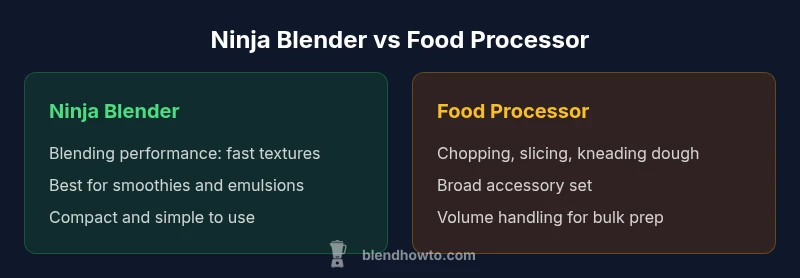
Ninja Blender vs Food Processor: A Practical Side-by-Side Guide
An analytical, side-by-side comparison of Ninja blenders and traditional food processors to help home cooks and hobbyists select the right tool for blending, chopping, and multi-task prep. Learn about blade design, capacity, attachments, cleaning, price, and real-world use cases.


TL;DR: For blending and smoothies, a Ninja blender excels with powerful blades and fast pulses; for chopping, slicing, and dough, a food processor delivers better precision and versatility. If you must choose one, base your pick on your primary kitchen tasks: prefer a Ninja for blending tasks and a food processor for chopping and dough work. A budget model can cover basic tasks.
The Core Question: ninja blender vs food processor
In everyday kitchens, the decision often boils down to dominant tasks. The phrase ninja blender vs food processor captures the practical split: blenders excel at blending and emulsifying, while food processors shine at chopping, slicing, and dough development. According to BlendHowTo, the decision hinges on your primary tasks in the kitchen. If you want quick smoothies, puree sauces, and ice-crushed drinks, a Ninja blender typically gives you speed and a smoother consistency. For dense chopping tasks, dough, or emulsified sauces that require precise texture, a traditional food processor is often the better fit. Understanding these core strengths helps you align equipment with your routines and space.
Blade design and motor fundamentals
Blade geometry and motor philosophy largely drive results with either appliance. A Ninja blender uses a high-torque blade stack designed for rapid blending, creating smooth textures quickly. A food processor relies on a set of interchangeable blades and discs that optimize chopping, slicing, shredding, and kneading. While speed is valuable for blending leafy greens or frozen fruit, torque and control matter more for doughs or dense vegetables. The key takeaway: the right blade configuration and a responsive pulse control make the biggest difference in texture, consistency, and user experience.
Capacity, speed controls, and texture consistency
Capacity and control options determine how much you can prep in one go and how predictable textures stay across batches. Ninja blenders typically offer tall, single-jar designs suited for smoothies and batters, with barrel-shaped jars promoting quick liquefaction. Food processors come with wider bowls and pulse settings that stabilize texture when chopping nuts, vegetables, or cheese. For repeatable results, consider jar size relative to batch volume, plus the available pulse modes and speed ramps.
Attachments, versatility, and typical tasks
The attachment ecosystem can define a device's long-term value. Ninja blenders usually emphasize blending and, in some models, limited add-ons. Food processors ship with chopping blades, slicing/shredding discs, and often a dough blade. If you regularly blend drinks and sauces, a Ninja is convenient; if you frequently dice, mince, or knead dough, a processor shines.
Cleaning, maintenance, and everyday practicality
Cleanup efficiency matters in busy kitchens. A Ninja blender jar and lid typically rinse quickly, with fewer parts in contact with food. A food processor often has more pieces to wash, including the bowl, lid, blades, and discs. Look for dishwasher-safe components and markings that indicate safe washing cycles. Regular care extends blade sharpness and motor life.
Price ranges and value for money
Price is a practical lens to compare Ninja blender vs food processor, especially for budget-conscious cooks. Ninja blenders commonly sit in the lower to mid range, offering strong blending performance without the high accessory count. Food processors span a broader range, from entry-level to heavy-duty models, with value increasing when you need precise chopping and dough work. When evaluating price, consider long-term value, accessory compatibility, and warranty terms.
Real-world scenarios: smoothies, sauces, dough, and more
In real kitchens, the choice hinges on the primary tasks. For all things blending—smoothies, crushed ice, nut milks—a Ninja blender often delivers smooth textures quickly. For chopping vegetables, shredding cheese, or kneading dough, a food processor handles texture control and volume more reliably. For hybrid prep, some models offer attachments that blur the lines, but you’ll usually gain the most efficiency by mapping tasks to each device.
Decision framework: a practical 4-step path
- Identify your top tasks (blending vs chopping vs dough). 2) Check jar/bowl capacity relative to typical batch sizes. 3) List essential attachments and evaluate their availability. 4) Compare cleaning effort, footprint, and warranty terms. This framework helps you choose the tool that minimizes effort and maximizes your results.
Common myths and misperceptions
A common myth is that a single appliance can do everything equally well. In reality, a blender excels at liquefying and emulsifying, while a processor delivers superior texture control for chopping and dough. Another misconception is that more attachments always equal better value; the real benefit comes from these tools matching your regular tasks and space.
Quick-start guide: evaluate your needs before buying
Start by listing the three most frequent prep tasks in your kitchen. Then map those tasks to blending, chopping, and kneading capabilities. Check the accessory kits for each model and estimate how often you’ll reach for each function. Finally, weigh price against long-term use and warranty coverage to pick the best overall value.
Comparison
| Feature | Ninja blender | Food processor |
|---|---|---|
| Blade design | Ninja blender uses a high-torque blade stack optimized for liquefying | Food processor uses multiple blades and discs for chopping, slicing, shredding |
| Motor power & speed | Ninja emphasizes high-speed blending with rapid pulses | Food processor emphasizes steady torque and versatile pulse control |
| Capacity | Ninja typically has tall jars suited for single servings or small batches | Food processor bowls are wide, supporting larger batches and bulk prep |
| Best for | Blending, smoothies, sauces, and emulsions | Chopping, slicing, shredding, and dough work |
| Attachments & versatility | Often a simpler accessory lineup focused on blending | Broad accessory set for chopping, slicing, grinding, and kneading |
| Easy cleaning | Fewer parts and simpler assembly for quick cleanup | More parts to wash but more precise results with less mess |
| Price range | Lower to mid-range for basic blending models | Broader range, from budget to heavy-duty, with higher performance options |
What's Good
- Great for quick blending and smoothies with minimal prep
- Compact footprint fits small kitchens
- Often lower upfront cost for entry-level blending tasks
- Easy maintenance and cleaning for most models
The Bad
- Less versatile for chopping, slicing, or kneading dough
- Attachment ecosystems may be limited
- Performance heavily dependent on blade design and jar size
Ninja blender vs food processor: choose by task, not by brand
If blending is your main activity, the Ninja shines. If chopping, kneading dough, or bulk prep is frequent, the food processor remains the better all-around tool. For many kitchens, a dedicated blender and a dedicated processor provide the best overall efficiency and texture control.
Frequently Asked Questions
Is a Ninja blender better than a food processor for smoothies?
For smoothies, a Ninja blender is typically faster and yields smoother drinks due to high-speed blending and blade design. A processor can make a chunkier texture but is not optimized for liquefying beverages.
Blenders usually make smoother smoothies faster.
Can a Ninja blender replace a food processor for dough or chopping tasks?
Dough and precise chopping are better suited to a food processor. While some Ninja models include chopping blades, they usually can't match the texture control and volume efficiency of a dedicated processor.
Blenders can do some chopping, but for dough and dense chopping, a processor wins.
What tasks are best left to a food processor?
Food processors excel at chopping, shredding, kneading dough, and making thick sauces. They maintain texture across larger batches more consistently than most blenders.
Processors are great for chopping and dough.
Do Ninja blenders come with attachments?
Most Ninja blenders focus on blending with a single jar, while some models offer optional attachments. If you want diced vegetables or dough capabilities, choose a model with a broader accessory kit.
Most Ninja blenders are straightforward, but some offer extra attachments.
How do I clean a blender vs a food processor?
Blenders are quick to rinse, often dishwasher-safe top-rack components. Food processors require washing the bowl, lid, blades, and discs, which takes a bit more time. Check manufacturer guidance for safe dishwasher cycles.
Blenders clean quickly; processors take a bit more elbow grease.
Are there budget-friendly hybrids that cover both functions?
There are compact devices designed to blend and chop, but they rarely match dedicated tools on performance. For frequent heavy chopping or dough work, a separate processor or upgrade is worth it.
Hybrid devices exist but may compromise performance.
What to Remember
- Define your core tasks first
- Compare blade systems and capacity for consistent texture
- Factor attachments and cleaning into daily use
- Budget with long-term value in mind
- Use the decision framework to map tasks to tools