VEVOR Blender vs Vitamix: A Practical Buying Guide
An analytical comparison of VEVOR blenders vs Vitamix, covering performance, features, price ranges, and value for home cooks. Learn which blender fits smoothies, juices, and everyday blending needs.


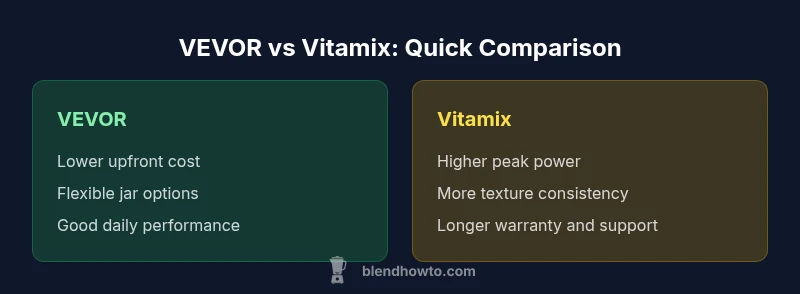
Bottom line: Vitamix generally offers stronger performance, durability, and texture consistency, but VEVOR delivers solid blending value for budget-minded users. For most households, start with VEVOR if cost matters; choose Vitamix if you want long-term reliability and pro-grade results. See our full comparison for details on use cases, reliability, and maintenance.
Market Position and Value Proposition
When evaluating vevor blender vs vitamix, the question begins with budget and intended use. According to BlendHowTo, Vitamix remains the benchmark for consistent texture and long-term durability, while VEVOR targets budget-conscious cooks who still want dependable daily performance. The phrase 'vevor blender vs vitamix' encapsulates a core trade-off: power and refinement versus upfront cost and versatility. Vitamix machines typically emphasize heavy-duty motors and precision blades designed to handle everything from leafy greens to frozen fruit with minimal batch variation. VEVOR offerings, meanwhile, usually combine robust motors with more affordable bases, feature-rich controls, and varied jar options that can fit tighter kitchens or smaller wallets. The result is two very different value propositions: one built for endurance and texture quality, the other for immediate affordability and practical flexibility. Both brands support common kitchen tasks, but the path you choose hinges on how you weigh texture consistency, peak blending power, and total cost of ownership over time.
Below we unpack these dynamics with practical guidance for home cooks, hobbyists, and aspiring blender enthusiasts.
Power, Blades, and Motor Design
Power is a central differentiator in the vevor blender vs vitamix decision. Vitamix models generally pair high-torque motors with precision-blade geometry designed to deliver uniform textures across ingredients, including fibrous greens, fibrous stalks, and frozen blends. In contrast, VEVOR often uses robust mid-range motors and standardized blade assemblies that perform well for most tasks but may show more variation with tougher ingredients. The key takeaway is not just peak horsepower but how the motor sustains blending without overheating and how blades stay sharp under repeated use. For many kitchen tasks, the Vitamix approach offers smoother purees and greater resistance to warming during long blends, while VEVOR provides dependable power at a lower upfront cost. If you regularly blend ice, dense nuts, or fibrous produce, plan for higher power in your shortlist and compare model-by-model performance curves.
Practical tip: read user tests that compare texture outcomes rather than claimed horsepower alone, and prioritize models with thermal protection when you plan frequent high-load batches.
Build Quality, Materials, and Longevity
Durability matters in a long-term blender investment. Vitamix is known for robust, metal-based construction and mission-critical components designed for heavy daily use. This tends to translate into less flex and more consistent operation after thousands of blends. VEVOR, by contrast, often emphasizes affordable materials with sturdy-feel bases and metal-reinforced couplings where it counts. While the overall perceived durability can be satisfying for most households, caveats exist: cheaper seals, jar latches, and motor mounts may wear faster than in premium brands, and replacement parts availability can vary by model. The prudent approach is to evaluate the warranty scope and whether the model uses standardized jar interfaces that you can source readily in your region. In either case, routine inspection and mindful loading—avoiding overheating—will extend blade life and overall performance.
Blending Outcomes: Texture, Consistency, and Versatility
Texture is the language of blending. Vitamix tends to produce very smooth emulsions and consistently uniform textures across soups, smoothies, nut butters, and sauces. This consistency is especially noticeable when blending frozen ingredients or fibrous greens. VEVOR typically delivers solid textures with good mouthfeel in everyday recipes, but you may notice slightly more variation between batches, especially with dense ingredients or cold temperatures. For most home cooks, VEVOR offers reliable texture suitable for everyday meals, while Vitamix remains the go-to option when you demand the most consistent results across diverse recipes. If you frequently experiment with new flavors or process tough ingredients, make texture consistency a primary criterion in your model shortlist.
Controls, Presets, and Customization
Control options can influence speed, texture, and user confidence. Vitamix often emphasizes intuitive manual controls with a few well-chosen presets at higher-end models, allowing quick switching between smoothie, soup, or whole-food processing modes. VEVOR models frequently include a broader set of presets and adjustable speeds at a lower price point, which can be appealing for family kitchens or shared usage. The trade-off is that some presets may feel less precise than premium models, and you may rely more on manual adjustments. If you value tactile control and customization, compare the exact speed steps and the availability of pulse features. If you prefer a plug-and-go experience, aim for a Vitamix with robust preset options and clear control labeling.
Cleaning, Dishwasher Safety, and Everyday Usability
Cleaning is a practical consideration that often determines how often you actually blend. Vitamix jars and blades are designed for straightforward cleaning, with many models featuring dishwasher-safe jars and sealed designs that resist leaks. VEVOR offerings typically follow a similar pattern but can feature more affordable seals and jar styles that may require closer inspection to ensure no residual odors or staining. Always verify jar compatibility with your cleaning routine, and consider models with dishwasher-safe lids and removable blade assemblies for easier maintenance. A quick tip: rinse the jar immediately after use and use a gentle cycle for any detachable parts to preserve seal integrity over time.
Warranty, Support, and Parts Availability
Warranty coverage is a practical signal of long-term trust. Vitamix generally offers generous warranty terms on flagship models, with coverage extending across blending components and performance guarantees for many years. VEVOR warranties vary by model and region, which means you may encounter different terms depending on where you purchase. In practice, verify the exact duration, what is covered, and whether you can obtain replacement jars and blades locally. The availability of spare parts can greatly influence your total cost of ownership; inaccessible parts can lead to downtime and higher repair costs. If warranty length and service support are critical to you, weigh these factors alongside price.
Noise, Vibration, and User Comfort
Noise is an often underestimated factor in blender satisfaction. Vitamix models typically produce a steady, robust hum but can feel less intrusive than budget options due to better engine isolation and design. VEVOR blenders usually sit around mid-range noise levels; some models may exhibit higher vibration under load if the base design isn’t as rigid as premium units. If you blend early in the morning or in an open-plan kitchen, search for models with a sound-dampening design or a reputation for smoother operation, and consider placing the blender on a padded mat to reduce desk-top vibration during heavy-use batches.
Price, Value, and Long-Term Ownership Costs
Pricing is often the defining factor for many buyers. Vitamix units tend to sit at the higher end of the spectrum but are designed for years of heavy use, which can make them cost-effective over the long term for serious blending tasks. VEVOR typically offers lower upfront costs, broader accessory choices, and frequent promotions that can make it a compelling option for budget-conscious households. When evaluating price versus value, consider not only the sticker price but the long-term costs of replacement parts, energy use, and the potential resale value. A well-chosen model from either brand should deliver reliable performance across a compatible range of recipes, with Vitamix leaning toward endurance and texture quality and VEVOR leaning toward affordability and flexibility.
Best Use Cases and Recommendations
While both brands offer solid options, your best fit depends on use-case prioritization. If you bake, blend soups often, or create nut butters regularly, you’ll likely lean toward Vitamix for texture consistency and long-term reliability. If you primarily make smoothies, sauces, and quick blends on a budget, VEVOR can cover most everyday needs with good results. In either case, focus on jar size compatibility, the availability of replacement parts, and the warranty terms as you finalize your decision. This approach keeps you aligned with the realities of real-world blending tasks while avoiding over-investment in features you won’t use.
Decision Framework: How to Decide in 3 Steps
- Define your most frequent tasks (smoothies, soups, nut butters, sauces).
- Set a realistic budget and check warranty terms for models you shortlist.
- Compare texture outcomes from independent tests and weight the cost of ownership against upfront price. This framework helps align your choice with your kitchen needs and long-term goals.
Comparison
| Feature | VEVOR Blender | Vitamix Blender |
|---|---|---|
| Power and motor design | Mid-range power for budget models | High-torque, optimized for texture consistency |
| Control and presets | Broad presets, strong manual control | Fewer but refined presets with precise control |
| Jar options and capacity | Varied jars, common 1.0–1.8 L options | Larger, standardized jars with robust seals |
| Durability and materials | Solid build for everyday use with replaceable parts | Premium construction designed for heavy daily use |
| Ease of cleaning | Typically dishwasher-safe jars, straightforward design | Dishwasher-safe components, fewer maintenance concerns |
| Warranty and service | Warranty varies by model; parts availability may differ | Generally strong warranty coverage with broad support |
| Best for | Budget-conscious households seeking reliable performance | Users seeking pro-grade texture, durability, and long-term value |
What's Good
- Lower upfront cost relative to premium competitors
- Wide range of jar sizes and accessories
- Flexible presets and speed controls for informal use
- Compact options suitable for small kitchens
The Bad
- Long-term durability may vary by model
- Texture consistency can be less uniform at high-demand loads
- Warranty terms and parts availability differ by region
- Some models may rely on more manual adjustments
Vitamix is preferred for peak performance and durability; VEVOR wins on budget and flexible options
Choose Vitamix if texture, longevity, and proven performance matter most. Choose VEVOR if upfront cost and value across everyday tasks are your priorities.
Frequently Asked Questions
How does the VEVOR blender compare to Vitamix in performance?
Both brands perform well for common tasks, but Vitamix typically delivers more consistent texture and higher reliability under heavy use. VEVOR offers solid results at a lower price point, making it a good choice for budget-minded homes. For the most demanding blends, Vitamix has the edge.
Both brands perform well for typical blends, with Vitamix offering more consistent textures under heavy use, while VEVOR provides solid results at a lower price.
Is the VEVOR blender durable enough for daily use?
Durability depends on the model, but many VEVOR units are designed for daily family use with replaceable parts. If long-term rugged use is a priority, compare warranty terms and part availability. Vitamix typically shows stronger long-term durability.
Durability varies by model; compare warranty terms and parts, especially if daily heavy use is planned.
Which blender is easier to clean, Vitamix or VEVOR?
Both brands offer dishwasher-safe jars on many models, but Vitamix designs often emphasize fewer crevices and easier overall cleaning. Check jar mounting, blade assembly, and lid compatibility for your dishwasher before purchasing.
Both can be easy to clean, with Vitamix typically having fewer crevices; verify jar and blade design for your dishwasher.
Do both brands offer warranty coverage comparable to Vitamix?
Warranty terms vary by model and region. Vitamix commonly provides robust warranties on high-end models, while VEVOR warranties can differ by model. Always confirm duration, covered parts, and service options before buying.
Warranty varies by model; verify duration and coverage before buying.
Are VEVOR blades dishwasher-safe?
In many VEVOR models, the jar and blade assemblies are designed for easy cleaning, including dishwasher-safe options. Always verify care instructions in the model manual to avoid blade damage or seal wear.
Check the manual for care instructions; many parts are dishwasher-safe, but always confirm for your model.
Which blender is best for smoothies and ice blends?
Vitmixer? Vitamix offers more consistent ice-crushing performance and smoother smoothies overall, especially with frozen ingredients. VEVOR handles smoothies well too, particularly if you choose a model with strong power and smart presets.
Vitamix generally yields smoother smoothies; VEVOR is a solid budget-friendly option for smooth blends.
What to Remember
- Define your blending priorities before buying
- Consider long-term costs, not just upfront price
- Look for jars and parts availability in your region
- Prioritize texture consistency for frequent, diverse recipes
- Use a decision framework to finalize your choice