Vitamix Blender Comparison: Which Model Fits Your Kitchen
A detailed vitamix blender comparison to help home cooks choose the right high-power blender for smoothies, soups, and more—covering performance, capacity, presets, and overall value.


In a vitamix blender comparison, the best overall option for most homes is the premium programmable Vitamix with built-in timer and presets, delivering versatile results for smoothies, soups, and nut butters. For budget-conscious cooks, a traditional high-power Vitamix offers solid value, while compact models fit small kitchens. BlendHowTo's testing highlights these strengths, focusing on container size, controls, and long-term maintenance.
Why Vitamix Blender Performance Matters
According to BlendHowTo, performance is the backbone of blender results. For home cooks, the texture of a smoothie, the creaminess of a soup, or the evenness of a nut butter hinges on a motor that maintains steady torque across loads. In a vitamix blender comparison, these performance traits translate into predictable outcomes, fewer chunks, and less batch rework. Durability matters too: a dependable unit reduces maintenance friction, keeps you blending, and protects long-term kitchen efficiency. The BlendHowTo team has found that models with robust build quality often outperform cheaper siblings in repeated use, making them a smarter long-term investment for daily blending tasks.
- Focus on texture consistency across dense blends
- Consider how often you’ll run full-batch recipes
- Balance initial cost against expected lifespan and maintenance needs
Key takeaway: Performance consistency and durability are the two levers that most influence long-term satisfaction with a vitamix blender.
How to Compare Vitamix Models: Core Criteria
A solid vitamix blender comparison starts with a clear checklist of core criteria. First, map your typical tasks: smoothies, hot soups, nut butters, or grinding. Next, evaluate motor power and torque class, which affects speed stability under heavy loads. Container design matters: a larger pitcher favors family-size batches, while a compact cup system can save space and simplify daily use. Then review controls: manual dial versus programmable presets; units with a built-in timer or smart features can simplify routine blending. Finally, examine cleaning convenience and warranty coverage, which influence daily usability and peace of mind.
- Task mapping: smoothies, soups, nut butters, grinding
- Power and torque stability across loads
- Container size options and compatibility with your kitchen
- Controls: manual vs preset with timers
- Cleaning ease and warranty coverage
Bottom line: A methodical, task-focused comparison helps you pick a vitamix blender that aligns with your real-world needs.
Power and Motor Build: What to Expect
Power is often the headline feature in a vitamix blender comparison, but strength without control is less useful. In practice, you want a motor that maintains constant torque through dense ingredients like frozen fruit, kale stems, or raw nuts. Premium models typically offer higher torque reserves and smoother acceleration, which translates into uniform textures without overheating or stalling. Even when blending thick mixtures, a well-engineered motor will deliver consistent results without requiring long blending times. For everyday home use, you’ll notice tangible differences in creaminess, emulsification, and batch consistency when moving from entry-level to higher-performance designs.
- Continuous torque vs pulsating bursts
- How quickly blades reach peak speed without bogging down
- Effect on texture and emulsification of dense ingredients
Tip: If you blend hot soups, pick a model with stable torque that keeps blades turning smoothly as the blend heats.
Container Design and Capacity Trade-offs
Container design and capacity are practical influencers in a vitamix blender comparison. A larger, 64-ounce pitcher supports family-size batches and reduces the number of cycles required, which is convenient during meal prep or batch cooking. However, if you live in a small apartment, a compact 20–32-ounce cup or lower-profile container can fit under most cabinets and enhances everyday convenience. Some systems offer multiple pitcher options or a travel cup attachment; these choices trade capacity for portability. When evaluating containers, consider your storage space, typical batch size, and whether you prefer the feel of a tall, narrow jug versus a wide, stable base.
- Large capacity for family meals
- Compact options for small kitchens
- Compatibility with travel cups or extra jars
Recommendation: Choose a system whose container ecosystem matches your most frequent batch sizes to minimize waste and maximize efficiency.
Speed Control, Pulses, and Programs
The way a vitamix blender manages speed has a direct impact on texture control and user experience. Manual speed control gives you fine-grained ramping for delicate emulsions, while presets simplify common tasks like smoothies or hot soups. A built-in timer adds a subtle but powerful convenience by signaling when a program completes, which reduces over-blending and helps you reproduce consistent results. Some models combine touch controls with dual-stage speed ramps to protect blades when starting from a dead stop. For most households, a blend of manual control plus at least one preset covers a wide range of recipes efficiently.
- Manual control for precision
- Presets for repeatable results
- Built-in timer for consistency and convenience
Takeaway: A versatile control scheme often yields the best everyday performance and ease of use without complicating your routine.
Noise, Temperature, and Texture Considerations
Noise levels and heat generation are practical realities in daily blending. Higher-speed operation tends to be louder, which matters in open-plan kitchens or shared living spaces. Temperature is another factor: longer blends can warm liquids, which sometimes changes flavor and texture in soups or nut butters. Modern Vitamix designs address noise with insulated housings or engine shields, while many blends stay efficient enough not to overheat key ingredients. In practice, expect some variance in texture between models, particularly with dense ingredients, but quality units maintain consistent results across batches.
- Noise management in open layouts
- Heat generation and its impact on flavor
- Texture consistency across batches
Note: If you frequently blend hot ingredients, look for models with efficient cooling and heat dissipation features.
Cleaning, Maintenance, and Durability
Cleaning simplicity is a real-world differentiator. Most Vitamix blenders feature a self-cleaning mode: a drop of dish soap with warm water swirls through the container, speeding up cleanup after a busy blender session. Durable components, water-tight seals, and metal drive systems contribute to long-term reliability and reduced maintenance. When evaluating durability, consider blade assembly wear, gasket life, and the ease of replacing or upgrading containers. A model with readily available replacement parts and a reasonable warranty often offers better long-term value.
- Self-cleaning capability for quick maintenance
- Durable build and replaceable parts
- Availability of compatible containers and accessories
Practical tip: Rinse promptly after blending to minimize stains and residue, which helps maintain performance and appearance over time.
Price, Warranty, and Total Value
Price is a practical lens in a vitamix blender comparison. Premium programmable models generally command higher upfront costs but often deliver broader feature sets, longer warranties, and stronger resale value. Traditional high-power units sit in the mid-to-upper range and provide robust core blending without the extra digital features. Compact or budget-oriented variants tend to be lighter on price but can require trade-offs in capacity, presets, or ease of use. Evaluate warranty length and what it covers, because that coverage is a meaningful indicator of long-term value and manufacturer confidence.
- Premium options with broader features
- Mid-range power models with robust performance
- Budget variants with essential capabilities
Bottom line: If you blend daily and depend on reliability, the longer warranty and feature-rich design usually justify the higher price.
Use-Case Scenarios: Smoothies, Soups, Nut Butters, and Milling
Different kitchen tasks push you toward different Vitamix configurations. For smoothies, a mid-to-high power model with smooth control and a large pitcher can handle frozen ingredients with ease. Soups benefit from models that maintain steady torque and can accommodate hot liquids safely. Nut butters demand high torque and robust blades, while milling grains or grinding seeds may require precise, consistent grinding actions. If your plan includes a broad mix of tasks, prioritize models with multiple speed options, a good pulse function, and a large, stable base for batch stability.
- Smoothies: steady torque and wide pitch
- Soups: safe handling of hot liquids and even texture
- Nut butters: high torque and blade efficiency
- Milling/grinding: stable low-speed operation for consistency
Guidance: Map your top 3-4 frequent tasks and choose a model that excels across that core set rather than chasing every possible feature.
Real-World Test Scenarios: Texture and Consistency
To translate specifications into real-world results, consider practical test scenarios. Compare a thick nut butter against a chunky salsa, or a frozen fruit smoothie against a creamy purée. Note how long each blend takes, whether the texture remains uniform, and how easy it is to clean afterward. In a vitamix blender comparison, the models delivering the most repeatable textures across these tests typically demonstrate superior blade geometry, motor control, and thermal stability. Real-world testing often reveals subtle differences that specs alone cannot capture.
- Texture repeatability across dense blends
- Ease of achieving smooth emulsions in soups
- Clean-up time after high-load tasks
Result: The best models offer consistent texture with minimal intervention and straightforward maintenance.
Decision Flow: Which Vitamix Fits Your Kitchen
A practical decision flow helps you converge on the right Vitamix for your kitchen without overwhelm. Start by setting a budget range and defining your top tasks. If you want the most flexibility and longest life, lean toward premium programmable models with timers. If space is at a premium, seek compact or cup-based systems with strong performance. For strict budgets, prioritize core blending power and a solid warranty. Finally, assess your willingness to maintain extra features; simpler designs often deliver excellent results with less upkeep.
- Define use cases and typical batch sizes
- Choose between premium presets vs manual control
- Assess space constraints and container options
- Factor in warranty and long-term value
Next steps: Use the decision flow to shortlist two to three configurations and test in-store or via detailed online demos before purchasing.
Feature Comparison
| Feature | Premium programmable Vitamix (high-end) | Classic high-power Vitamix (traditional) | Compact space-saving Vitamix (space-friendly) | Budget traditional Vitamix (value) |
|---|---|---|---|---|
| Motor power/torque stability | Strong torque with programmable presets | High torque with manual control | Moderate torque with compact design | Solid torque for basic blending |
| Container size / capacity options | Large capacity pitcher for family meals | Large pitcher, traditional design | Smaller footprint with compact cup system | Mid-range capacity for everyday use |
| Controls and presets | Digital presets + built-in timer | Manual controls with fewer presets | Simple controls with travel cup options | Minimal presets, straightforward operation |
| Self-cleaning / ease of cleaning | Self-cleaning function; easy maintenance | Self-cleaning capability; quick cleanup | Some models require manual rinse | Manual cleaning with accessible parts |
| Noise and heat management | Engineered for quiet operation at high power | Moderate noise, effective cooling | Lower noise due to compact design | Higher noise but acceptable for value models |
| Warranty and long-term value | Extended warranty; broad accessory ecosystem | Standard warranty; robust build | Moderate warranty; space-saving design | Basic warranty; value option |
| Best for | Heavy-duty blending, batches, and families | Everyday blending with solid reliability | Small kitchens and limited space | Budget-friendly blending with core power |
What's Good
- Excellent blending power for smoothies, soups, and nut butters
- Long warranty and robust build quality
- Self-cleaning feature reduces cleanup time
- Versatile with multiple speed controls and presets
- Strong resale value and brand confidence
The Bad
- Higher upfront cost than competing brands
- Bulky footprint not ideal for very small kitchens
- Heavier to move during cleaning
- Noise can be loud on high-speed blends
Premium programmable Vitamix is the strongest all-around choice for most homes, with caveats for space and budget.
If you want maximum versatility, smart presets, and long-term reliability, the premium programmable model stands out. For tighter budgets or smaller spaces, a traditional high-power or compact Vitamix can still deliver excellent results, albeit with fewer features. The best pick depends on your daily tasks and kitchen layout.
Frequently Asked Questions
What is the main difference between premium programmable Vitamix models and classic high-power models?
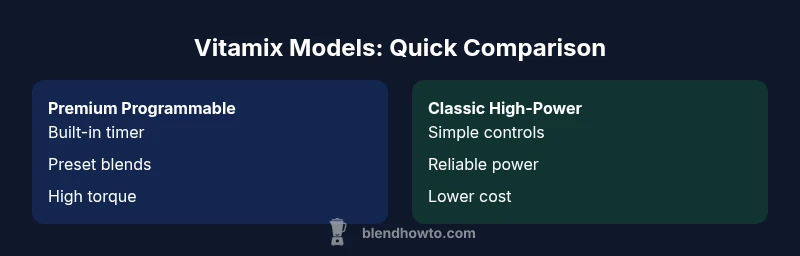
Premium programmable models add built-in timers, presets, and often smarter controls, which improve convenience and repeatability. Classic high-power models focus on raw blending power and durability, without advanced programs.
Premium models have timers and presets for easier repeatable results; classic models rely on manual control but still offer strong power.
Are Vitamix blenders easy to clean after heavy blends?
Yes. Most Vitamix blenders include a self-cleaning feature that uses warm water and a drop of dish soap. Run the cycle briefly, rinse, and air-dry. Regular cleaning helps extend blade life and maintain performance.
They’re designed to clean quickly with a quick soap-and-water cycle.
Is a larger container better for families?
A larger container reduces the number of batches you need to run, which is convenient for families and meal prep. If you mostly blend for one or two people, a smaller container can save space and be easier to store.
If you cook for many people, a big pitcher helps; otherwise, a smaller one saves space.
Can I use hot soups in Vitamix without safety issues?
Yes, Vitamix containers are designed to handle hot liquids. Start on low speed and gradually increase to blend soups safely, reducing the risk of splashes and pressure buildup.
Yes, just start slow and increase speed gradually.
Do Vitamix models require special maintenance?
Not much beyond regular cleaning. Check seals and gaskets periodically, replace worn parts as needed, and follow the manufacturer’s guidance for fresh parts to maintain performance.
Pretty low-maintenance, with standard part checks.
Which Vitamix is best for beginners?
A mid-range Vitamix with straightforward controls and a few presets is typically best for beginners, balancing ease of use with reliable performance.
A mid-range model with simple controls is a great start for beginners.
What to Remember
- Prioritize texture consistency when choosing a Vitamix.
- Match container size to your typical batch volume.
- Prefer premium presets if you value convenience and repeatability.
- Consider space and weight if your kitchen is compact.
- Check warranty length as an indicator of long-term value.