Which Kitchen Blender Is Best: A Practical Guide
This BlendHowTo buying guide compares blender types, features, and price ranges to help home cooks pick the best kitchen blender for smoothies, sauces, and nut butters in 2026.


If you're asking which kitchen blender is best, most homes benefit from a mid-range countertop model. Look for 1000-1200W, a 64-ounce pitcher, multiple speeds, and a solid warranty. Immersion and personal blenders are useful for narrow tasks but usually trade power or capacity. Your best pick depends on your primary tasks and budget.
Why the question 'which kitchen blender is best' depends on use
Choosing the right blender isn't a one-size-fits-all decision. The best blender for you hinges on what you plan to blend, how often you blend, and how much cleanup you're willing to tolerate. According to BlendHowTo, a practical definition of best is a model that consistently meets your core needs without excessive cost or complexity. For a wide range of households, this means prioritizing power, capacity, and reliability while avoiding features that add little real value. In this guide, we'll dissect what to look for and how to balance performance with price so you can answer the question with confidence.
Blender categories at a glance
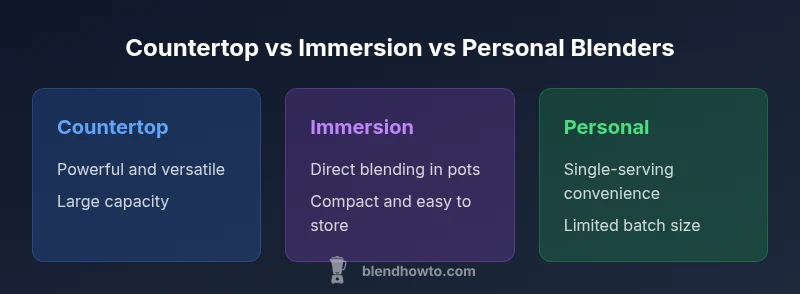
Blenders come in several families, each designed around different use cases. Countertop blenders tend to offer the best blend of power and capacity for multi-task jobs like smoothies, hot soups, and thick nut butters. Immersion (hand) blenders shine when you're blending directly in a pot or cup and want a compact footprint. Personal or single-serve blenders are great for quick, small batches and portability but often sacrifice pitcher size and motor power. Understanding these categories helps you map features to needs and set reasonable expectations for durability and performance.
Core features to compare: what actually matters
Beyond brand names, the heart of choosing the best blender lies in evaluating a handful of core features. The motor wattage and gearbox determine how well it handles ice and tough ingredients. Blade design and pitcher geometry influence texture and consistency. Capacity affects batch size and family meals. Speed options and pre-programmed modes offer convenience but can add cost. Finally, consider ease of cleaning, dishwasher safety, warranty length, and service availability. These criteria apply across countertop, immersion, and personal blenders alike and are the most reliable way to compare models.
Price tiers and value: what you get for the money
Budget blenders under roughly $50-$100 provide basic crushing and mixing, but performance can be inconsistent and parts availability may be limited. Mid-range models in the $100-$200 range often balance power, capacity, and durability, with better blade materials and longer warranties. Premium models above $200-$300 usually deliver stronger motors, premium materials, more precise controls, and extensive accessory ecosystems. When evaluating value, weigh real-world performance for your daily tasks against the added cost of bells and whistles.
Use-case driven picks: smoothies, sauces, hot soups, and nut butters
For smoothies and icy drinks, prioritize a high-torque motor, durable stainless-steel blades, and a wide, sturdy pitcher. Sauces and dressings may benefit from finer blades and speed control to avoid overheating. Hot soups can be blended directly in a heat-safe pitcher or portable pot with a blender that tolerates high temperatures. Nut butters demand a powerful motor, robust blades, and a long blend time. Always consider batch size and whether you need pulse or pre-programmed modes to tackle each task.
Maintenance and longevity: keeping your blender performing
Long-term reliability comes from regular care. Rinse the blender immediately after use to prevent dried residue from corroding seals. Check blade sharpness periodically and replace worn seals, gaskets, or cups as needed. Keep the motor vent clear and avoid running the blender on dry blades. A frequent, light cleaning routine is more important than occasional deep cleans. A well-maintained blender can outlast several cheaper models and justify a higher upfront investment.
How BlendHowTo evaluates 'best' for different households
BlendHowTo assesses best-blender candidates by balancing power, capacity, durability, and user needs. We simulate common tasks, review real-world reliability, and analyze warranty conditions and service networks. We emphasize practical performance over marketing buzz and prefer models with straightforward maintenance. Remember: the best blender is the one that consistently delivers the texture you want for your most frequent recipes.
Quick-start shopping checklist: decide in minutes
- Define your top three tasks (smoothies, sauces, etc.).
- Choose a motor in the 1000-1200W range for versatility.
- Target a 64-ounce (or closest available) pitcher for family meals.
- Check blade quality and pitcher material (stainless steel blades, glass or BPA-free plastic).
- Review warranty length and parts availability in your region.
- Consider size, noise, and ease of cleanup to match your kitchen and lifestyle.
Common mistakes shoppers make (and how to avoid them)
- Equating watts with performance alone; blade design matters too.
- Overlooking cleaning ease; a dishwasher-safe pitcher saves time.
- Ignoring warranty or service options; quick repairs save money later.
- Buying based on a single use; a versatile model may reduce clutter and cost over time.
Feature Comparison
| Feature | Countertop Blender | Immersion Blender | Personal/Single-Serve Blender |
|---|---|---|---|
| Power range | 1000-1500W | 180-900W | 200-700W |
| Pitcher/bowl capacity | 64-72 oz (1.9-2.1 L) | N/A (wand-based) | 14-20 oz (0.4-0.6 L) |
| Best for | Versatile family meals, smoothies, soups | Direct blending in pots or cups | Compact, on-the-go servings |
| Ease of cleaning | Dishwasher-safe pitcher; removable blades common | Rinse-between-use wand; some models dishwasher-safe | Minimal cleanup; easy to rinse |
| Price range | $100-300 | $20-120 | $20-60 |
What's Good
- Strong power-to-value balance for most households
- Wide availability of parts and accessories
- Large capacity suits families and entertaining
- Versatile for many tasks with fewer appliances
The Bad
- Premium features add cost without always improving daily results
- Immersion blades can clog with thick mixtures if not careful
- Personal blenders struggle with ice and dense blends
- Countertop footprint may be large in small kitchens
Mid-range countertop blenders win for overall versatility and value
For most homes, a 1000-1200W countertop model with a 64 oz pitcher offers the best balance. It handles smoothies, sauces, and simple soups well, while avoiding the clutter and performance gaps of cheaper or ultra-high-end options.
Frequently Asked Questions
What is the most important feature to look for in a kitchen blender?
Power and blade design are the core determinants of texture and smooth blending. A good balance of motor torque, blade material, and pitcher geometry often yields the best results across common tasks.
Look for a strong motor and good blades; that combination is usually what gives you smooth texture.
Is higher wattage always better?
Not necessarily. Real-world performance depends on gearbox efficiency, blade design, and your typical batch size. A well-designed 1000W blender can outperform a cheaper 1500W model.
Wattage helps, but design and controls matter just as much.
Are immersion blenders good for smoothies?
Immersion blenders excel at direct blending in pots or cups but often struggle with thick smoothies or ice. They’re best for soups, sauces, and small batches.
They’re handy, but they’re not the best for thick smoothies.
How important is warranty when buying a blender?
A longer warranty reflects confidence in durability and provides peace of mind if a seal or blade fails. Look for at least a two-year warranty and easy parts access.
Warranty matters; it protects your investment.
Should I buy a blender with pre-programmed modes?
Pre-programmed modes can add convenience, but they can also complicate repair or limit customization. Ensure you can override modes for more control.
Pre-programmed modes are nice, but you want control too.
How do I clean a blender effectively?
Disassemble as allowed, rinse immediately after use, and run a quick blend with warm soapy water. For stubborn residue, soak and scrub the pitcher and blades if removable.
Clean as you go, and give it a quick wash after use.
What to Remember
- Prioritize motor power and pitcher capacity for versatility
- Match your tasks to blender type (countertop vs immersion vs personal)
- Expect best value from mid-range models with solid warranties
- Consider ease of cleaning and parts availability to extend life