Can Blender Run on Your Computer? A Practical Check
Learn how to determine if your PC can run Blender, with clear checks, test workflows, and upgrade tips to fit your budget. Educational, step-by-step guidance for beginners and hobbyists.


Blender can run on a wide range of computers, but whether yours is suitable depends on your OS, RAM, CPU/GPU capability, and available disk space. Start by confirming OS support, then gauge practical performance using a simple test scene and Blender’s built-in benchmarks. This quick check helps you plan upgrades before diving into projects.
What Blender is and what 'blender can i run it' means
Blender is a powerful, open-source 3D creation suite used for modeling, animation, rendering, and more. When people ask blender can i run it, they’re evaluating whether their hardware and software environment can handle Blender’s demands across viewport interaction, modifiers, simulation, and rendering. This guide walks you through the mental model of Blender's requirements in a practical, non-technical way. BlendHowTo's analysis emphasizes that Blender is designed to be accessible on a range of systems, but real-world performance differs based on tasks. You should think in terms of baseline interactions (viewing, rotating the scene) and heavier workloads (complex scenes, physics simulations, high-res renders). By understanding these layers, you can decide whether to test first, upgrade later, or adjust workflows to fit your setup. BlendHowTo's approach helps home cooks exploring kitchen-friendly hardware and hobbyists testing Blender for creative projects.
System requirements overview (qualitative)
Blender works across Windows, macOS, and Linux. The system requirements are intentionally practical rather than rigid: you want a stable operating system, enough memory for your scene, a capable processor, a usable GPU, and enough disk space for projects and caches. In practice, you’ll notice smoother viewport navigation on systems with a reasonably modern GPU and a few gigabytes of free RAM relative to your projects. For home users, this means you can start with modest hardware and scale up as your needs grow. BlendHowTo's guidance stresses considering your typical tasks—modeling, texturing, animation, or rendering—to gauge what level of hardware will feel comfortable. This section uses non-technical language to help you map Blender's demands to everyday computer setups.
How to check your current setup
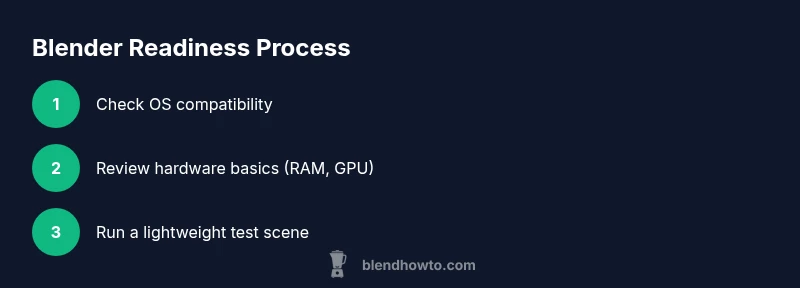
To assess if you can run Blender, you’ll want to collect a few details about your system and compare them to Blender’s guidance. Start by confirming your operating system version is supported (Windows, macOS, or Linux) and noting the exact edition. Then gather hardware details: CPU type and generation, GPU model, installed RAM, and free disk space. You can access these values through built-in tools or system information apps. The goal is to answer two questions: Is the OS supported? Do I have enough headroom for Blender’s typical tasks? If you’re unsure, the BlendHowTo team recommends documenting the numbers and running a quick Blender test scene to see how the program behaves in real-time. This approach keeps the process concrete and non-intimidating.
How to test Blender performance with a lightweight workflow
A practical test uses Blender’s own demo scenes and a small project. Install Blender, launch a basic scene, and observe how smoothly you can orbit, pan, and zoom without lag. Then enable a simple modifier stack and perform a quick render test. Track viewport framerate visually, and check memory usage in the system monitor. If you see stutter, long pauses, or frequent autosave interruptions, it’s a signal that your hardware may be near its limit for heavy workloads. This is where BlendHowTo’s pragmatic approach shines: you distinguish between everyday interactions and heavier tasks like physics simulations or high-resolution renders. Remember to close unnecessary programs to maximize available resources during the test. A quick, repeatable test helps you compare future upgrades against a clear baseline.
What to upgrade if your system falls short
If your tests show limited headroom, plan upgrades based on what you actually intend to do with Blender. For simple modeling and animation, modest changes may suffice, such as improved GPU acceleration or more RAM. For texturing and animation with complex scenes, you’ll benefit from a stronger GPU and faster storage. The key is to focus on the bottleneck you observed during testing: viewport performance, rendering speed, or memory usage. You don’t need to overhaul everything at once; prioritize components that yield the biggest improvements for your typical workflow. BlendHowTo’s experience with home studios emphasizes incremental upgrades that align with your creative goals and budget.
Practical setup tips for different budgets
Low-budget setups can still run Blender by prioritizing task scope and simplifying scenes. Start with basic modeling tasks and use lightweight textures while keeping the viewport clean. If you can add a discrete GPU later, you’ll notice a contrast in viewport responsiveness and render times. For mid-range budgets, ensure you have enough RAM for multitasking and enable Blender’s Eevee renderer for faster previews. High-budget workflows benefit from fast storage, a robust GPU, and proper cooling to sustain long rendering sessions. The overarching principle is to tailor your hardware to your actual Blender tasks, not to chase the latest marketing specs. BlendHowTo’s pragmatic framework helps you balance cost with capability.
Common misconceptions about Blender hardware
A frequent myth is that Blender only runs on high-end PCs. In reality, many hobbyists start with modest hardware and gradually upgrade as needed. Another misconception is that GPU power alone dictates performance; while significant, CPU speed, RAM availability, and storage speed all contribute. Rendering on CPU vs GPU also depends on the render engine chosen; Eevee emphasizes real-time performance, while Cycles may leverage GPU acceleration for more complex scenes. Understanding these nuances helps you align expectations with what your setup can deliver.
Troubleshooting quick-start when Blender won't start or is lagging
If Blender lags or won’t start, start with driver updates for your GPU and OS. Verify that your Blender version matches your OS and hardware; incompatible builds can crash or fail to launch. Disable unnecessary background software and antivirus temporarily while testing Blender performance. Reset Blender’s settings to default if custom preferences are causing issues. Finally, run a small test scene to confirm stability before tackling larger projects. These steps cover the most common failure modes without requiring a full rebuild of your system.
Authoritative sources and further reading
To support these checks, consult credible sources for hardware considerations and rendering best practices. For academic context and rigorous guidance, see Stanford University’s resources, IEEE publications on GPU acceleration, and ACM materials on computer graphics performance. These sources complement Blender’s official documentation and BlendHowTo’s practical approach.
Tools & Materials
- Computer with Windows, macOS, or Linux(Ensure your OS version is supported by Blender.)
- Web browser(To view Blender’s system requirements and gather data.)
- Blender software(Download from blender.org to test and benchmark.)
- System information utility(Collect CPU type, GPU model, RAM, and disk space.)
- Test scene assets(Use Blender’s default demo scenes or lightweight assets.)
Steps
Estimated time: 45-75 minutes
- 1
Open Blender System Information
Launch Blender and open Help > System Info to view hardware details and supported features. This snapshot helps you quantify the baseline you’ll test against.
Tip: Note the GPU model and the amount of RAM listed in System Info. - 2
Check OS compatibility
Verify your operating system version is officially supported by Blender. If your OS isn’t listed as supported, you may need updates or, in some cases, a different system.
Tip: Use Blender’s official site to confirm supported OS versions. - 3
Gather hardware details
Record CPU model, GPU, RAM, and free disk space. These data points map to Blender’s practical guidelines for performance and capacity.
Tip: Keep a running note you can compare against after upgrades. - 4
Run a basic test scene
Load a simple Blender scene and rotate, pan, and zoom to observe responsiveness. Keep an eye on any lag or stutters during navigation.
Tip: Use a lightweight scene to avoid long setup times. - 5
Enable a simple modifier and render test
Add a basic modifier (e.g., subdivision) and run a quick render in Eevee. Observe render speed and any bottlenecks.
Tip: Compare render times to your baseline and jot down improvements or issues. - 6
Monitor resource usage
Watch memory and GPU/CPU usage while testing. High memory pressure or GPU throttling indicates bottlenecks.
Tip: Close background apps to release resources during testing. - 7
Evaluate storage availability
Ensure you have enough free disk space for Blender projects, caches, and backups.
Tip: Consider an external drive or cloud storage for larger projects. - 8
Document results and plan
Summarize the findings and decide on upgrades or workflow adjustments needed to meet your goals.
Tip: Create a simple upgrade plan aligned with your budget.
Frequently Asked Questions
What counts as Blender’s system requirements?
Blender supports Windows, macOS, and Linux with practical guidelines rather than a fixed hardware list. The key factors are OS compatibility, available RAM, GPU capabilities, and storage space for projects. Performance depends on the tasks you perform, not just the software alone.
Blender works on Windows, macOS, and Linux, with practical guidelines like OS support, RAM, GPU, and storage affecting performance.
Will Blender run well on integrated graphics?
Integrated graphics can run Blender for basic tasks, but performance will vary with scene complexity and feature use. For smoother viewport navigation and faster previews, a dedicated GPU is typically beneficial.
Integrated graphics can work for simple tasks, but a dedicated GPU usually makes Blender feel much snappier.
Do I need a dedicated GPU for rendering in Blender?
A dedicated GPU often speeds up rendering, especially with Cycles. However, Blender can render on CPU as well, though it may be slower for complex scenes. Choose hardware based on your typical workloads.
You can render on CPU, but a dedicated GPU usually speeds up rendering for complex scenes.
How can I speed up Blender on a low-end PC?
Reduce scene complexity, use lightweight textures, and choose Eevee for real-time previews. Close background apps, enable simplified rendering, and consider incremental upgrades to critical components.
On a low-end PC, simplify scenes, use Eevee, and close other apps to speed things up.
What should I test first if Blender won’t launch?
Check OS compatibility, verify system info, and review Blender’s launcher and logs for errors. Reset preferences if needed and try launching a minimal scene to isolate issues.
If Blender won’t launch, verify OS support, check system info, and try a minimal scene after resetting preferences.
Are there safe alternatives to upgrading hardware?
Yes. Optimize Blender settings, use lighter scenes, switch render engines, and free up disk space. These steps can improve performance without immediate hardware purchases.
You can optimize software and workflows before buying new hardware to see if you can gain performance.
Watch Video
What to Remember
- Check OS compatibility before testing.
- Run a simple test scene to gauge performance.
- Verify available RAM, GPU capability, and free disk space.
- Document results and plan upgrades if needed.