Best Blender for Ice: How to Crush Ice Perfectly
Learn how to choose and use a blender for ice, with practical tips for crushed, shaved, and chunky textures. Safety, power tips, and real-world recipes for drinks and smoothies.


By the end, you’ll know how to pick the best blender for ice, prepare ice properly, and achieve consistently smooth or chunky textures. This guide covers blade design, motor power ranges, safety tips, and practical steps to prevent clumping and melt, with clear comparisons and recommended practices for drinks, smoothies, and crushed-ice recipes. Ready to blend ice like a pro?
Why ice presents a blending challenge
Ice behaves very differently from soft fruits when blended. A true blender for ice must withstand freezing temperatures, convert blade motion into consistent chopping, and manage heat. If you treat ice as just a harder fruit, you’ll end up with uneven texture: big chunks, thin slush, or a slurry that melts quickly. The phrase blender for ice isn’t just about motor power; it’s about blade geometry, jar design, and how the machine handles icy loads. In home kitchens, the texture you want—crushed, shaved, or chunky—depends on how you feed ice, how you circulate it, and how long you blend. BlendHowTo’s analysis emphasizes the importance of selecting a model that aligns motor capability with your ice texture goals, while keeping safety and cleaning top of mind. This ensures predictable results rather than kitchen experimentation.
How to choose the right blender for ice
Choosing a blender for ice begins with defining your texture goals. If you want ultra-fine crushed ice for cocktails, a high-torque motor (typically 1000 watts or more) paired with robust stainless steel blades is essential. For shaved-ice desserts, a machine that can maintain a cold environment and produce uniform shavings matters. A widely effective rule is to look for a blender with a sealed blade assembly, a solid motor, and a pulse function that allows you to intervene while the ice breaks down. In short, the best blender for ice balances power, blade geometry, and control. Always compare models on motor torque, blade count, jar shape, and user safety features. BlendHowTo’s guidance suggests prioritizing consistency and control, not just raw watts, when selecting a blender for ice.
Blade design and motor power explained
Blade geometry determines how efficiently ice is sheared. A multi-edge, stainless steel blade stack with curved edges creates more surface area to fragment ice quickly. The motor must supply steady torque without overheating; otherwise you’ll over-blend, softening the texture. When evaluating a blender for ice, check for overcurrent protection, thermal sensors, and a reputable warranty. If you notice a blender stalls or strains on even small batches, it’s a sign the motor is underpowered for ice. A high-torque motor with a strong blade design produces consistent results, enabling you to achieve the texture you want without turning ice into a melt-prone mush.
Ice textures: crushed, shaved, and chunky
Crushed ice is ideal for cocktails and certain smoothies because it chills rapidly while maintaining body. Shaved ice creates a fluffy, snow-like texture perfect for desserts and snow cones. Chunky ice is great for textured beverages and for adding ice crunch to drinks. Your choice of texture depends on the recipe, but the underlying principle is predictable breakdown. A blender for ice should allow you to target particle sizes by adjusting pulse duration, batch size, and the liquid-to-ice ratio. Practice with small batches to calibrate texture, then scale up for party-sized servings.
Best practices for pre-chilling and loading ice
Pre-chilling ice helps maintain texture because warm ice melts faster under blade heat. Start with cold ingredients and use cold liquids to keep the blend cool. Load ice in batches rather than all at once; this reduces torque spikes and helps blades cut more evenly. Between batches, pause and inspect texture before continuing. For the blender for ice, keeping the ice at a consistent temperature and avoiding overfilling the jar yields the most uniform results.
Safety and maintenance when blending ice
Ice blending can be loud and generate splashes. Always secure the lid, and keep hands away from blades while operating. Allow the blender to rest if it heats up during a long blend, and never run an empty blender with ice. After blending, unplug the device and rinse the jar, blades, and lid promptly to prevent residue from hardening. Regular maintenance, including checking blade sharpness and gasket integrity, extends the life of your blender for ice.
Common mistakes and how to avoid them
Common mistakes include overfilling the jar, adding warm liquids, skipping the pulse function, and blending too long in one go. Overfilling causes uneven chopping and overheating; warm liquids invite premature melting. Always start with a cold liquid, use short pulses, and check texture frequently. Investing in a model with reliable ice-handling capabilities reduces the chance of these errors. BlendHowTo recommends starting with small trials to dial in your preferred texture.
Real-world recipes and texture targets
Texture targets vary by drink type. For a Moscow Mule inspired crush, aim for fine granules that chill quickly without melting into a slushy moat. For smoothie bowls, you might want a coarser blend with small ice shards that provide bite. Keep notes about ice-to-liquid ratios and blended times for each recipe, so you can reproduce results consistently. The goal is predictable texture that matches your favorite drinks and desserts, using a suitable blender for ice.
Cleaning and storage after ice blending
Ice residue can cling to blades, necessitating thorough cleaning. Rinse immediately after blending to prevent mineral buildup. Use warm water and dish soap, then dry all components completely before reassembly. If you store leftovers, transfer the blend to an airtight container and refrigerate promptly; ice-based textures can separate if left standing. Regular cleaning helps preserve blade sharpness and odor-free operation for your blender for ice.
Tools & Materials
- Countertop blender (high-torque, 1000+ watts)(Choose a model with robust motor and sealed blade assembly)
- Ice (cubes or crushed)(Fill to model-specific max; avoid overfilling)
- Cold liquids (water, juice, dairy-free options)(Helps prevent heat buildup and improves texture)
- Measuring cup or kitchen scale(For consistent ice-to-liquid ratios)
- Towel or heat-resistant gloves(Protect hands from splashes and cold surfaces)
- Silicone spatula or tamper (optional)(Use if your blender supports a tamper to move ice during blending)
- Dish soap, sponge, cleaning brush(Clean promptly to prevent odor and residue)
Steps
Estimated time: 15-20 minutes
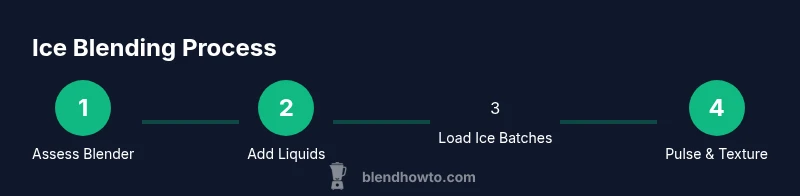
- 1
Check equipment and prep ice
Inspect motor and blades for wear. Pre-chill ice and measure liquids to establish a baseline texture goal. This ensures the blender for ice can perform reliably from the first pulse.
Tip: If the motor strains, stop and re-check the batch size. - 2
Add liquids first
Pour the cold liquid into the blender jar before adding ice. This creates a smoother surface for blades to cut and reduces motor stress.
Tip: Keep liquid level below the max line to prevent overflow. - 3
Load ice in batches
Add ice in smaller portions instead of all at once. This helps blades engage cleanly and prevents overloading the motor.
Tip: Pause after each batch to check texture progress. - 4
Pulse, then pause and assess
Use short pulses (1-2 seconds) followed by a brief pause. Check texture; aim for consistent particle size with minimal heat.
Tip: Avoid continuous blending that overheats the motor. - 5
Scrape and re-evaluate
If needed, stop and scrape down the sides to incorporate unmixed ice. This step improves uniformity.
Tip: A silicone spatula helps reach stubborn bits without stopping the motor. - 6
Finish to texture target
Blend in rapid bursts to refine texture to your target (crushed, shaved, or chunky).
Tip: For very fine texture, reduce batch size and blend a bit longer. - 7
Taste and adjust
Taste the texture and adjust with a splash more liquid if too dry, or a touch more ice if too wet.
Tip: Keep notes for future reference. - 8
Clean up promptly
Rinse the jar, blades, and lid immediately after use to prevent residue and odors.
Tip: Let parts dry completely before reassembly.
Frequently Asked Questions
What blender is best for ice?
A high-torque blender (1000+ watts) with sturdy blades typically performs best. Look for models with strong motor protection and a sealed blade assembly to withstand ice. If you don’t need heavy-duty use, a mid-range blender can still work with small batches.
For ice, a high-torque blender with strong blades is ideal. Check motor protection and blade seal for best results.
Why does ice melt quickly when blending?
Friction from the blades generates heat. Use short pulses, keep liquids cold, and avoid running the blender continuously for long periods.
Heat from the blades melts ice; pulse and keep things cold.
Can I use an immersion blender for ice?
Immersion blenders can handle ice in some cases, but they’re generally less effective for large batches or very hard ice. Use shallow batches and shorter bursts if you do, and avoid long continuous blending.
Immersion blenders can work for ice in short bursts, but aren’t ideal for heavy ice loads.
How can I prevent clumps when blending ice?
Add cold liquid first, load ice in small batches, and use pulses to break up clumps gradually. Scrape the sides as needed.
Add liquid first, pulse, and scrape to break clumps.
Is crushed ice better for cocktails or smoothies?
Crushed ice chills drinks quickly and creates a smooth mouthfeel for cocktails and some smoothies. Texture choice depends on the recipe and preferred finish.
Crushed ice chills quickly and blends well with cocktails; adapt texture to your recipe.
What safety steps should I follow when blending ice?
Always use the lid, keep hands away from blades, unplug before cleaning, and handle hot surfaces with care. Do not attempt to modify blades or run if damaged.
Keep hands away from blades, unplug before cleaning, and use the lid.
Watch Video
What to Remember
- Choose a high-torque blender for ice.
- Add liquids before ice to reduce torque.
- Pulse in short bursts for texture control.
- Clean immediately after use to prevent odors.