How to Add Blender: A Practical Kitchen Guide
Learn how to add blender to your kitchen with a step-by-step guide. Compare countertop and immersion models, safety tips, and cleaning routines from BlendHowTo for confident, efficient blending.


How to add blender to your kitchen: first define your needs, choose between countertop and immersion models, assemble the unit safely with compatible attachments, learn basic operation, and establish a simple cleaning routine. This guide compares types, safety features, and maintenance so you can start blending confidently and efficiently today.
Why adding a blender changes everyday cooking
A blender is more than a gadget; it’s a versatile tool that can save time, unlock textures, and expand your recipe repertoire. If you’re wondering how to add blender to your kitchen routine, understanding the value of blending will help you pick the right model and use it confidently. According to BlendHowTo, many home cooks underestimate how a quality blender can simplify sauces, smoothies, soups, and even homemade nut butters. The BlendHowTo team found that choosing the right blade design and jar capacity directly affects meal prep flow and cleanup time. In this section we explore the core reasons to add a blender and how it fits into different cooking styles, from quick weekday breakfasts to batch-cooking experiments. Blenders provide consistent texture, emulsify ingredients, and allow you to control thickness precisely. They support budget and space decisions by offering compact personal units or larger countertop machines. For small kitchens, an immersion blender may be ideal; for families, a robust countertop model may be more efficient. The key is to align blender features with your typical meals, storage space, and cleaning preferences.
Understanding blender types: countertop vs immersion vs personal
Blenders come in several flavors, each with a distinct set of strengths. Countertop models usually host a dedicated jar and a powerful motor, ideal for thick smoothies, soups, and nut milks. Immersion (handheld) blenders offer maneuverability and compact storage, best for blending directly in pots or tall jars. Personal or mini blenders fit small portions and quick sauces but may lack power for dense blends. When deciding how to add blender to your setup, evaluate where you’ll use it most, how much space you have, and whether you value speed, texture control, or ease of cleaning. BlendHowTo’s guidance emphasizes matching your routine to the unit’s jar size, motor power, and attachment compatibility to maximize results.
How to choose the right blender for your needs
Start with your typical tasks: smoothies, sauces, soups, or batters. If you batch-produce meals or need heat tolerance, a countertop blender with a larger jar and a robust motor is worth the space. If you frequently blend directly in a pot or need easy cleanup, an immersion model with a detachable shaft may win. Consider features like blade design, jar material (stainless steel or BPA-free plastic), noise level, ease of cleaning, and dishwasher-safe parts. Also, verify that the blender’s wattage aligns with your budget and power outlet limitations. This decision matters because the right blender improves texture, reduces prep time, and simplifies post-blend cleanup.
Safety first: essential safety features and practices
Safety is the backbone of any blending task. Always unplug the unit before assembling or disassembling parts. Handle blades with care and ensure the jar is securely attached to the base before powering on. Look for non-slip bases, secure lids, and vented caps to reduce pressure during hot blending. If you’re using an immersion blender, follow manufacturer guidelines for using the tamper and avoid submerging the motor in liquids. A simple safety habit is to never overfill the jar and to let blades come to a complete stop before opening.
Kitchen integration: setup, storage, and workflow
Create a blending zone that minimizes clutter and maximizes safety. Place the base on a dry, stable surface near a power outlet, and keep all attachments in a dedicated drawer or container. Use a pitcher or jar with a wide mouth for easier ingredient loading and cleaning. Establish a routine: assemble parts, load ingredients, blend, rinse, and dry in order. If storage space is limited, consider stackable jars and compact blades. This approach keeps your kitchen efficient and reduces the time between decision and delicious results.
Attachments and accessories: what you might need
Your blender ecosystem may include jars of varying sizes, different blade assemblies, lids with secure seals, a tamper for thick blends, and a cleaning brush. Ensure any attachment is compatible with your base and jar. For immersion blenders, you might also want a whisk attachment for emulsions. When choosing extras, prioritize dishwasher-safe parts, strong jar seals, and compatibility with your most-used recipes to avoid buying duplicates.
Cleaning and maintenance: keep blades sharp and safe
Regular maintenance preserves performance. Rinse the jar and blade immediately after blending sticky ingredients, then wash with warm soapy water. For stubborn residues, soak removable blades in warm water with a mild detergent and use a brush to remove buildup. Dry parts thoroughly before reassembling to prevent corrosion. Periodically inspect seals and gaskets for wear and replace them as needed. A quick, consistent cleaning routine makes your blender last longer and keeps flavors pure.
Practical recipes and use cases: smoothies, sauces, soups
Blenders shine in versatile applications. Create green smoothies with leafy greens, fruit, and yogurt for a balanced breakfast. Whip sauces like vinaigrettes or creamy tomato soup by adjusting blending speed and duration. For thicker mixtures like nut butters or hummus, blend in batches or add a splash of liquid to reach the desired texture. Always consider ingredient size and order to achieve smooth, even results.
Common mistakes and quick fixes
Overfilling the jar leads to spills; under-blending leaves chunks. If blades stop abruptly, your unit may have overheated or jars may be misaligned. Use pulses for thick mixtures to prevent overheating. If the texture is gritty, blend longer or add a little liquid to help emulsify. When cleaning, avoid submerging non-waterproof motor sections and never immerse the base in water. By anticipating these issues, you’ll enjoy consistent blends every time.
Quick-start setup checklist
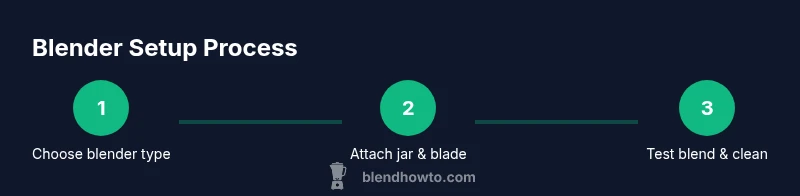
Gather the base, jar, blade, and lid. Attach the jar to the base and secure the lid. Place ingredients in a safe order, then start at the lowest speed. Check texture, adjust speed, and blend until smooth. Finish by cleaning and drying all parts. This quick-start routine helps you begin blending within 20-30 minutes after unboxing.
Tools & Materials
- Countertop blender base or immersion blender handle(Ensure it matches your kitchen outlet type and power needs)
- Jar or pitcher (capacity suited to need)(Stainless steel or BPA-free plastic; fit to base)
- Blades and blade assembly(Check compatibility with jar and base; handle with care)
- Lid with secure seal(Prevents spills and ensures safe blending)
- Tamper (optional for immersion if needed)(Use only if manufacturer supports it)
- Measuring cups and spatula(For portions and scraping down sides)
- Dish soap and soft sponge(Gentle cleaning agents prevent damage)
- Kitchen towel or drying rack(Dry parts thoroughly before reassembly)
- Electrical outlet nearby(Safe space for cord and plug)
Steps
Estimated time: Estimated total time: 25-40 minutes
- 1
Unbox and identify parts
Carefully unpack the blender and lay out all components. Identify the base, jar, lid, blade assembly, and any attachments. Confirm you have the pieces matching your model and keep instruction manual within reach.
Tip: Take a photo of the box contents so you can verify parts if you’re missing anything later. - 2
Choose the right jar and blade
Select a jar size appropriate for your typical batches and ensure the blade is compatible with the jar. Check for any decorative rings or seals that might affect fit. Avoid forcing incompatible parts together to prevent damage or leaks.
Tip: If you’re unsure, consult the manufacturer’s compatibility chart before mixing parts. - 3
Attach blades to jar
Place the blade assembly on the jar and twist gently clockwise until it locks. Hold the jar steady to avoid cross-threading. Ensure the blade is clean and dry before installation.
Tip: Never touch blades when assembling; use the jar as a handle during attachment. - 4
Assemble the blender
Secure the jar onto the base and ensure the lid is properly seated. If you’re using an immersion blender, attach the shaft and any provided whisk or other attachments. Plug into a nearby outlet only once everything is aligned.
Tip: Place the blender on a stable, dry surface to prevent spills. - 5
Load ingredients safely
Add ingredients in a balanced order: liquids first, soft ingredients next, and solids last. Do not exceed the jar’s maximum fill line. Cut large pieces into uniform sizes for even blending.
Tip: Cut fruits and vegetables into uniform chunks to prevent jams. - 6
Start blending at low speed
Turn on at the lowest speed or use the pulse setting. Gradually increase speed as needed. Stop to scrape down the sides with a spatula and re-cover before continuing.
Tip: Use short pulses for thick mixtures to control texture. - 7
Test texture and adjust
Check the texture after a initial blend; blend longer for smoother results or pause to turn ingredients over with a spatula if needed. Avoid overheating by blending in shorter bursts.
Tip: If your blend seems thick, add a small amount of liquid and blend again. - 8
Clean up and store
Disassemble the jar and blades after use. Rinse components under warm water, wash with dish soap, and air dry completely before reassembly. Store blades safely with a blade cover if available.
Tip: Always ensure blades are completely dry to prevent rust.
Frequently Asked Questions
What is the best blender for a beginner?
For beginners, a countertop blender with a moderate motor, durable jar, and simple speed controls is ideal. Look for dishwasher-safe parts and straightforward cleaning. Choose a model that fits your typical recipes and space.
For beginners, start with a countertop blender that has a simple control panel and dishwasher-safe parts.
Can I use an immersion blender for smoothies?
Yes, immersion blenders work for smoothies, but they’re usually less powerful for thick blends. Use a tall jar and blend in short bursts for best texture.
Yes, you can, but use a tall jar and blend in short bursts for thick blends.
How do I clean a blender safely?
Disassemble and rinse parts, wash with warm soapy water, and dry thoroughly. For tough residue, soak blades if removable and scrub gently.
Unplug, take apart, wash with warm soapy water, and dry completely.
Is it okay to blend hot liquids in a blender?
Most blenders can handle warm liquids if vented properly. Blend in small batches and allow steam to escape through the cap vent to avoid pressure buildup.
Yes, usually, but vent and blend in small batches to stay safe.
How do I replace blender parts safely?
Consult the manual for compatible parts, unplug before handling, and replace blades only with manufacturer-approved components.
Unplug first and use only approved parts for safety.
What’s the difference between immersion and countertop blenders?
Immersion blenders are handheld and great for pots and quick emulsions; countertop blenders are more powerful and suited for large batches and thicker textures.
Immersion is handheld; countertop is more powerful for bigger batches.
Watch Video
What to Remember
- Choose the right blender type for your needs
- Prioritize safety features and easy cleaning
- Assemble, blend, and clean with a clear routine
- Match attachments to your jar for best results
- Develop a quick-start setup to start blending fast