Juicer Compared to Blender: A Practical Guide
Compare juicers and blenders across outputs, texture, nutrients, maintenance, and value. Learn when to juice, blend, or both in this analytical, practical guide by BlendHowTo.


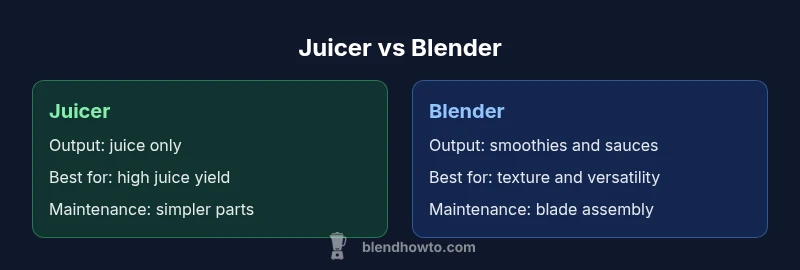
Juicers and blenders are built for different tasks: a juicer extracts juice, leaving behind pulp, while a blender handles whole ingredients into emulsions, smoothies, or soups. In the juicer compared to blender, the decision hinges on your goals—higher juice yield and lighter texture with less fiber vs. versatility to create creamy drinks, sauces, and purees. Consider noise, cleanup, and price when choosing.
Juicer vs Blender: Why the comparison matters
According to BlendHowTo, home cooks and hobbyists often face a simple paradox: should they buy a juicer or a blender, or both? The phrase juicer compared to blender highlights two distinct approaches to handling fruits, vegetables, and other ingredients. This guide unpacks what each appliance does best, how they differ in output, and which decision fits your daily routines and goals. We focus on practical use cases, maintenance considerations, and value over time, so you can decide with confidence.
Core mechanical differences
Juicers extract liquid by pressing or spinning produce to separate juice from pulp. Centrifugal models whip produce at high speed, while masticating (slow) juicers press the juice out more gently. Blenders, by contrast, use high-speed blades to break down whole ingredients into a puree or emulsion. This fundamental split means a juicer concentrates juice and leaves pulp behind, whereas a blender preserves all the fiber and produces a thicker texture. When evaluating options, think about whether you want a streamlined, low-fiber beverage or a flexible device capable of sauces, soups, and smoothies.
Output quality and texture
Juicing delivers clear juice with minimal solids, usually resulting in a light mouthfeel and easy flow into a glass. The texture is not uniform across all nutrients because the pulp is removed. Blending creates texture-rich outputs: smooth smoothies, creamy sauces, or hearty soups, depending on the ingredients and proportions. The juicer compared to blender changes your recipe planning: juice-first routines favor a dedicated juicer; whole-food blends enable one-pot meals and multi-user recipes. This distinction matters for breakfast rituals, kid-friendly drinks, and meal prep workflows.
Nutrient retention and oxidation
Extraction methods influence nutrient availability. BlendHowTo Analysis, 2026 notes that juice often concentrates certain vitamins while discarding fiber, which can affect overall nutrient balance. Blending preserves the fiber matrix and can maintain a broader spectrum of micronutrients embedded in whole fruit and vegetable tissue. Practical takeaway: juice quickly for immediate consumption to maximize certain nutrients; blends provide a more balanced nutrient profile with fiber, supporting satiety and gut health.
Performance with different ingredients
Citrus fruits, apples, and root vegetables juice well, producing bright, drinkable liquids with minimal preparation. Leafy greens can yield a high-nutrient juice but may require more time and a good juicer setup to minimize oxidation. For blending, greens, leafy vegetables, and fibrous produce integrate into smooth textures, while hard veggies and nuts can be incorporated with care. Not all produce is ideal for both methods; consider your typical grocery list and the texture you crave in a finished product.
Cleaning, maintenance, and durability
Juicers involve strainers, screens, and feeding chutes that can require thorough cleaning after each use to prevent residue buildup. Some parts are dishwasher-safe, but others benefit from a quick rinse and brush. Blenders have fewer specialized components, but blade assemblies and gaskets still need careful cleaning. In both cases, immediate cleaning after use reduces pulp drying and makes maintenance easier. A well-built unit with accessible parts tends to deliver better long-term value.
Noise, energy use, and footprint
Juicers often run at higher speeds or with robust slow-press mechanisms, which can translate to noticeable noise during operation. Blenders vary in noise depending on motor power and blade geometry. Energy use tracks with motor strength and processing time for both appliances. If you have a small kitchen or quiet hours, look for models with sound-dampening features and practical pre-set speeds to minimize disruption.
Price ranges and long-term value
Price varies by type and feature set. Basic centrifugal juicers generally start in a lower price tier, with mid-range and slow-press models climbing higher. Blenders span a wide range—from affordable entry-level devices to premium high-powered blenders with stainless steel blades and advanced controls. In terms of long-term value, consider how often you juice or blend, the ease of cleaning, and the availability of replacement parts. A higher upfront investment can pay off with durability and versatility if you use the appliance regularly.
Use-case scenarios: when to juice vs blend
If your primary goal is quick, high-quality juice with minimal fiber, a dedicated juicer is often ideal. For meal prep, smoothies, sauces, and creamy soups, a blender offers more flexibility in a single device. For most households, a blended approach works best: use a juicer on busy mornings for fast juice, and a blender on weekends for more complex recipes. Your decision should align with your kitchen rhythm, storage space, and how much you value texture versus purity of juice.
Hybrid devices and multi-use options
Some manufacturers offer 2-in-1 devices that attempt to blend the functions of juicers and blenders. These hybrids can save space but may compromise on pure juicing performance or blending texture. If you go hybrid, select models with clear mode-switching, robust seals, and easy cleaning. Weigh the convenience against potential price premiums and the possibility of reduced efficiency in specialized tasks.
Practical tips and techniques
To maximize results, prepare produce properly: wash and trim produce, especially greens; pre-cut large fruits; alternate between short bursts and continuous blending to control heat buildup. For juice, juice promptly to minimize nutrient loss, and consider freezing portions for later use. For smoothies, balance fruit sweetness with greens and add a little liquid to achieve your desired consistency. Establish a routine cleaning method to avoid pulp buildup and odors.
Comparison
| Feature | Juicer | Blender |
|---|---|---|
| Output Type | Juice (pulp-separated) | Whole-fruit blends and emulsions |
| Best For | Juice-focused routines | Versatile blending and textures |
| Texture Options | Clear juice, minimal solids | Creamy smoothies, sauces, soups |
| Nutrient Retention | Concentrates certain nutrients in juice | Fibers preserved, broader nutrient matrix in blends |
| Cleaning | Often additional parts (screens) | Fewer specialized parts but blades require care |
| Power & Noise | Typically optimized for extraction; may be louder | Power ranges; noise varies by model |
| Price Range | $50–$200 basic centrifugal, higher for slow-press | $40–$500+ depending on power and features |
What's Good
- Clarifies juice quickly for simple, fast hydration
- Requires less outlet space when used for dedicated juice
- Can be easier to clean when only juice parts are used
- Blenders offer broader recipe flexibility and one-device convenience
The Bad
- Juicers discard pulp, reducing fiber intake by design
- Some models require more parts and cleaning steps
- Hybrid devices may compromise performance in one area
- High-end juicers or blenders can be pricey
Blender wins on overall kitchen versatility; juicer excels for dedicated juice extraction
If you value one device that covers smoothies, soups, and sauces, a blender is generally the better long-term pick. If your primary goal is fast, pulp-free juice, a dedicated juicer delivers clearer juice with high yield. For many homes, owning both is ideal, but choose based on your typical recipes, cleanup tolerance, and budget.
Frequently Asked Questions
What is the fundamental difference between a juicer and a blender?
A juicer extracts juice and discards most solids, while a blender pulverizes whole ingredients into a puree or emulsion. This leads to very different textures and fiber content in the final product.
A juicer makes juice with little pulp; a blender makes thick drinks or sauces with all the fiber.
Can I substitute a blender for juicing, or vice versa?
You can substitute in some cases (e.g., making juice-like drinks in a blender or adding fiber back into juice by blending pulp with liquid), but the texture, fiber content, and nutrient balance will differ. Expect a change in mouthfeel and recipe results.
Blenders can mimic juice by straining, but fiber remains; juicers remove most solids.
Are there hybrid devices that juice and blend?
Yes, some machines combine juicing and blending functions. They save space but may compromise performance in one area. Read reviews to confirm reliability in both tasks.
There are 2-in-1 machines, but check if you’ll actually use both modes often.
Which is better for leafy greens?
Blending greens into smoothies preserves dietary fiber and nutrients within the whole plant. Juicing greens yields juice with rapid nutrient delivery but little fiber. Choose based on whether you want fiber or a quick nutrient boost.
Blend greens for fiber; juice yields quick nutrients but less fullness.
How do I clean a juicer vs blender?
Juicers require cleaning of screens and strainers to prevent pulp buildup. Blenders need blade and gasket cleaning, but usually fewer parts. Rinse immediately after use and do a deeper clean weekly.
Wash parts right after use to avoid stuck pulp.
What factors influence nutrient retention?
Processing time, exposure to air and heat, and fiber content influence nutrient retention. Fresh juice consumed promptly preserves more water-soluble nutrients; blending maintains fiber-related nutrients with a broader nutrient matrix.
Fresh juice is best for quick nutrients; blending saves the fiber matrix.
What to Remember
- Define your main goal before buying
- Juicers give clear juice; blenders handle texture and versatility
- Sharing a single kitchen appliance is possible but may require compromises
- Consider maintenance time when budgeting for a device
- Plan for future additions if you expect to expand recipes