Blender Model Download: Find, Verify, and Import 3D Assets
Master safe Blender model downloads with license checks, formats, and import steps. A practical BlendHowTo guide for sourcing, verifying, and importing 3D assets in Blender.


In this guide you will learn how to locate reliable Blender model download sources, evaluate license terms, and import assets into Blender without headaches. You'll understand common formats, licensing basics, and safety steps to avoid malware. By following practical steps from BlendHowTo, you’ll build a reusable workflow for sourcing models that fit your project needs.
Why quality Blender model downloads matter
Quality matters because a good model saves time and improves final renders. A poorly structured mesh can cause shading artifacts, topology problems, and animation glitches. This is especially true when working on close-up renders or character rigs where every edge counts. According to BlendHowTo, the best Blender model download workflows start with a quick quality check before you download. Look for clear texture sets, proper UV maps, and well-documented materials. The keyword blender model download should appear often in your workflow as you vet assets, especially when building a project library. In practice, you’ll notice that high-quality downloads include well-organized geometry, consistent scale, and embedded texture maps. Investing in vetted assets reduces rework and helps maintain visual consistency across scenes.
Where to find reliable Blender model downloads
Finding trustworthy sources requires a blend of discipline and curiosity. Start with platforms that clearly display license terms, provide texture maps, and show previews of the asset. BlendHowTo’s analysis shows that reputable sources label licenses plainly, include attribution guidance, and offer multiple formats (e.g., .blend, .fbx, .obj). When you search for blender model download, apply filters for license type, polygon count, and texture quality. Avoid sites that hide licensing details or rely solely on user-uploaded previews. Establish a small set of go-to sources and test new assets on non-critical projects to gauge compatibility and performance. A well-curated list speeds up future work and reduces licensing confusion, helping you stay compliant and efficient.
Licensing basics for Blender models
Licensing often governs how you can use a downloaded model. Common terms include permissive licenses like CC0, attribution-required licenses, or commercial-use permissions with or without attribution. Always read the license text and check whether textures are included. Some licenses permit modification and redistribution; others restrict commercial use or require attribution. If terms are unclear, contact the author for clarification. BlendHowTo recommends prioritizing models with clear, permissive licenses for commercial work to minimize risk and maximize reuse. Tracking license types in a personal catalog keeps your projects compliant and organized, reducing the chance of accidental misuse.
Understanding file formats and import workflow
Blender handles many formats, with .blend, .fbx, and .obj being the most common. Each format has trade-offs: .blend preserves scene data but is Blender-specific; .fbx supports animation and rigging across apps, while .obj is widely supported and texture-ready but may exclude materials. Before importing, unzip archives to a dedicated project folder and verify that textures accompany geometry. In Blender, go to File > Import and select the appropriate format, then re-link textures if needed. Keeping a consistent import workflow ensures predictable results across projects and reduces troubleshooting time when you scale your asset library. A thoughtful blender model download strategy includes ensuring compatibility with your Blender version and render engine.
Safe downloading practices and malware risks
Untrusted sources can harbor malware, corrupted models, or hidden scripts. Always scan downloads with up-to-date antivirus software, verify checksums if provided, and inspect the archive structure before extracting. Prefer packages with a single top-level folder that contains textures, materials, and a license file. Avoid executables and installers bundled with model files. Keep Blender updated to address security vulnerabilities and enable default file safety checks during import. Safe practices protect your system and maintain project integrity, especially when you rely on a blender model download in collaborative workflows.
Practical sources and how to verify credibility
Begin with official marketplaces or curated repositories that emphasize licensing clarity and asset quality. When you search blender model download, use filters for license terms, polygon count, texture quality, and compatibility. If you experiment with community-driven sites, review contributor reputations, update frequency, and user feedback. BlendHowTo’s research suggests pairing a core set of trusted sources with periodic audits of imported assets to keep your library reliable and up-to-date. This approach minimizes compatibility surprises as you scale your library across multiple Blender projects.
Importing textures, materials, and rigging considerations
When a model includes textures and materials, you must verify that image textures are properly linked or embedded. If textures aren’t embedded, you’ll need to reconnect image textures in the Shader Editor and verify color management settings. For rigged characters, check bone orientation, weight painting, and compatibility with your Blender version. If rigging isn’t ready, you can export the rig separately or apply non-destructive modifiers to approximate motion. A well-prepared blender model download integrates smoothly with your existing materials and scene lighting, ensuring consistent results across renders and animations.
Quick start workflow: find, verify, download, import
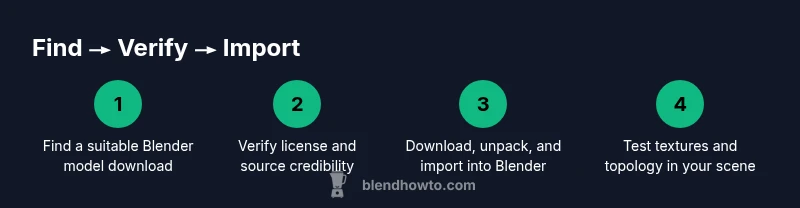
A practical flow you can reuse begins with a focused search for blender model download and license-aware filtering. Next, verify the source credibility and license terms before downloading. Inspect polygon counts and topology to anticipate performance in Blender, and ensure textures are included or easily relinkable. After downloading, extract the package to a dedicated folder, import the model in Blender using the correct format, and confirm that materials and textures align with your scene. This repeatable workflow becomes a reliable backbone for assembling a personal model library that scales with your projects.
Best practices for library management and future-proofing
Create a local, well-organized library with folders for project, license, and asset version, plus a simple changelog. Regularly prune unused assets to conserve storage and keep backups. When you build a blender model download library, you save time and reduce licensing confusion across teams. Establish naming conventions, maintain license notes, and schedule periodic reviews of assets to reflect updates in licenses or textures. A disciplined approach enables faster iteration and more consistent results across Blender projects.
Tools & Materials
- Computer or laptop with Blender installed(Blender 3.x or newer recommended; enable GPU acceleration if available)
- Stable internet connection(For downloading assets and licenses securely)
- Storage space(Adequate free space for assets; consider 10–20 GB buffer)
- Archive extraction tool(7-Zip or similar to unpack downloaded archives)
- License tracking sheet(Spreadsheet or note system to log license terms per asset)
Steps
Estimated time: 30-60 minutes
- 1
Identify target asset
Define the asset you need (character, prop, environment) and search using precise keywords, including 'blender model download'. Check initial previews and scale compatibility with your project. This step saves time by filtering out ill-fitting assets early.
Tip: Start with low-poly tests to verify topology and performance before committing to a high-poly model. - 2
Check license and usage rights
Open license terms and note whether the asset supports your intended use (personal/commercial, attribution, modification). If terms are unclear, contact the author for clarification. Record the license in your tracking sheet for future reference.
Tip: Prefer licenses that explicitly permit commercial use without attribution for easier reuse. - 3
Download from a trusted source
Choose a reputable source with visible license terms, recent updates, and texture sets. Download the asset package to a dedicated folder and verify the archive structure before extracting.
Tip: Avoid sites that require login without showing license details or offer only thumbnails. - 4
Unpack and organize files
Extract the package to a project folder and maintain a clean hierarchy (models/, textures/, licenses/). Preserve the original textures and ensure they’re properly named to match the model.
Tip: Keep a copy of the license file in the same folder for quick reference. - 5
Import into Blender
Open Blender and use File > Import to bring in the asset in its correct format (.blend/.fbx/.obj). Check scale, orientation, and coordinate systems to align with your scene.
Tip: Import with minimal transforms first; adjust scale in the scene properties rather than the object to avoid distortion. - 6
Verify geometry and textures
Inspect topology, shading, and UV maps. If textures aren’t embedded, relink them in the Shader Editor and confirm color management settings for consistent renders.
Tip: Use a simple lighting setup to validate texture fidelity quickly. - 7
Optimize and adjust materials
If performance is an issue, consider decimation, re-baking textures, or simplifying materials. Ensure asset compatibility with your render engine and scene scale.
Tip: Document any material tweaks for future projects and library reuse. - 8
Save to library and document license
Store the asset in your organized library with a clear filename and a note about the license, attribution requirements, and source. This makes future re-use fast and compliant.
Tip: Create a quick metadata file (JSON/CSV) to capture license, source URL, and version.
Frequently Asked Questions
What counts as a high-quality blender model download?
A high-quality download has clean topology, proper UVs, complete textures, and a clear license. It imports with minimal fixes and renders reliably.
A high-quality blender model download has clean topology, full textures, and a clear license.
Can I use free Blender models for commercial projects?
Yes, if the license permits commercial use and attribution requirements are followed. Always verify licensing terms before use.
Yes, as long as the license allows commercial use and you follow the terms.
Which formats should I prefer when downloading models?
Prefer .blend for Blender-specific data, or formats like .fbx and .obj for cross-application workflows. Textures should be included or easily relinkable.
Choose .blend, or cross-compatible formats like .fbx or .obj with textures included.
How do I verify a model's license quickly?
Read the license file provided with the asset, check for attribution or commercial-use terms, and contact the author if unclear.
Read the license and contact the author if terms are unclear.
What about textures and materials if they’re missing?
If textures aren’t embedded, relink or bake textures in Blender. Check material nodal setups to ensure consistent rendering.
Relink textures and confirm materials in Blender.
How do I import assets into Blender correctly?
Use File > Import and select the correct format, adjust scale, and verify that textures and shading import properly.
Use Blender's Import tool, then adjust scale and shading.
Watch Video
What to Remember
- Identify asset needs and license terms before downloading.
- Choose reputable sources with clear licensing for blender model download.
- Import, verify, and organize assets in a repeatable workflow.
- Maintain a license-aware library for faster, compliant future work.