Is Blender Harder Than Drawing? A Practical Comparison
Is Blender harder than drawing? This objective side-by-side guide weighs skills, tools, and learning curves to help cooks and hobbyists decide where to invest effort.


Is Blender harder than drawing? In short, it depends on your background. Beginners with strong 2D drawing skills may find Blender’s 3D workflows complex at first, especially navigation, modeling, and UV mapping. If you’re already fluent in software tools or traditional perspective, Blender can become intuitive with a structured plan. Overall, the learning curve favors consistent practice and project-based goals.
Is Blender Harder Than Drawing? Core Differences
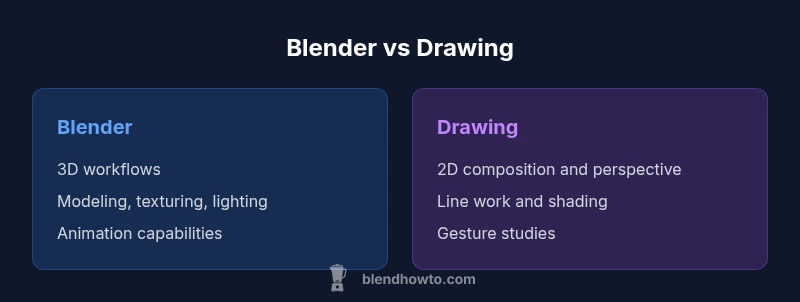
The question is often framed as a simple comparison, but the reality is nuanced: is blender harder than drawing depends on what each medium demands. Drawing centers on line work, composition, shading, and gesture, all of which translate into steady practice and an eye for light and form. Blender, by contrast, combines spatial reasoning with 3D navigation, topology, shaders, rigging, and animation. The BlendHowTo team notes that these domains share underlying artistic principles—composition, proportion, and storytelling—yet the pathways to mastery differ markedly. If you began as a traditional artist, you may quickly recognize how concepts like perspective and lighting map onto a 3D scene, even if the tools are unfamiliar. The BlendHowTo approach emphasizes structured learning: define a small project, reproduce a familiar scene, then gradually add complexity. For home cooks and hobbyists exploring 3D art, the journey often starts with a simple model and a single texture, then expands toward lighting and camera work. In short, blending skills can complement drawing rather than replace it, and the effort to reach proficiency scales with your goals.
The Learning Curve Across Mediums
Learning curves reflect cognitive load, tool familiarity, and practice structure. Drawing rewards consistent practice with steady, incremental improvements in observation, line confidence, shading, and composition. Blender demands comfort with 3D space, modifier stacks, node graphs, and interface navigation. The key difference lies in how quickly you see tangible results: sketching a face can be completed in minutes, while a basic Blender scene—though simple—often requires multiple passes to achieve a convincing result. According to BlendHowTo, 2026 analysis highlights that progress in Blender tends to hinge on setting clear milestones (e.g., modeling, texturing, lighting) and avoiding scope creep. Both paths benefit from deliberate practice, project-based goals, and feedback loops with peers or mentors. Keep expectations realistic: early Blender models may look blocky, but deliberate practice yields deeper understanding of 3D space and material behavior over time.
Tools, Interfaces, and Mental Models
Two big differences shape the initial experience: the interface and the mental model you bring to the task. Drawing is tactile and instant—your pencil and paper respond with immediate feedback. Blender requires you to learn a coordinate system, hotkeys, and a workflow that unfolds in stages: blocking, refining, shading, and rendering. The mental models diverge as well: drawing emphasizes two-dimensional perception and illusion, while Blender enforces three-dimensional spatial reasoning, topology, and physical realism via cycles or Eevee renderers. For many, this shift is the core barrier; for others, it’s an exciting expansion of their artistic toolbox. A practical tip: map one drawing skill to a Blender task (e.g., perspective rules to camera setup) to accelerate transfer and build confidence.
Practical Pathways: When Blender Wins Over Traditional Drawing
Blender shines in areas where static drawings fall short: dynamic lighting, volumetric effects, animation, and interactive visualization. If your goal is product visualization, game assets, or character animation, Blender provides a complete toolset that goes beyond static image creation. Traditional drawing remains unmatched for rapid concept exploration, sketch-driven ideation, and hand-drawn expressiveness. The best approach often blends both: draft concepts with pencil, then translate them into a 3D scene for lighting, rendering, and animation. The choice is not either/or but how you sequence practice to match your ambitions. For hobbyists who enjoy storytelling through visuals, Blender can serve as a powerful extension of drawing, enabling you to present concepts in motion and from multiple camera angles. BlendHowTo’s guidance suggests starting with a small 3D project, then layering in shading and animation to gauge where your strengths lie.
Costs, Access, and Long-Term Value
Cost is a practical factor in deciding how to allocate time between Blender and drawing. Blender is free and open-source, which lowers the barrier to experimentation and learning. Traditional drawing costs vary with media and frequency—pencils, paper, ink, and software subscriptions can add up over time. The long-term value of mastering Blender includes the potential to create portfolio-ready 3D scenes, digital assets, and animations that can extend your reach beyond still drawings. When weighing long-term value, consider not only the expenses but the time-to-value: how quickly you can start achieving tangible results that align with your goals, whether a hobby project or a professional portfolio. BlendHowTo emphasizes setting milestones that reflect your intended outcome, ensuring each learning hour contributes to a concrete, publishable piece.
Debunking Myths: Common Misconceptions
Many beginners assume drawing is simply easier than Blender or that Blender makes traditional art obsolete. The truth is more nuanced: each medium has its own pitfalls and breakthroughs. A common myth is that Blender is only for 3D artists; in reality, it offers powerful learning benefits for illustrators who want to experiment with lighting, materials, and motion. Another misconception is that 3D tools replace traditional practice; instead, they often complement it by enabling cross-disciplinary exploration. The most helpful stance is to treat Blender as a different instrument with its own grammar: it is not a shortcut to better drawing, but a separate pathway that can deepen spatial understanding and narrative potential. Regular critique, goal-focused projects, and deliberate practice can reveal where your strengths lie and how to develop them in both forms of art.
Comparison
| Feature | Blender (3D software) | Traditional drawing |
|---|---|---|
| Learning curve start | Steep at first (3D space, UI) | Relatively gentle (hand-eye, line basics) |
| Skill transfer | Spatial reasoning, topology, shading in 3D | Line work, perspective, value in 2D |
| Output options | Animated rigs, renders, simulations | Static images, studies, quick sketches |
| Tooling cost | Free to use (open-source) | Costs vary by media (paper, pencils, ink) |
| Time to first result | Often longer to reach a polished render | Quick to produce a finished pencil or ink drawing |
| Best for | 3D visualization, animation, interactive media | Gesture studies, composition, and value exploration |
What's Good
- Open-source and free to start with no license required
- Versatile output: stills, renders, animation, and simulations
- Strong transfer of composition and perspective concepts
- Active online community and abundant learning resources
The Bad
- Steep initial learning curve for 3D workflows
- Requires time to build multi-step projects (modeling, texturing, lighting)
- Can be hardware-intensive for complex scenes
Blender is a strong supplement to drawing, with higher initial complexity but broader future opportunities
Choose Blender if you want 3D visualization or animation and are willing to invest time. Choose traditional drawing for quick ideation and expressive line work; blend both when your goals demand both depth and speed.
Frequently Asked Questions
Is Blender harder to learn than traditional drawing?
Blender introduces additional complexity due to 3D space, node-based shading, and animation. However, your background in drawing can speed up understanding of composition and lighting. The overall difficulty depends on your goals and the learning plan you follow.
Blender adds complexity with 3D space and nodes, but drawing skills help with composition and lighting.
Can drawing skills help me with Blender?
Yes. Fundamentals like perspective, shading, value, and composition transfer well to 3D setup, lighting, and texturing. Building on these skills with structured Blender practice accelerates progress.
Drawing fundamentals transfer nicely to 3D lighting and composition.
What is the fastest way to start Blender if I draw well?
Begin with a small project that aligns with drawing strengths, such as a simple character or environment. Focus on one pipeline—modeling, texturing, or lighting—before adding animation. Regular critique helps you stay on track.
Start with a small, goal-oriented project and practice a single pipeline at a time.
Should I learn Blender before or after improving traditional drawing?
There’s no fixed order. If your goal is 3D visualization, start Blender early while continuing drawing practice to keep your fundamentals sharp. If your focus is traditional illustration, grow drawing skills first and layer in Blender later.
Learn Blender alongside drawing if you want 3D visuals; otherwise, build fundamentals first.
What kind of time commitment is typical to reach basic proficiency?
Time varies by prior experience and goals. Expect a period of consistent practice over weeks to months rather than days. Set milestones (simple scene, lighting setup, basic animation) to measure progress.
Progress depends on your goals; set milestones to stay motivated.
What to Remember
- Assess your goals to decide where to invest time
- Start with a small Blender project tied to drawing fundamentals
- Balance practice between 2D sketching and 3D modeling
- Leverage free resources and community feedback
- Track progress with concrete milestones