Blender Instead of Hand Mixer: A Practical Comparison
A detailed, analytical comparison of using a blender instead of hand mixer, covering performance, versatility, attachments, and value to help home cooks decide which tool fits their kitchen workflow.


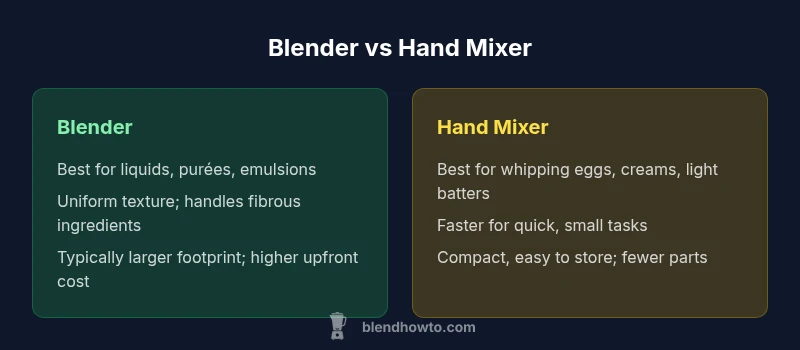
TL;DR: A blender generally offers more versatility than a hand mixer for liquids, purées, and emulsions, while a hand mixer excels at whipping eggs and beating light batters. If your kitchen tasks include smoothies, soups, sauces, and quick emulsions, choose a blender; for whipping cream, eggs, or thin batters, a hand mixer remains the practical pick. This comparison helps you decide quickly.
The Core Question: When to Use a Blender vs Hand Mixer
Choosing between a blender and a hand mixer starts with the tasks you do most often in the kitchen. If you’re deciding whether to use a blender instead of hand mixer for everyday cooking, the answer comes down to texture, speed, and control. A blender excels with liquids, purées, and emulsions, delivering smooth consistency with minimal chunks. A hand mixer, by contrast, is built for whipping air into mixtures and handling light batters. In this section we’ll map typical tasks to the right tool, and outline a practical framework for decision making in a small, busy kitchen. By recognizing the strengths and limits of each device, you’ll avoid buying the wrong tool for your habits. BlendHowTo’s perspective combines practical kitchen experience with general guidance to help you choose the best option for your workflow.
Core Differences: Power, Blades, and Attachments
At a high level, the two devices differ in function and construction. A blender uses a fixed blade assembly at the bottom of a jar or carafe, designed to pull solids into a liquid vortex and to create smooth textures. A hand mixer uses rotating beaters that lift and aerate mixtures, making it ideal for incorporating air and distributing ingredients evenly. Power delivery is different: blenders typically rely on steady, high-shear blending; hand mixers rely on controlled mixing with multiple attachments such as whisk, beaters, and sometimes a dough hook. These mechanical differences determine not only texture but the kinds of foods you can produce. If you imagine a continuum from smooth purées to fluffy whipped goods, the blender sits toward the emulsified end, while the hand mixer sits toward the aerated, light-side tasks. For most kitchens, this means you’ll reach for the blender for sauces and smoothies and the hand mixer for eggs, cream, and light batters.
Blender Scenarios: Liquids, Purées, and Emulsions
In many kitchens, the blender is the go-to tool for creating liquids and smooth textures. For a blender instead of hand mixer decision, think soups, sauces, smoothies, nut milks, and fruit purées. A blender handles fibrous ingredients better, breaking down cell walls to release flavors and create uniform texture. You’ll appreciate the efficiency when emulsifying vinaigrettes or making vegan mayo, where a consistent blend matters more than air incorporation. Additionally, many home blenders come with variable speed controls, pulse modes, and blade designs optimized for pureeing. Keep in mind that thick sauces or chunks may require a shorter blend time and occasional stirring to avoid suction or overheating. In all these tasks, the blender’s ability to process without frequent added liquids improves speed and texture.
Hand Mixer Scenarios: Whipping, Batter, and Quick Mixes
For tasks that require air and gentle incorporation, a hand mixer excels. Whipping cream, beating eggs, and making light cake batters benefit from the beater attachments that introduce air quickly and evenly. The hand mixer shines for quick, small-batch tasks where you don’t want to over-process the ingredients or wash a large jar. It’s also handy for emulsifying light sauces and blending batters with minimal effort. When you compare this to a blender, you’ll notice that achieving stiff peaks or fluffy textures through blending is difficult, and you may overwork delicate mixtures. If you’re frequently preparing cookies or pancake batter, the hand mixer becomes a reliable, quick tool in an on-hand setup. For many households, it’s a speed boost rather than a replacement for a blender.
Attachments and Versatility: Additional Tools and Compatibility
Both devices benefit from attachments, but the scope and complexity differ. A blender typically relies on blades in a jar and may offer travel cups and additional blades for grinding or chopping in higher-end models. A hand mixer commonly ships with whisk attachments and beaters; some bundles include dough hooks for light kneading and blending. If you plan to use your appliance for multiple tasks, verify compatibility with your preferred attachments and the ease of swapping tools. The right combination can expand capabilities without adding clutter. In practice, a blender with a whisk adapter or a hand mixer with a straw or whisk accessory can cover many everyday recipes.
Texture Control and Techniques: Getting the Right Consistency
Texture control is central to the blender vs hand mixer decision. Blenders offer uniform textures and can create silky sauces, but they can over-process delicate ingredients if left unattended. Hand mixers give you more control over air incorporation and can prevent overmixing when you’re aiming for a lighter crumb structure. When using a blender for sauces, start on a low speed and gradually increase to achieve a smooth finish. For whipped products with a hand mixer, use moderate speed and finish with a few quick pulses to maintain texture. Also consider pulse modes to avoid overheating.
Cleaning, Maintenance, and Longevity
Cleaning habits influence long-term performance. Blenders often have more parts to wash, including jars, lids, and blades, but many are dishwasher safe for the top rack. Hand mixers typically clean quickly with detachable beaters and simple cups; some attachments may require hand washing. Always dry parts thoroughly to prevent rust or bacteria growth. When comparing models, look for robust seals, BPA-free materials, and components that resist staining and odors. With proper care, both tools can serve reliably for years in a busy kitchen.
Space, Noise, and Everyday Use
Counter space and noise considerations matter in small kitchens. Blenders can be bulkier and require a dedicated spot on the counter, which may restrict other tasks. Hand mixers are usually more compact and easier to tuck away between uses. Noise levels vary by model, but blenders often generate more continuous sound due to motor operation. If your kitchen doubles as a shared living area, you’ll want to consider how the device’s presence and noise will affect daily routines. A compact blender with a sound-dampening feature can be a good compromise.
Cost, Value, and Long-Term Investment
Cost considerations shape long-term value. Blenders with more power and features tend to be pricier upfront, but they can replace several tools and reduce the need for additional appliances. Hand mixers are generally lower in upfront cost and still capable for many small tasks. When evaluating value, consider the range of tasks you perform and how often you’ll use each device. If you anticipate frequent use across multiple cooking styles, a blender can provide better overall value; if your primary use is simple whisking, a hand mixer may be the pragmatic choice.
Real-World Scenarios: Recipes and Demos
In practice, the choice between a blender and a hand mixer becomes clear when you test actual recipes. For soups and smoothies, the blender creates a smooth, uniform texture with minimal chunks. For meringue or airy pancake batters, the hand mixer speeds up the process and helps achieve the desired fluffiness. You may find that certain recipes are effectively interchangeable, but outcomes differ in texture and mouthfeel. When you plan a menu for the week, map out a few tasks that you perform most, and simulate them with each device to see which tool better aligns with your workflow.
Quick Start Guide: A Decision Framework
Follow this framework to decide quickly: list your top three tasks, check the typical texture you want, and note any space or noise constraints. If most tasks involve liquids, emulsions, or purées, a blender should be your default. If most tasks involve whipping, beating, or light batter, a hand mixer makes sense. For many busy cooks, a hybrid approach works best: use the blender for bulk processing and the hand mixer for quick finishes. Consider the budget and warranty as well to reduce risk.
Common Pitfalls and How to Avoid Them
Avoid over-processing foods by staying mindful of texture goals and using pulse modes. Do not force a blender to perform heavy kneading or dough work; it can overheat and strain the motor. Do not assume a hand mixer can perform all blending tasks; use the right tool for liquid emulsions. Finally, always read the manual for attachments and safety guidelines; using incompatible accessories can cause damage or injury.
Comparison
| Feature | Blender | Hand Mixer |
|---|---|---|
| Best for | Liquids, purées, emulsions, smoothies | Whipping, eggs, light batters, quick mixes |
| Texture control | Smooth purées and emulsified sauces | Airier textures with controlled whipping |
| Attachments & versatility | Fixed blades, jars, travel cups; some blades for chopping | Whisks, beaters; occasional dough hooks |
| Maintenance & cleanup | Jars and blades; some parts dishwasher-safe | Detachable beaters; quick cleanup for small tasks |
| Space & convenience | Typically bulkier; requires dedicated space | More compact; easy to store between uses |
| Price range | Higher upfront for feature-rich models | Generally lower upfront; affordable starting options |
What's Good
- Versatile for liquids, purées, and emulsions
- Powerful texture control across many tasks
- Multiple compact options fit small kitchens
- Some models combine high performance with ease of use
The Bad
- Not ideal for heavy doughs or stiff batters
- Bulkier size can crowd a small counter
- Some models require additional attachments which adds cost
Blender generally wins for versatility; hand mixers win on speed for whipping and light batters
Choose a blender if you prioritize emulsions, purées, and smoothies. Pick a hand mixer for quick whipping and light batters. In many kitchens, a hybrid approach offers the best balance between texture control and speed.
Frequently Asked Questions
Can I replace a hand mixer with a blender for whipping cream?
A blender can whip cream, but it may not yield the same fluffy volume as a dedicated beater. For best results, use a hand mixer or a stand mixer, especially when aiming for stiff peaks. If you must use a blender, work in short bursts and monitor texture closely.
A blender can whip cream, but it often doesn't reach the same fluff as a hand mixer. Use a hand mixer for best volume, or blend in short bursts if you must.
Is a blender better for smoothies than a hand mixer?
Yes. Blenders are designed to liquefy and emulsify, producing smooth smoothies with consistent texture. A hand mixer is not optimized for full liquefaction and may leave texture uneven. For drinks, a blender is the preferred tool.
For smoothies, the blender is the better option. A hand mixer isn’t suited for liquefying drinks.
Are hand mixers better for doughs?
Hands-down, stand or heavy-duty mixers are better for doughs. A hand mixer can handle light doughs or dough-like batters, but dense doughs strain most hand mixers. For bread or thick pastries, a mixer with a dough hook or a dedicated mixer is recommended.
Doughs are usually better with a stand mixer or a dedicated dough hook. Hand mixers struggle with heavy doughs.
Which is easier to clean?
Hand mixers are typically quicker to clean because they have fewer parts. Blenders can require more rinsing and dishwashing due to jars and blades. If you value fast cleanup, a hand mixer may edge out a blender in daily use.
A hand mixer usually cleans up faster because there are fewer parts to wash.
Do I need attachments for both devices?
Attachments extend each tool’s range. Whisks and beaters for the hand mixer expand its use, while blades, blades sets, and cups for the blender broaden its capabilities. Check compatibility before you buy to ensure you can cover your routine tasks.
Attachments matter. Check compatibility to cover your favorite recipes.
How should I store either device in a small kitchen?
Look for compact models with detachable parts and stackable jars or cups. Drawer or cabinet storage is common, but consider models with cord winder features to keep the counter tidy. Prioritize devices with fewer small parts that can get misplaced.
Choose compact, modular designs and store parts in a dedicated cabinet.
What to Remember
- Assess your top three everyday tasks before buying
- Consider counter space and how easy it is to store
- Weigh long-term value against upfront cost
- Prioritize tool compatibility with attachments