Blender Similar to Nutribullet: Quick Buying Guide
Compare Nutribullet-style blenders with high-powered alternatives to help home cooks choose the right model. Practical guidance, real-world use cases, and maintenance tips for long-term value.


For many home cooks, a blender similar to Nutribullet offers quick, single-serve convenience, while a high-powered blender delivers broader versatility for textures, batches, and tougher ingredients. This guide compares Nutribullet-style models with traditional high-powered blenders, highlighting which is best for your cooking habits, space, and budget. Read on to identify the model that aligns with your daily routines and goals.
Why Consumers Seek a Blender Similar to Nutribullet
The blender landscape has several compact, single-serve options designed for speed and convenience. A blender similar to Nutribullet appeals to home cooks who want a quick morning smoothie, a quick sauce, or a small batch of ice-cream alternative without dragging out a full-size blender. These models typically use short, sturdy cups with integrated blades and simple lids, making them approachable for beginners and perfect for small kitchens. In this guide, we compare Nutribullet-style models with traditional high-powered blenders to help you decide which fits your kitchen workflow, dietary goals, and budget. BlendHowTo's research shows that most users value ease of use, quick cleanup, and predictable results when blending soft ingredients. By understanding these priorities, you can determine whether a compact Nutribullet-like device suits your cooking style and daily routines.
Key Differences Between Nutribullet-style and High-Powered Blenders
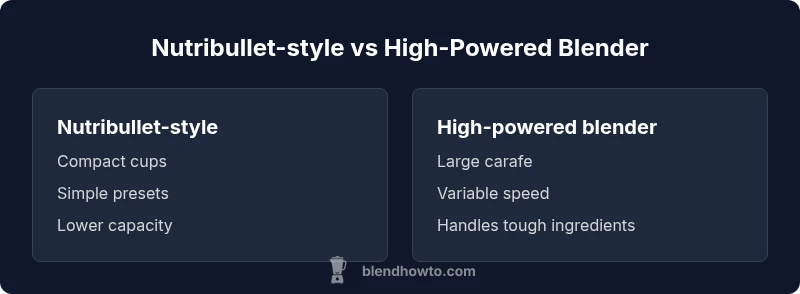
In broad terms, Nutribullet-style blenders emphasize convenience and portability, while high-powered blenders emphasize versatility and endurance. The key differences appear in four areas: power and blade design, cup/canister system, texture control, and expandability. Nutribullet-style units often use shorter, drop-in blade assemblies and smaller cups with built-in blending chambers. They excel at smooth, quick blends for soft ingredients and small batches. High-powered blenders rely on larger carafes, more robust blades, and variable speed controls that handle tough ingredients, ice, frozen fruit, and hot soups more reliably. This combination yields a broader range of textures and functions, from buttery nut butters to creamy soups. From BlendHowTo's perspective, the right choice depends on your cooking style, ingredient preferences, and how often you want to blend in bulk. We'll cover practical implications for everyday kitchen tasks and long-term cost considerations in the next sections.
How to Choose the Right Model for Your Needs
Consider your typical recipes and space constraints. If you mostly blend smoothies for one or two people and value speed, a Nutribullet-style blender can be a strong match. If you regularly puree dense ingredients, make nut butters, or cook soups, a high-powered blender offers greater versatility. Pay attention to capacity (cups versus carafe), ease of cleaning (dishwasher-safe parts, blade assembly design), noise level, warranty, and compatibility with accessories like travel cups or meal-prep jars. Also assess learning curves: some users appreciate preset programs, while others prefer manual control for precise textures. Finally, think about future-proofing: can you expand using additional jars or blades? Your answer to these questions will guide a well-balanced purchase.
Real-World Use Cases: Smoothies, Sauces, and Beyond
Sticky insights: Nutribullet-style blenders shine in quick morning routines. They blend fruit, leafy greens, yogurt, and seeds into smooth textures rapidly, with easy cleanup afterward. For sauces and dressings, they are convenient when you need a consistent emulsion without extra equipment. In contrast, a high-powered blender supports thicker smoothies, hot soups, nut butters, and frozen dessert bases, plus bulk prep for families. The texture control and torque allow you to hit chunky, creamy, or silky finishes. A practical tip: pre-cut hard ingredients and layer liquids and soft items to prevent clogs. With the right model, you can scale from personal servings to multi-serving batches while maintaining consistent texture.
Setup and Accessories: What to Buy and What to Skip
Weigh the cost of extras against usefulness. Start with a base unit and one or two cups or carafes, plus a blade assembly that matches your typical tasks. Travel lids and to-go cups are nice for on-the-go breakfasts. If you anticipate hot soups or delicate emulsions, check compatibility for heating via friction heat in the blender and ensure your pitcher is heat-resistant. For Nutribullet-like models, replacement blades and gaskets are common maintenance items; for high-powered devices, you may consider additional containers and a power-base upgrade if you expect heavy daily use. In either case, look for parts that are easy to replace and widely available.
Maintenance and Longevity
Keep blenders clean and free of solid buildup. Rinse blades immediately after blending sticky ingredients, and periodically remove the blade assembly to wash between threads. Check seals and gaskets for wear and replace as needed. Avoid running the blender with dry blades or overfilling beyond the max line, as this can gunk the motor and shorten life. Note that dishwasher temperature and cycle can affect plastics over time, so refer to the user manual for guidance on safe cleaning. With proper care, your blender can remain a reliable workhorse for years.
Common Pitfalls and How to Avoid Them
Underestimating capacity can lead to spills; overfilling is a frequent mistake, especially with dense ingredients. Skipping pre-cutting or not layering ingredients can leave you with uneven texture. Relying on presets exclusively may cause frustration; combine presets with manual control to achieve the exact texture you want. Finally, neglecting maintenance or using incompatible accessories can shorten life and void warranties. A mindful approach keeps you in control of results.
Quick Case Studies: Everyday Scenarios
Case A: A single-serve morning routine. A Nutribullet-style blender saves time with quick smoothies and a small footprint. Case B: Batch prep in a busy household. A high-powered blender handles larger batches, thicker soups, and nut butters, enabling weekend prep. These scenarios illustrate how different models serve different lifestyles and how to optimize your setup with minimal extra investment.
Final Thoughts: Best-Value Picks for Different Kitchens
Bottom line: For compact kitchens and quick single-serve blends, Nutribullet-like blenders offer excellent value with simple operation. If your kitchen routine includes batch cooking, varied textures, and heavier blending tasks, a high-powered blender provides broader capabilities and long-term versatility. Your best-value choice balances upfront cost, ease of use, and future-proofing.
Comparison
| Feature | Nutribullet-style blender | High-powered blender |
|---|---|---|
| Power/Blending Capacity | Moderate power, optimized for soft ingredients and quick blends | High power, handles ice, frozen fruit, and dense ingredients |
| Cup/Carafe System | Smaller cups with integrated blades | Larger carafe with separate blade assembly |
| Texture Control | Simple texture with presets | Wide range of textures with manual control |
| Ease of Cleaning | Fewer parts; straightforward cleaning | More parts; richer cleaning options |
| Best Use Case | Single-serve smoothies, light sauces | Batch prep, soups, nut butters, dessert bases |
| Price Range | Lower upfront cost | Higher upfront cost but broader capability |
| Upgrade Potential | Limited expandability | High expandability with accessories and jars |
What's Good
- Compact footprint suits small kitchens
- Lower upfront cost
- Faster cleanup for simple blends
- Easy to learn and use
- Widely available replacement blades and gaskets
The Bad
- Limited versatility for tough ingredients
- Small capacity may require batch blending
- Shorter lifespan for daily heavy use
- Fewer advanced features
Nutribullet-style blenders excel for quick, single-serve tasks; high-powered blenders win for versatility and bulk prep.
Choose a Nutribullet-like model for speed and simplicity. Choose a high-powered blender if you need more texture control and the ability to cook and prep in larger batches.
Frequently Asked Questions
What is a blender similar to Nutribullet best used for?
Best used for quick smoothies, small batches, and light sauces. It’s ideal when speed and convenience matter more than multi-tasking. For new users, the compact size reduces setup and cleanup time.
Great for quick smoothies and small recipes.
Ice and frozen fruit in Nutribullet-style blenders?
They handle ice and frozen fruit better than many basic devices, but you may need to blend in batches or crush chunks first to prevent clogging. Avoid dense ice when using ultra-short blends.
Yes for lighter ice tasks, but crush larger pieces first for best texture.
Are high-powered blenders worth the cost for home cooks?
If you frequently blend thick or large batches, they offer more versatility and better texture control. For occasional use, a Nutribullet-style model may meet your needs at lower cost.
Worth it if you need bulk prep and tougher textures.
What features matter most when buying a blender for smoothies?
Look for capacity, blade design, power, texture presets, and ease of cleaning. A model that balances these factors will handle daily smoothies with less fuss.
Focus on capacity, blades, power, and cleaning.
Do Nutribullet-like blenders require special jars or accessories?
Most use standard cups and blades, but check compatibility with replacement parts and lids. Accessory availability varies by brand and model.
Usually not, but verify part availability.
How long do these blenders last with daily use?
Longevity depends on maintenance and build quality. Mid-range models typically last several years with proper care and warranty coverage.
With good care, several years; follow the manual for maintenance.
What to Remember
- Identify your typical batch size and ingredient mix
- Prefer simple cleanup for busy mornings
- Weigh upfront cost against long-term versatility
- Check blade design and jar compatibility for future needs