Can a Blender and Food Processor Be Interchangeable? A Practical Guide
Explore when a blender and a food processor can substitute for one another, with task-by-task guidance, texture expectations, and a practical framework for choosing one or both.


Short answer: they aren’t strictly interchangeable, but they overlap enough for some tasks. A blender excels at smooth purées and beverages, while a food processor handles chopping, shredding, and dough-like mixing more efficiently. For quick substitutions, expect texture differences and watch for blade fit and capacity. When in doubt, use the right tool for the job to avoid uneven results.
Can a blender and a food processor be used interchangeably? The practical reality
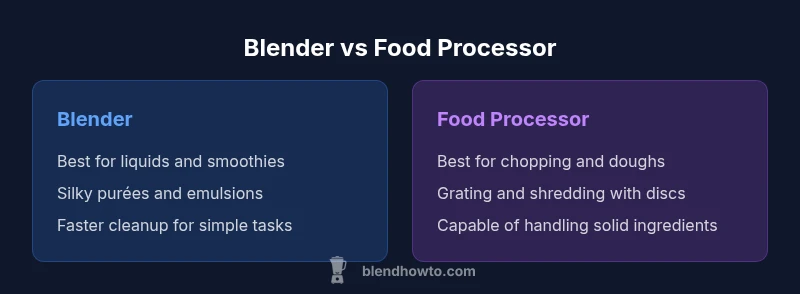
The short answer is nuanced. In many home kitchens, you can substitute one for the other for a subset of tasks, but the results will often differ in texture, consistency, and even processing time. The question can a blender and a food processor be used interchangeably hinges on you understanding what each appliance is optimized to do. Blend-only tasks like smoothies, milkshakes, and silky sauces typically lean toward a blender’s strengths, while chopping, shredding, grating, and dough-like mixing align with a processor. This guide uses the Blender vs. Food Processor framework to help you decide which tool to reach for, and when it makes sense to own both for maximum kitchen flexibility. BlendHowTo’s guidance emphasizes practical decision-making built on typical home-use scenarios so your recipes come out as you intend.
For those who regularly cook from scratch, the interchangeability question goes beyond one-off recipes. It’s about texture control, time efficiency, and the ability to handle different ingredients without over-processing. In the end, you may find that a carefully chosen set of tasks can be completed with a single device, but for more complex meals or batch work, owning both often saves time and preserves dish quality. This exploration nods to the BlendHowTo perspective: you gain predictability by matching the task to the tool, rather than forcing a blender to mimic a processor or vice versa.
-1lengthless further content?null
Comparison
| Feature | Blender | Food Processor | |||
|---|---|---|---|---|---|
| Primary function | Liquids and smooth textures | Chopped, shredded, grated textures | |||
| Best for | Smoothies, purées, emulsions | Chopping, kneading, heavy mixing | |||
| Blade design | Fixed blades for blending liquids | Interchangeable blades/discs for grating, shredding, chopping | |||
| Control and speed | Fewer precise texture controls; pulse common | More precise texture control; variable discs | ]},{ | feature | values3 |
| Capacity and size | Typically wider opening, taller carafe | Bowl capacity varies; can be compact or large | |||
| Cleanup & maintenance | Often easier to rinse; blades fully submerged | Discs and blades may require careful washing | |||
| Typical price range | $40-150 | $50-200 | |||
| Best for | Liquids, smoothies, purees | Chopped ingredients, dough, batters |
What's Good
- Clarifies task focus and texture goals upfront
- Helps you avoid over-processing or under-processing
- Guides efficient kitchen planning and storage
- Reduces trial-and-error in recipes
The Bad
- Limited cross-functionality can frustrate ambitious cooks
- Texture outcomes vary more with substitutions
- Buying both can be a bigger upfront investment
Own both for maximum kitchen flexibility; use each tool for what it does best to preserve texture and efficiency
Blenders excel at liquids and smooth textures, processors at chopping and dough-like tasks. When you need consistent texture across a range of recipes, having both is the most reliable approach. If you must choose one, pick based on your most frequent tasks, then consider a second tool for the remaining jobs.
Frequently Asked Questions
Can I use a blender to chop vegetables or nuts?
A blender can do rough chopping only in a pinch, but it often results in uneven texture and over-pureed bits. For consistent chopping, a food processor or a sharp chopping blade is preferable.
You can try rough chopping in a blender, but expect uneven texture. Use a processor for even results.
Is it safe to blend dough in a blender?
Most blenders aren’t designed for kneading dough or handling heavy, dense mixtures. Dough can overwork the blades and strain the motor. Opt for a stand mixer or a dedicated dough function if available on your appliance.
Dough isn’t ideal for a blender; use a mixer instead for best results.
Can I make smoothies in a food processor?
You can make smoothies in a processor, but you’ll likely get a thicker, chunkier texture and possibly more air. For classic smoothness, a blender is usually the better choice.
Smoothies are better in a blender for a truly smooth texture.
Do high-end models offer interchangeable blades for both tasks?
Some high-end models come with optional attachments or discs, but most blenders and processors rely on separate blade assemblies. Check compatibility and wattage before buying.
Some models have extendable options, but check compatibility before purchasing.
How do I clean both devices efficiently?
Rinse blades immediately after use, use warm soapy water for the blending jar or bowl, and consider a quick run with a capful of dish soap for the blender. Dry all parts thoroughly to prevent mold.
Clean parts promptly and dry well to keep blades sharp.
Should I buy one or both?
If you cook frequently and value texture control, both devices are worth it. If you must choose, pick the tool that covers your most common tasks first, then add the other as needed.
Choose the primary tool first, then add the other if your tasks demand it.
What to Remember
- Match tasks to tool strength for best texture
- Expect texture differences when substituting; plan ahead
- A two-gear approach (blender + processor) usually yields the best results
- Consider storage, budget, and the most frequent recipes when deciding