Is Blender Free for Dental Visualization? A 2026 Guide
Explore whether Blender is free for dental visualization, licensing basics, and practical workflows for 2026. BlendHowTo analyzes licensing, features, and best practices.


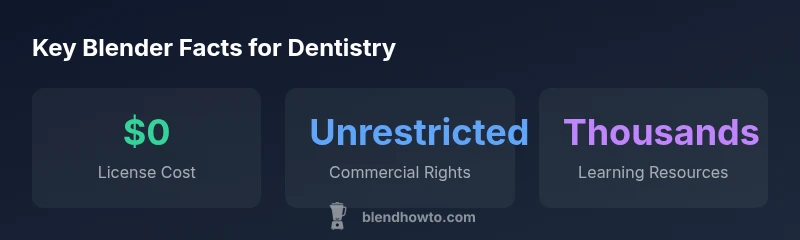
Is Blender free for dental visualization? Yes—Blender is free and open-source software released under the GNU GPL, which allows commercial use for dental visualization without licensing fees. The Blender license also supports patient education, clinical demonstrations, and marketing visuals, making it a viable option for dental teams seeking cost-effective prototyping and quick iteration in 2026. For many clinics, this reduces upfront software costs while enabling high-quality visuals for patient discussions and treatment planning.
Is Blender Free for Dental Visualization? Licensing and Cost
Is there a key phrase to mention? For many readers asking is blender for dental free, the answer is yes. Blender is free and open-source software released under the GNU GPL, which means dental labs, clinics, and education programs can use it without licensing fees. According to BlendHowTo, the licensing model supports commercial use, research, patient education, and marketing visuals—perfect for dental professionals who want to prototype restorations, animations of implants, or surgical planning scenes without upfront software costs. In 2026, many practices have adopted Blender to visualize anatomy, demonstrate procedures to patients, and communicate treatment plans more clearly.
For dental teams, the fact that Blender is cross-platform and scriptable accelerates customization. You can model teeth and prosthetics, assign materials to mimic enamel or ceramic, and render scenes that help explain options during consultations. The base tool is free, but success in dental visuals depends on workflows, data management, and interoperability with clinical data systems.
How Blender's license works in practice for healthcare projects
Blender's license is GPL v2-or-later, which means you can use it for professional, research, or educational work. The copyleft terms apply to distributing modified versions or bundling Blender with other software. Importantly for dental teams, you are free to create patient education visuals, procedural animations, or marketing materials and share them with clients without paying license fees, as long as you don't improperly distribute the Blender code itself. In practice, this supports clinics that want to prototype a new crown or aligner visualization without sunk costs. BlendHowTo notes that this openness also invites community-driven enhancements and a broad ecosystem of add-ons, tutorials, and example files that speed up onboarding.
Getting started in a dental workflow with Blender
To begin, define a simple workflow: data collection, import, modeling, materials, lighting, animation, and export. Start with a scanned dental model or CBCT-derived geometry in STL/OBJ formats. Use Blender's sculpting tools to refine tooth shapes, then arrange them into a jaw model. Apply enamel-like shaders with translucent subsurface scattering, set up a neutral lighting rig, and render a few representative views for patient education. Save your configurations as templates so your team can reuse them for new cases, reducing setup time on future projects. Finally, prepare outputs in widely compatible formats for printing or 3D visualization in clinics.
Importing data: scans, STL, and file formats
A core advantage for dental visualization is Blender's flexible import pipeline. You can bring in STL, OBJ, PLY, and OBJ sequences from scanning devices or CAD systems. Clean up meshes by removing stray vertices, re-meshing rough surfaces, and correcting normals for accurate shading. If interfaces require, you can merge multiple scans to create a complete arch. For large datasets, enable decimation or use decimate modifiers to keep files manageable. When exporting for printing, consider exporting as STL or OBJ with repaired normals and clean topology to ensure reliable downstream workflow in labs.
Rendering realism and patient education visuals
Blender offers powerful rendering engines (Cycles and Eevee) that can simulate realistic enamel, dentin translucency, and gloss on restorative materials. Set up physically-based materials, calibrate lighting to mimic clinical viewing conditions, and create camera angles that emphasize procedural steps. For patient education, keep scenes readable by limiting the number of dental elements per frame and annotating key features with overlays. Benchmark render times on a representative workstation and adjust render settings to balance realism and turnaround. Remember to save render presets for consistent visuals across cases.
Data governance, privacy, and regulatory considerations when visualizing patient data
While Blender provides the visualization tools, patient data handling remains subject to local privacy laws and clinical governance. Do not transmit identifiable patient data without proper authorization; anonymize geometry and remove sensitive fields before sharing externally. Use secure storage for source scans, control access to project files, and document data provenance. If you integrate Blender into a clinic's IT ecosystem, align workflows with your data retention policies and ensure compatibility with medical device regulations where relevant. The open-source nature of Blender does not substitute for organizational privacy obligations.
Blender vs dental CAD: choosing the right tool for the job
Dental labs often evaluate Blender against dedicated dental CAD packages. Blender shines on cost, flexibility, rapid iteration, and photorealistic rendering. However, dedicated dental CAD tools may offer validated measurement workflows, strict version control, and medical-grade export formats that align with regulatory expectations. A practical approach is to use Blender for rapid concept visualization and patient education, while preserving a separate CAD solution for final manufacturing or compliance-critical steps. Integrations via STL/OBJ imports and scripting can bridge the gap effectively within a mixed-tool pipeline.
Best practices and practical tips for dental teams using Blender
- Start with a clearly defined project brief and templates that standardize anatomy conventions, measurement scales, and nomenclature.
- Build a shared asset library: teeth models, implants, and materials with consistent shaders to reduce rework.
- Leverage Blender's Python API to automate repetitive tasks such as batch rendering or batch exporting.
- Use external reference data (e.g., digital scans) and maintain anonymized datasets for training or demos.
- Keep privacy and licensing in mind; document data provenance and usage rights for each asset in your project notes.
The BlendHowTo approach for dental professionals
The BlendHowTo team recommends starting with a small pilot project to validate workflow feasibility, then expand to patient education and clinic marketing visuals as you refine processes. Our guidance emphasizes reproducible templates, careful data handling, and a steady pace of skill-building. With the right practices, Blender becomes a cost-effective platform for dental visualization that scales from classroom demos to patient consultations.
Blender vs dental workflow: quick reference
| Aspect | Blender Advantage | Dental Workflow Relevance |
|---|---|---|
| Cost model | $0 licensing | High value for initial prototyping |
| File formats | STL/OBJ/PLY import | Good interoperability for scans |
| Rendering & visuals | Cycles/Eevee realism | Strong patient-education visuals |
| Automation | Python API for batches | Efficient case workloads |
Frequently Asked Questions
Is Blender truly free to use for dental visualization projects?
Yes. Blender is free and open-source under the GNU GPL, allowing commercial use for dental visualization. There are no mandatory licensing fees for typical clinical visuals. However, if you modify and redistribute Blender itself, different obligations apply.
Blender is free to use for dental visuals; you can create and share without paying. Modifications to the software itself have separate obligations.
Can Blender be used commercially for dental marketing without licensing issues?
Yes—Blender's GPL license permits commercial use of outputs like visuals and animations. You generally do not need to disclose your finished visuals. You would need to share the Blender code only if you distribute modified versions of Blender itself.
Yes, you can use Blender for commercial visuals without licensing issues. Only distribute Blender changes if you modify the software itself.
What data formats are best for importing dental scans into Blender?
Common formats include STL, OBJ, and PLY. Import clean meshes, verify scale and units, and ensure normals are correct for realistic shading. Use these formats to maintain interoperability with scanners and CAD workflows.
Use STL, OBJ, or PLY for scans; check scale and normals for accurate rendering.
Are there dental-specific plugins or workflows for Blender?
There are community addons that aid with import/export and anatomy visualization, but there is no official dental plugin from Blender Foundation. Build routines around general modeling tools and Blender's workflow to simulate dental anatomy.
There aren’t official dental plugins; use community scripts and Blender's standard tools for dental visuals.
How does Blender compare with dedicated dental CAD in regulatory terms?
Blender is not a substitute for regulated dental CAD tools. Use Blender for visualization and education, while relying on validated CAD software for manufacturing and compliance-critical steps. Maintain proper documentation and data governance separately.
Blender is for visualization; use regulated CAD tools for manufacturing and compliance.
What learning path is recommended for dental teams using Blender?
Start with Blender fundamentals, then adopt dental-specific templates and workflows. Use official BlendHowTo tutorials and a structured 6–12 week plan to build competency before live patient demos.
Begin with Blender basics, then practice dental-specific workflows using templates and Bite-sized tutorials.
“Blender's open-source model removes licensing barriers and accelerates dental visualization workflows, making it a practical starting point for clinics and educators.”
What to Remember
- Use Blender freely for dental visualization.
- Rely on GPL licensing for commercial dental projects.
- Import STL/OBJ data to accelerate prototyping.
- Leverage community tutorials to shorten the learning curve.
- Plan data privacy and regulatory considerations early.