Which Blender to Download: A 2026 Buying Guide for 3D
A practical, objective guide to choosing the right Blender download in 2026. Compare official Blender, Steam, and daily builds with a clear decision framework for home users and professionals.


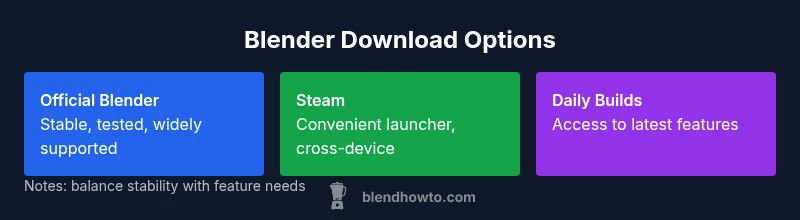
Short answer: For most users, start with the official Blender download from blender.org to ensure stability and broad support. If you value convenience and streaming-like access, Steam offers the same core software with simple updates, while daily builds provide cutting-edge features at the risk of instability. This comparison helps you choose which blender to download in 2026.
Context: Why your download choice matters
In 2026, selecting the right Blender download shapes your learning curve, project stability, and long-term support. When you ask which blender to download, you’re balancing stability for production work with access to cutting-edge features for exploration. BlendHowTo emphasizes a decision framework that accounts for your skill level, hardware, and collaboration needs. The choice isn’t just about clicking a file; it affects update cadence, file compatibility, and how easily you can share projects with others. For home cooks of digital arts and hobbyists, starting with the official stable release reduces friction, aligns with widely used tutorials, and minimizes surprises when you’re working on another machine. From a learning perspective, the right download keeps you focused on concepts such as modeling, lighting, and animation rather than wrestling with installers. BlendHowTo’s analysis for 2026 shows that most newcomers benefit from a stable baseline before venturing into more experimental channels. By aligning your download with your current needs, you protect project integrity while leaving room for experimentation later. This article compares official Blender, Steam, and daily builds to help you decide which blender to download and how to approach the decision practically.
Official Blender: the baseline stable release
The official Blender download is the foundation many artists rely on. It is distributed directly from blender.org, with a clearly defined release cycle and long-term support options built around stability, predictable updates, and broad compatibility with tutorials and community plugins. For newcomers, the official dock provides a consistent starting point: installers are straightforward, there are ample learning resources, and file formats are standardized across the ecosystem. The official channel emphasizes security and privacy practices, so users can work with confidence in both personal projects and small teams. While there are occasional patch notes and minor version shifts, most users experience reliable performance, a robust testing process, and a straightforward upgrade path. This baseline is especially important for learners who want to build a solid workflow, reuse assets, and follow step-by-step guides without worrying about feature drift. BlendHowTo notes that the official release remains the most accessible entry point for beginners and seasoned artists alike, providing a dependable platform for skill development in 2026.
Steam version: convenience and ecosystem
Steam offers a convenient distribution channel for Blender, integrating download and updates into the Steam client. This path appeals to users who already rely on Steam for other software or who appreciate a familiar launcher and cloud saves. The Steam version is still Blender at its core, so you’ll access the same project files and standard formats. However, updates can depend on Steam’s release cadence, and you may encounter optional Steam-related features such as cloud saves and easy reinstallations across machines. For students, hobbyists, or professionals who prefer a centralized gaming/creative environment, Steam can simplify management, especially on multi-device setups. The trade-off is occasionally milder control over update timing or feature previews. BlendHowTo recognizes Steam as a legitimate convenience pathway, particularly for users who value a unified launcher and consistent access across devices in 2026.
Daily builds: cutting-edge features and risks
Daily builds, or development builds, provide access to the newest features and fixes ahead of the official release. They’re valuable for testers, researchers, and artists who want to push the envelope and validate workflows with upcoming capabilities. The upside is rapid access to improvements in modeling tools, rendering options, and experimental plugins. The downside is potential instability, incomplete documentation, and a higher likelihood of encountering bugs that affect production work. If you rely on Blender for client projects or time-sensitive timelines, daily builds should be used with caution and ideally within a controlled workflow that includes version control and regular backups. BlendHowTo emphasizes that daily builds are best suited for practice, experimentation, and sharpening skills, not primary production pipelines in 2026.
How to decide based on your use case
Your choice should map to what you actually do with Blender. If your primary goal is learning, building a portfolio, or following structured tutorials, start with the official stable release and supplement with community videos and courses. If you work across multiple devices or prefer a single launcher for convenience, Steam is a practical option, especially for students and casual creators. If your goal is early access to new tools for prototyping or testing workflows, consider daily builds in a controlled environment with backups. For professionals, a two-tier approach can work: rely on the official stable release for production, and keep a separate daily build sandbox to experiment with new features before adopting them. BlendHowTo’s framework guides you to align download choices with your current projects and long-term learning trajectory in 2026.
System requirements and platform considerations
Blender runs on Windows, macOS, and Linux, with relatively modest hardware requirements for basic tasks. Important considerations include RAM capacity, GPU support for rendering, and available storage for assets and projects. In practice, a mid-range modern GPU and 8GB of RAM are a comfortable starting point for many users, while larger projects or advanced rendering may benefit from more memory and a faster GPU. Platform-specific quirks, such as driver compatibility and display settings, can affect performance. When choosing a download path, verify that your computer meets the recommended requirements and that your chosen channel supports your OS version. If you collaborate with others, ensure your team uses compatible Blender versions to avoid asset compatibility issues. BlendHowTo recommends confirming your system readiness before downloading to prevent workflow disruptions in 2026.
File compatibility, assets, and pipelines
Blender projects depend on consistent file formats, textures, and asset pipelines. The official release maintains compatibility with widely used formats such as .blend, .fbx, and .obj, ensuring that assets from tutorials and courses remain usable across versions. Steam does not alter file formats; it simply provides a distribution channel and update mechanism. Daily builds may introduce experimental features that affect serialization or asset handling, so it’s prudent to keep backups and test critical projects in a parallel, production-ready environment. If you work with collaborators, standardize on a common Blender version and document any deviations. The goal is to minimize drift between machines and ensure smooth sharing of scenes, rigs, and textures in 2026.
Installation steps: download, install, verify
The installation process varies slightly by channel but follows a common pattern. For the official release, download the installer from blender.org, run it, and follow the prompts to complete installation. Steam users simply add Blender as a non-Steam game or use the Steam client to install it directly. For daily builds, download the latest build from the Blender website and extract or install as directed. After installation, launch Blender, verify the UI loads correctly, and load a sample project to confirm that rendering and animation tools function. Always check your graphics drivers and ensure your system recognizes the GPU for optimal performance in 2026.
Security, updates, and long-term support
Security and reliability are critical when choosing a download path. Official releases come with tested security updates and documented support lifecycles. Steam updates are reliable within Steam’s cadence, which can streamline maintenance but may delay feature parity with the latest official release. Daily builds provide the newest features but require careful management of version control and backups to protect active projects. Regardless of the channel, always keep backups, use versioned project files, and stay informed about known issues in current builds. BlendHowTo encourages users to adopt a disciplined workflow that shields projects from unexpected changes during upgrades in 2026.
Practical steps to install and verify your download
- Decide on your channel based on your workload and risk tolerance. 2) Ensure your system meets the recommended requirements. 3) Download the installer from the chosen source. 4) Install Blender and confirm the interface loads correctly. 5) Open a test project and perform basic operations like modeling, lighting, and rendering. 6) Save a copy of your project in multiple locations or on cloud storage if possible. 7) Document the version you used for future reference and collaboration. 8) Plan a review cycle to reassess if you need to switch channels as your skills grow. This practical approach helps you maintain a stable workflow while exploring new features in 2026.
Feature Comparison
| Feature | Official Blender (stable) | Blender on Steam | Blender Daily Builds |
|---|---|---|---|
| Installation and access | Direct download from blender.org | Steam client required | Direct download via blender.org (daily builds) |
| Update cadence | Fixed release schedule | Steam updates via Steam | Daily builds updated daily |
| Stability | High stability for production | Moderate stability depending on Steam | Variable stability; higher risk |
| Best for | Learning, tutorials, production work | Convenience across devices | Experimentation and early testing |
| Cost | Free | Free (via Steam) | Free |
What's Good
- Zero cost and open-source
- Broad community support and tutorials
- Cross-platform compatibility
- Flexible workflow options
- Strong ecosystem of plugins and add-ons
The Bad
- Daily builds may be unstable for production
- Steam pathway depends on Steam cadence
- Daily builds require disciplined version control
Blender Official (stable) is the safest starting point; Steam offers convenience, while daily builds suit experimentation
Choose the official stable release for production and learning. Use Steam for ease across devices, and reserve daily builds for testing new features with proper backups.
Frequently Asked Questions
What’s the difference between Blender stable, Steam, and daily builds?
Stable builds prioritize reliability and wide compatibility, Steam offers a convenient launcher, and daily builds provide early access to new features with potential instability. Choose based on your need for stability versus access to the latest tools.
Stable is best for production; Steam is convenient; daily builds are for testing new features.
Can I use daily builds for production work?
Daily builds are not recommended for production projects due to potential instability. Use them for learning and experimentation, and validate critical work with the official stable release.
They’re great for testing, not ideal for finished client work.
Is Blender on Steam the same as the official installer?
Both deliver the same Blender core, but the update cadence and installation workflow differ. Steam provides a centralized launcher; the official installer offers direct access from blender.org.
Core software is the same; the path to updates and launchers differs.
Do I need a Steam account to download Blender from Steam?
Yes, a Steam account is required to download and install Blender from Steam. If you don’t have one, use the official Blender download instead.
You’ll need Steam if you go through that channel.
Which Blender version is best for beginners?
For beginners, start with the official stable release. It provides a steady learning path with abundant tutorials and a predictable interface.
Go with the stable official release when you’re new.
What to Remember
- Start with the official Blender stable release
- Use Steam for convenient cross-device access
- Reserve daily builds for experimentation only
- Always verify system requirements before download
- Maintain versioned backups for safe collaboration