Blender Update Guide: Safe, Smooth Upgrades for 2026
Learn how to perform a Blender update safely with a practical, step-by-step approach. This BlendHowTo guide covers backups, addon compatibility, platform differences, and post-update testing for stable workflows in 2026.


By following this Blender update guide, you’ll learn to back up work, check addon compatibility, and perform a safe upgrade across Windows, macOS, and Linux. You’ll verify release notes, update the Blender launcher, and test a scene after installation to ensure your projects stay stable and ready for new features. Ready for a smooth, secure Blender update? Let's dive into the steps.
Why Blender updates matter
A Blender update isn’t just about new features; it’s about stability, performance, and compatibility with your pipelines and assets. The blender update process can fix memory leaks, improve viewport responsiveness, and patch security issues that affect daily work. For home users and professionals alike, staying current helps access improved rendering engines, better shading tools, and more reliable addons. In this BlendHowTo guide, you’ll learn why updates matter, how to assess your needs, and how to complete a safe upgrade across Windows, macOS, and Linux. This approach minimizes risk while maximizing the benefits of the latest Blender improvements, including faster renders, smarter denoising, and better viewport navigation during heavy scenes. If you’re aiming to keep your projects compatible with new features, plan a deliberate update window and follow a structured checklist.
BlendHowTo’s expertise in kitchen blending and 3D workflows informs this guidance, ensuring practical steps that apply whether you’re modeling, animating, or lighting a scene.
Assessing update needs: stability vs features
When deciding whether to perform a blender update, compare the new version’s feature set with your current workflow. If you rely on specific addons, check their compatibility notes and Python version requirements. For hobbyists updating mid-project can be risky, so consider waiting for a stable, non-breaking point release if your scenes are complex. If your pipeline depends on external assets, review the release notes for changes to shading, rendering engines, and file format support. In many cases, the update brings worthwhile stability enhancements and performance gains, but not all features may be immediately necessary. Create a short test plan: run a simple scene to verify core operations (modeling, shading, and rendering) and then test with a representative project. Balance the desire for new features with the need for ongoing project stability and team compatibility.
Backup and prepare before updating
Preparation is the key to a stress-free blender update. Start by backing up active projects and crucial assets to a secure destination—an external drive or cloud storage works well. Save your current Blender preferences and download any essential release notes. If you maintain multiple workspaces or custom scripts, copy your startup folder and addon configurations. Disable auto-save during the update window to avoid conflicts, and ensure your power source won’t interrupt the process. Having a restore point or rollback plan reduces downtime if something unexpected occurs during installation. Finally, set a clear update window and communicate it to collaborators to avoid mid-update work.
How to perform the update on different platforms
Blender supports Windows, macOS, and Linux with slightly different install paths. On Windows, use the official installer or the Blender Launcher to manage versions; on macOS, install from the DMG and move Blender to the Applications folder; on Linux, use your distribution’s package manager or a wheel from Blender's site. Always verify you’re downloading from the official Blender site to avoid tampered files. After installation, open Blender and check the splash screen to confirm the new version number. Then run a quick render on a simple scene to ensure the build functions correctly and your GPU drivers cooperate with the new build. If issues occur, revert to the previous version or consult the release notes for known fixes.
Post-update steps: addons, settings, and testing
Post-update testing is crucial for a smooth transition. Launch Blender in a test project to validate major workflows, including modeling, texturing, animation, and rendering. Check addon behavior by loading a few popular plugins and confirming they run without errors. Reconcile any Python version changes with your scripts, and adjust preferences such as render devices, color management, and denoising settings if needed. Consider exporting a quick benchmark scene to compare performance against the previous version. Document any changes you make to your workspace so your team can align on the updated workflow.
Common pitfalls and recovery options
Common blender update pitfalls include addon incompatibilities, broken user preferences, and GPU driver conflicts. If you encounter errors, first try starting Blender with factory settings to distinguish between user configuration and core changes. Reupload missing assets, re-enable addons, and verify Python paths. If the update causes significant issues, revert to the previous stable version using the Blender Launcher or official installer, and wait for an official patch. Keeping a rollback plan and a small set of test scenes helps you recover quickly and prevent lost work.
Tools & Materials
- Stable internet connection(Prefer wired; ensure download speeds meet update size requirements)
- Blender installation(Existing version and access to installation files for upgrade)
- Backup storage(External HDD/SSD or reliable cloud storage)
- Release notes(Keep a local copy or bookmarked page for reference)
- Admin rights(Necessary on Windows/macOS for installing updates)
Steps
Estimated time: 60-75 minutes
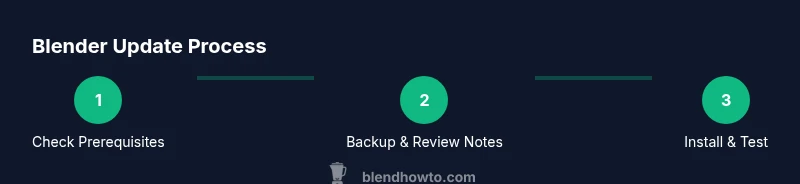
- 1
Check prerequisites and back up
Before updating, verify your system meets the new version’s requirements and back up all active projects and assets. Create a restore point or copy essential folders to a safe location. This safeguards your work if the update introduces a complication.
Tip: Label backups with date and Blender version to simplify rollbacks. - 2
Review release notes and choose update channel
Read the official release notes to understand breaking changes, new features, and addon compatibility. If you rely on plugins, verify their status and Python version requirements before upgrading.
Tip: Note any recommended steps specific to your addons or render engines. - 3
Download and install the update
Use Blender’s built-in updater or the official installer for your OS. Close all running projects and run the installer with administrator rights to prevent permission issues.
Tip: Install the update in a new directory or as a separate version to retain access to the old build. - 4
Verify addon compatibility
Launch Blender and enable your critical addons one by one. Check for deprecation notices or API changes that affect scripts or workflows you rely on daily.
Tip: If an addon is broken, search for an updated version or temporary workaround before moving forward. - 5
Test a small scene and validate renders
Open a representative project or a test scene and run a basic render. Compare results with your previous build to identify any regressions in lighting, shading, or performance.
Tip: Document any differences so you can adjust settings if needed. - 6
Document changes and update workflows
Record any preferences, driver adjustments, or pipeline changes caused by the update. Share notes with collaborators to ensure consistent practice across the team.
Tip: Create a quick one-page guide for your team outlining new steps and caveats.
Frequently Asked Questions
When should I update Blender?
Update after reviewing release notes and addon compatibility. Avoid mid-project updates to prevent disruption; plan a dedicated update window when possible.
Update after checking release notes and addons. Avoid updating in the middle of a project.
How do I back up before updating?
Copy active project folders, save important assets, and back up Blender preferences to a secure location. Use external drives or cloud storage for redundancy.
Back up your projects and preferences to an external drive or cloud storage first.
Will addons break after update?
Some addons may require updated versions or Python changes. Check addon pages and the release notes; upgrade addons when a compatible版本 is available.
Addons can break after updates; verify compatibility and update as needed.
How can I revert the Blender update if something goes wrong?
If issues arise, revert to the previous Blender version using the Blender Launcher or reinstall the earlier installer and redeploy scenes from backups.
If things go wrong, revert to the previous version using the installer or launcher and restore from backups.
Do I need to update Python for Blender?
Blender bundles its own Python; you don’t install Python separately. However, verify scripts and addons rely on specific Python APIs after the update.
Blender includes Python; you don’t install it separately, but check scripts for API changes.
Are there security benefits to updating Blender?
Yes. Updates often patch vulnerabilities and improve overall security hygiene for your pipeline and rendering workflows.
Updates fix security issues and harden your rendering pipeline.
Watch Video
What to Remember
- Back up projects before updating
- Check addon compatibility and Python needs
- Review release notes for breaking changes
- Test with a small scene post-update
- Document changes for future updates