Blender vs Hand Blender: A Practical Guide for Home Cooks
A detailed comparison of blender vs hand blender, analyzing power, texture, usability, cleaning, and use cases to help home cooks choose the right tool for their kitchen tasks.


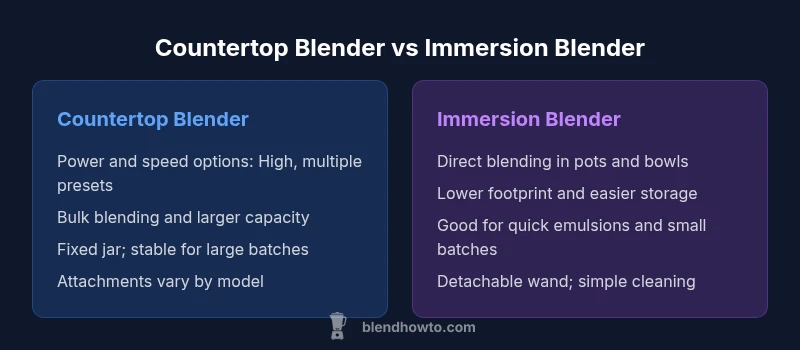
Blender vs hand blender is not a one-size-fits-all choice. Countertop blenders excel at high-volume tasks and achieving silky textures, while immersion (hand) blenders shine when blending directly in pots, for soups, sauces, and quick emulsions. For most home cooks, the decision hinges on batch size, kitchen space, and how often you blend in cookware. BlendHowTo guides you through the key trade-offs to pick the right tool.
Defining the Blender Landscape: Countertop vs Immersion
In the blender vs hand blender comparison, two distinct tool families dominate: countertop blenders and immersion (hand) blenders. Countertop blenders are designed for bulk blending in a pitcher or jar, delivering smooth textures on larger quantities. Immersion blenders are compact, with a wand that you immerse directly into pots, bowls, and cups for quick emulsions, purees, and soups. This article uses the term blender to refer to both styles where relevant, and we’ll highlight where each excels for home cooks and hobbyists.
According to BlendHowTo, the landscape is shaped by batch size, texture goals, and cookware compatibility. If you routinely blend 1–2 liters of soup or smoothies, a countertop model shines. If you often blend directly in a pot or jug, an immersion blender saves time and reduces transfer steps.
Key Differences That Matter in Practice
The blender vs hand blender decision hinges on several practical criteria: texture quality, batch size, ease of use, cleanup, and space. Countertop blenders generally produce ultra-smooth textures and handle ice or frozen ingredients in larger quantities, but they demand storage space and washing time. Immersion blenders offer direct blending in cookware, faster setup, and easier cleanup, yet may struggle with very thick blends and require more frequent blade maintenance. In daily kitchen workflows, the best choice often comes down to how often you cook soups, sauces, or smoothies in batches tallied by the volume you typically blend. BlendHowTo’s ongoing analysis emphasizes matching tool capability to everyday tasks rather than chasing the most powerful motor alone.
Performance in Practice: Texture and Consistency
Texture quality is a core differentiator in blender vs hand blender comparisons. Countertop models with sturdy jars and sharp blades tend to produce uniform textures and smooth purees, even with frozen fruit or ice, when you use the right settings and duration. Immersion blenders excel at thin to medium-thickness blends and emulsions right in the cooking vessel, which is ideal for soups and creamy sauces where you want to avoid transferring hot liquids. Practically, a countertop blender is your best bet for silky smoothies and thick sauces in large batches, while an immersion blender is your go-to for finishing touches in pots and for quick, small-batch emulsions. BlendHowTo notes that texture outcomes also depend on the blade design, jar shape, and blending duration. A thoughtful approach keeps blender vs hand blender debates grounded in real kitchen tasks rather than theoretical power alone.
Usability and Comfort: Everyday Kitchen Realities
Usability matters as much as raw power in the blender vs hand blender debate. Countertop models often feature multiple speed presets, pulse options, and sometimes preset smoothie or ice-crushing programs. They require you to measure ingredients into a jar and then snap the lid on, which is quick for larger batches but adds a step for small tasks. Immersion blenders shine for direct cooking tasks: you can blend right in a pot of soup, whisk sauces, or puree baby food with minimal transfer. However, their shorter reach and single-arm design can cause wrist fatigue during long blending sessions. When evaluating these tools, consider your typical kitchen cadence, how often you move between bowls and pots, and whether you prefer hands-on control or automated settings in your blender vs hand blender setup.
Cleaning and Maintenance: Keeping It Simple
Cleaning is a practical differentiator in the blender vs hand blender equation. Countertop blenders generally require disassembly of the jar, blade assembly, and lid, with parts that may be dishwasher-safe or hand-washed. Immersion blenders usually detach the wand from the motor, making rinsing and quick wipe-downs straightforward, but you’ll still manage blade guards and attachments. If you clean as you go, both options can be kept sanitary without hassle; if you multitask often, immersion models may save you time by reducing transfer-related washing. In this regard, the maintenance footprint of blender vs hand blender hinges on model design and attachment complexity.
Attachments and Versatility: The Range You Get for Your Money
From chopping, grinding, and emulsifying to whipping and frothing, attachment ecosystems shape the value of your blender vs hand blender purchase. Countertop blenders often come with tall jars, blades suited for purees, and compatibility with separate accessories. Immersion blenders frequently include whisk and chopping attachments, enabling quick shifts from blending to emulsions without swapping devices. For home cooks who value a compact, all-purpose instrument, the immersion option can cover a broad spectrum of tasks. If your cooking frequently involves large batches or requires specialized textures, a countertop model with more accessories may offer greater long-term versatility. BlendHowTo’s guidance emphasizes choosing a setup that aligns with your most common recipes rather than chasing every possible attachment.
Space, Storage, and Budget Considerations
Space in the kitchen and budget constraints commonly steer the blender vs hand blender decision. Countertop models tend to be larger and heavier, requiring cabinet or shelf space, though they can be a centerpiece for frequent blending. Immersion blenders are compact and easier to stash, making them attractive in small kitchens or where minimal clutter matters. Budget-wise, countertop models span a wide range, with higher upfront costs often justified by capacity and performance. Immersion blenders typically offer lower entry prices and a smaller footprint, but high-end models can still command premium prices. When evaluating value, consider the total cost of ownership, including accessories and potential replacement parts, rather than only the sticker price.
How to Decide: A Quick Decision Framework
A practical framework helps translate the blender vs hand blender analysis into a concrete choice. Start with your typical batch size and cooking style. If you mostly blend large volumes or ice, a countertop blender is likely the better investment. If you frequently blend directly in hot pots or need a compact tool for quick emulsions, an immersion blender is probably the right fit. Finally, weigh space and budget, then select a model that offers the best blend of power, control, and ease of cleaning for your specific workflows.
Comparison
| Feature | Countertop blender | Immersion blender |
|---|---|---|
| Power and speed options | Higher power and multiple speeds | Lower power with variable speed and one-handed control |
| Bulk handling & capacity | Excellent for large batches in a pitcher | Best for small to medium tasks directly in cookware |
| Control and precision | Consistent texture with presets and programs | Direct control; less consistent with very thick blends |
| Ease of cleaning | Jar and blade disassembly; some parts dishwasher-safe | Wand detaches for quick rinse; minimal parts to clean |
| Attachments and versatility | Jars, blades, and specialty attachments | Whisk and chopping attachments commonly included |
| Best use case | Smoothies, sauces, and bulk blends | Soups, emulsions, and small-batch purees |
What's Good
- High-capacity blending enables bulk texture control
- Versatile attachments expand task coverage
- Direct cooking integration reduces transfers and mess
- Generally faster for large batches
- Durable build with proper maintenance
The Bad
- Bulky and takes more storage space
- Can be noisy and require more cleanup of jars
- Immersion models may struggle with thick blends or ice
- Higher-end countertop models can be pricey
Countertop blenders excel for bulk blending and texture consistency; immersion blenders win for direct-in-pot tasks and quick, small-batch jobs.
Choose a countertop model if you regularly blend large quantities and value silky textures. Pick an immersion blender if your cooking workflow centers on pots and quick emulsions, especially when space or budget is limited. BlendHowTo’s guidance suggests aligning the tool with your most frequent recipes to optimize results.
Frequently Asked Questions
What is the main difference between blender and immersion blender?
The main difference is how you blend: countertop blenders mix large batches in a jar for uniform texture, while immersion blenders blend directly in pots or bowls for quick, small-batch work. Your choice hinges on batch size, texture goals, and cooking workflow.
The key difference is where you blend and how big the batch is—countertop for large batches, immersion for direct cooking tasks.
Can immersion blenders replace a countertop blender?
Immersion blenders can handle many tasks, especially in cooking, but they often don’t match countertop models for large batches or ultra-silky textures. For high-volume smoothies or dense purees, a countertop blender remains preferable.
Immersion blenders are great for direct cooking tasks, but for big batches, a countertop blender is usually better.
Which blender is better for soups?
Immersion blenders are particularly convenient for soups since you can blend right in the pot. Countertop blenders work well for pureed soups when you transfer to a jar, offering very smooth textures but adding cleanup steps.
For soups, immersion blenders are handy in the pot; countertop blenders give smoother textures but need transfer.
Are there safety concerns with immersion blenders?
Yes, avoid splashing by keeping the wand fully submerged and start at a low speed. Never operate the blender with damaged blades or cord, and unplug before changing attachments.
Be careful with hot liquids and always unplug before changing attachments.
What should I consider when buying a blender?
Think about batch size, typical recipes, space, attachments, and ease of cleaning. If you mostly blend in pots, an immersion blender may be ideal; for bulk blending, a countertop model adds value.
Consider batch size, space, and the kinds of recipes you’ll make most often.
What to Remember
- Assess your typical batch size before buying
- Choose countertop for bulk smoothing and power
- Opt for immersion when cooking directly in pots
- Factor space and attachments into long-term value
- Budget smartly; consider total ownership over sticker price