Immersion Blender Pros and Cons: A Practical Guide for Home Cooks
A balanced, evidence-based guide to immersion blender pros and cons, weighing in-pot convenience against power and versatility. Learn how to choose, use, and maintain handheld blenders for soups, sauces, and small-batch blending.


Immersion blender pros and cons hinge on convenience, control, and space. They excel at blending directly in pots, quick emulsions, and small batches with minimal cleanup, making them ideal for everyday cooking. Yet they’re generally less powerful than premium countertop blenders and may struggle with dense ingredients or large volumes, requiring patience or multiple passes.
What is an immersion blender and how do we evaluate its pros and cons
An immersion blender, also called a stick blender, is a handheld blender with a long shaft and blade at the end. It blends directly in your pot, bowl, or pitcher. When evaluating its pros and cons, designers and testers focus on power, ergonomics, versatility, and how attachments extend its usefulness. This article uses the phrase immersion blender pros and cons to anchor the discussion, but the goal is practical guidance for home cooks and hobbyists. The BlendHowTo team emphasizes practical testing that mirrors real kitchen scenarios, from creamy soups to emulsified sauces. Consider noise levels, heat tolerance, cleaning effort, and the pace of blending when weighing options. The right choice depends on how you cook, how often you blend, and how much you value compact storage versus maximum power.
Quick snapshot: Core advantages of immersion blenders
Immersion blenders offer several practical benefits that fit busy kitchens. They blur the line between appliance and utensil by letting you blend directly in the pot, reducing transfers and minimizing cleanup. Their compact size makes them easy to store, and many models are affordable enough for casual cooks to upgrade without breaking the bank. Attachments such as whisk, chopping cup, and extra blades expand what you can do, from whipping cream to pureeing sauces. In everyday cooking, speed and control matter: you can puree a carrot soup to the desired texture without pouring into a separate blender. For many users, this translates to faster weeknight meals, less cookware, and a cleaner counter.
Notable drawbacks and limitations
While immersion blenders are convenient, they aren’t a one-size-fits-all answer. They typically deliver less raw power than high-end countertop models, which can limit their ability to handle very dense ingredients or large volumes in a single pass. Some tasks require repeated passes or careful technique to avoid chunkiness. Attachments add versatility, but they also add cost and cleaning complexity. Ergonomics matter: a poorly balanced handle can cause fatigue during longer blending sessions, and vibration can become noticeable with continuous use. Finally, consistency can vary across models, so texture control may require more practice than with a dedicated countertop blender.
Key design features that affect performance
Performance of an immersion blender hinges on several design choices. Power (wattage) sets baseline capability, but true performance comes from a well-balanced motor and efficient blade geometry. Variable speed ranges let you adjust from a gentle puree to a quick chop, while turbo or push-button boosts help with tough ingredients. The shaft length and blade reach determine how deeply you can blend in tall pots or wide bowls without creating splatter. Attachments—whisks, choppers, and extra blending cups—multiply the tool’s utility but add cleanup steps. Weight and grip quality influence comfort, especially during extended use. Finally, cleanability and dishwasher compatibility of detachable parts influence daily convenience.
Use cases where immersion blenders shine
This section covers scenarios where immersion blenders truly excel. Creamy soups benefit from direct blending in the pot, enabling smooth textures without transferring hot liquids. Emulsions such as vinaigrettes and mayonnaise can be stabilized with precise whisking and controlled speed. Baby food, sauces, and dressings become easier to prepare in small batches, with minimal equipment and cleanup. They’re also handy for puréeing softened vegetables, mashing fruits for spreads, and blending hot liquids without cooling dramatically. In addition, their compact form helps when you’re working in small kitchens or cooking spaces without a full set of countertop appliances.
When to reach for a countertop blender instead
Countertop blenders generally outperform immersion models on one key axis: power and texture consistency for large batches or very smooth results. If your routine includes blending large volumes, crushing ice, grinding seeds, or producing ultra-smooth smoothies, a high-powered countertop unit may be worth the extra counter space. For dense ingredients like raw nuts or fibrous produce, a countertop blender can deliver a uniform texture more quickly. In multi-task kitchens, having both types can cover a broad spectrum of recipes, from silky tomato bisque to chunky pestos and sauces. The choice boils down to batch size, texture target, and how often you blend directly in cookware.
Cleaning, maintenance, and longevity tips
To maximize longevity, detach blades and wash parts promptly after use to prevent staining and odors. Avoid submerging the motor housing; instead, rinse the shaft under running water and wipe dry. Use warm, mild soap and a soft brush to remove food residues from the blade area. Regularly check attachments for wear, especially seals around whisk and chopping cups. If the device comes with a warranty, keep proof of purchase and documentation; a well-maintained unit typically lasts longer and maintains peak performance. Storing with attachments in place can help keep them organized, but ensure blades are dry to prevent corrosion.
How to choose: power, speed, ergonomics, attachments
Choosing the right immersion blender involves evaluating several criteria. Start with power and speed range; high-wattage motors with multiple speeds handle a broader set of ingredients. Ergonomics matter: a comfortable grip, balanced weight, and minimal vibration reduce fatigue. Attachments expand capability—look for a whisk, chopper, or beaker; verify compatibility with standard blender jars and accessories. Consider the shaft length; longer shafts are better for deep pots, while shorter ones work well in shallow pans. Ease of cleaning is essential; dishwasher-safe parts save time. Finally, balance price and expected use: a modestly priced model with reliable attachments can be a smarter buy for light, frequent use.
Budget considerations and value over time
Price ranges for immersion blenders vary by power, build quality, and included attachments. A basic unit can offer essential blending for everyday recipes, while mid-range models provide extended speed options and more robust attachments. Premium options emphasize ergonomics, motor durability, and a broader accessory ecosystem. When evaluating value, consider lifetime usage: if you blend weekly and rely on delicate emulsions, investing in a model with reliable seals and a comfortable grip can reduce replacement costs over time. Remember that some tasks may require additional tools; plan your budget around anticipated needs rather than a single ideal feature.
Practical blending techniques and recipes to get the most from a handheld blender
Mastering practical techniques makes a handheld blender a powerful kitchen companion. For silky soups, blend chunks gradually, then finish with a quick tastings test to adjust seasoning and texture. When emulsifying dressings or sauces, start with an acid and gradually incorporate oil while blending at a steady pace to avoid separation. For baby-friendly purées, alternate between blending and mashing to control texture. Ice-crushed smoothies can be achieved by pulsing in short bursts with small ice chunks and soft fruits. Practice with soft vegetables like cooked carrots or squash to develop a feel for texture without over-processing.
Durability, warranties, and long-term reliability
Durability hinges on motor quality, blade safety, and the rigidity of detachable components. Most brands offer at least a one-year warranty for parts and labor, with longer coverage for motors in some premium models. Look for splash protection and a secure locking mechanism to prevent accidental detachment. Regular maintenance, such as cleaning and drying blades thoroughly, extends life. If you rely on frequent use, consider models with reinforced shafts and larger grip surfaces designed to withstand daily wear. A good warranty can provide peace of mind when choosing between similar options.
Common myths and misconceptions debunked
Myth: Immersion blenders can replace all countertop blenders for every task. Reality: they excel at in-pot blending and small batches but may underperform on very dense blends or large volumes. Myth: Higher wattage automatically equals better results. Reality: blade design, torque, and control matter more than raw wattage. Myth: All attachments are equally compatible. Reality: Attachment ecosystems vary; ensure you can access the tools you actually use. Myth: Cleaning is always quick. Reality: Some models have more parts, making cleaning longer; check dishwasher compatibility.
Comparison
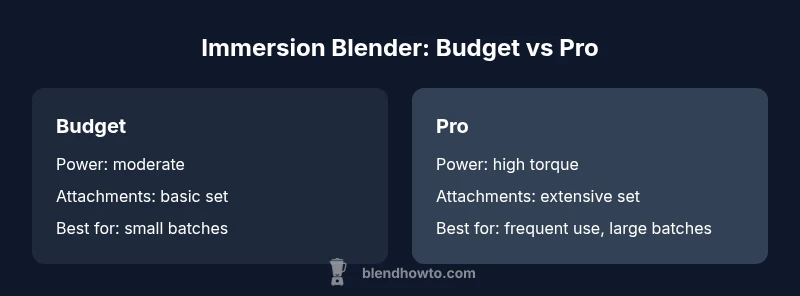
| Feature | Budget immersion blender | Pro immersion blender |
|---|---|---|
| Power | moderate wattage | high wattage or robust motor |
| Variable speed | basic or few speeds | extensive speed control with turbo |
| Attachment versatility | limited whisk/blade | rich accessory set (whisk, chopper, emulsifier) |
| Ease of cleaning | simpler parts | more parts to clean |
| Weight & ergonomics | lighter, compact | balanced, heavier build |
| Price range | budget-friendly | premium-priced |
| Best for | small batches, soups | frequent blending, large batches |
What's Good
- Direct blending in pots and bowls saves transfer steps
- Compact design saves cabinet space and is easy to store
- Quick cleanup for small batches reduces kitchen mess
- Attachment variety expands usage beyond blending
The Bad
- Less power for dense ingredients or large batches
- More parts to clean and maintain with additional attachments
- Long blending sessions can cause fatigue if ergonomics are poor
- Texture consistency can vary compared with high-end countertop blenders
Immersion blenders offer in-pot convenience and fast cleanup for everyday cooking; they excel at soups, sauces, and small batches, but choose a countertop model for large-volume or ultra-smooth results.
They’re ideal when you want one tool that handles multiple tasks in the pot. For frequent heavy blending or large quantities, a countertop unit remains the better choice.
Frequently Asked Questions
What is an immersion blender best used for?
Immersion blenders excel at soups, sauces, purées, and small-batch emulsions. They’re ideal when you want to blend directly in the cooking vessel and reduce cleanup. You’ll often get quick results with minimal equipment.
Great for soups, sauces, and small batches right in the pot—very handy in busy kitchens.
Can immersion blenders replace a countertop blender?
They can handle many tasks, especially in small batches, but for large volumes or ultra-smooth textures, a countertop blender is usually better. Consider your typical recipes before deciding.
They’re great for small jobs, but not always a direct substitute for a high-power countertop blender.
Are immersion blenders dishwasher safe?
Many models offer dishwasher-safe attachments, but motors should not be submerged. Check your manual for cleaning instructions and ensure parts are thoroughly dry before reassembly.
Usually safe for the detachable parts; avoid getting the motor wet.
What features should I look for in a good immersion blender?
Power, speed range, ergonomics, weight, and the quality of attachments. Look for easy cleanup, a secure blade assembly, and a shaft long enough for your biggest pot.
Focus on power, comfort, and the right add-ons for your cooking style.
Is an immersion blender good for making smoothies?
Yes for small portions or soft fruits; frozen ingredients and ice-heavy blends may require a more powerful machine or a separate blender.
They work for small smoothies, but not ideal for large or very icy blends.
How do I clean an immersion blender safely?
Unplug the device, detach blades, rinse under warm water, and wash with mild soap. Dry thoroughly before reassembling and storing.
Unplug, detach blades, clean, and dry—don’t soak the motor.
What to Remember
- Choose immersion blender for in-pot blending and quick cleanup
- Be mindful of power and ergonomics to avoid fatigue
- Invest in essential attachments to maximize versatility
- For large batches or ultra-smooth textures, consider a countertop blender