Immersion Blender vs Mixer: A Practical Comparison
Compare immersion blender vs mixer across performance, attachments, space, price, and ease of use to decide which tool fits your home kitchen best. Practical guidance for home cooks and hobbyists.


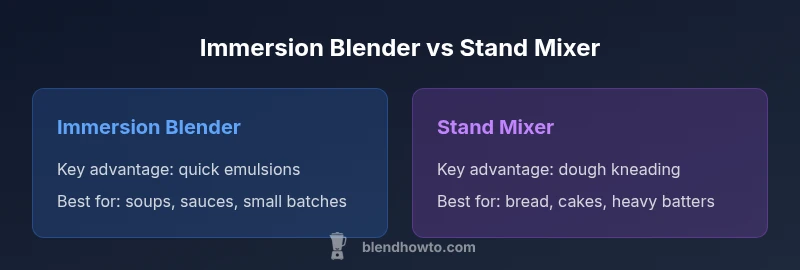
According to BlendHowTo, the immersion blender vs mixer decision hinges on task type and kitchen space. Immersion blenders excel at soups, emulsions, and quick blends right in the pot, with minimal cleanup. Stand mixers dominate doughs, batters, and large batches, delivering power and texture that handhelds struggle to match. For most homes, the choice comes down to how often you bake bread or puree, given storage limits.
Quick Context: What are immersion blenders and stand mixers?
Immersion blenders (often called stick blenders) and stand mixers sit at opposite ends of the kitchen appliance spectrum. An immersion blender is a handheld motor with a fixed blade that you insert directly into pots, pans, or bowls for rapid blending, emulsions, and purees. A stand mixer, by contrast, is a powered base with a bowl and fixed attachments (typically a whisk, dough hook, and paddle) that automate mixing, kneading, and whipping with substantial torque. In everyday cooking, these tools answer different needs. According to BlendHowTo, the immersion blender vs mixer decision hinges on task type and kitchen space. Immersion blenders excel at soups, emulsions, and quick blends right in the pot, with minimal cleanup. Stand mixers dominate doughs, batters, and large batches, delivering power and texture that handhelds struggle to match. For most homes, the choice comes down to how often you bake bread or puree, given storage limits.
Core Differences at a Glance
- Power and performance: Immersion blenders offer quick, variable blending with lower sustained power; stand mixers deliver high torque for heavy doughs and large batches.
- Attachments: Immersion blenders use a blending wand and sometimes whisk attachments; stand mixers rely on dough hooks, beaters, and whisks for diverse tasks.
- Control: Immersion blenders provide rapid, on-the-fly control in the mixing vessel; stand mixers provide consistent speeds via a rotating bowl and fixed attachments.
- Space: Immersion blenders are compact and easy to store; stand mixers are bulkier and often require a dedicated shelf or cabinet.
- Cleaning: Immersion blenders are quick to clean when used for small tasks; stand mixers have more parts but can be cleaned gradually or partially disassembled for deep cleaning.
- Price and ownership: Entry-level immersion blenders tend to be cheaper upfront, while stand mixers can be pricier but offer long-term value for heavy-use tasks.
Performance in Common Tasks
For quick blending, emulsions, and purées, the immersion blender shines. A few seconds of blending in a pot or bowl yields smooth soups, smoothies, and sauces with minimal dishwashing. When it comes to thick batters or kneaded dough, the stand mixer has the edge, delivering steady mixing, thorough gluten development, and reliable air incorporation. High-fat emulsions (like mayonnaise) can be achieved with either tool, but the mixer offers more predictable texture when you're handling large batches. BlendHowTo’s practical guidance emphasizes choosing the tool that results in fewer steps and transfers for your most frequent tasks.
Control, Ergonomics, and Noise
Ergonomics matter: immersion blenders are light and easy to maneuver but require one-handed operation and often a straighter wrist. Prolonged blending can tire the arm, especially when processing large quantities. Stand mixers reduce manual effort, thanks to a stable base and hands-free bowl rotation, but they demand careful placement to prevent tipping and require tilt-head or lift-off designs for access. Noise levels vary by model, but immersion blenders tend to be louder per watt due to the proximity of the blades to the food. In short, choose the tool that minimizes fatigue for your typical tasks and kitchen layout.
Attachments and Versatility
Attachments extend versatility. Immersion blenders sometimes offer whisk attachments or chopper bowls, enabling quick purees and light emulsions without transferring to another container. Stand mixers bring a broader range of accessories (dough hooks, wire whisks, paddle attachments, and sometimes pasta attachments), enabling breadmaking, cake batters, and meringues with more consistent results. If you bake or whip frequently, the mixer’s ecosystem often justifies the higher price. If you mostly blend liquids and soups, the immersion blender’s compact kit can cover most needs.
Cleaning and Maintenance
Immersion blenders usually come apart quickly for washing: detach the wand, rinse, and air dry. Some models are dishwasher-safe for certain parts, but you should avoid submerging the motor housing. Stand mixers require washing the bowl and attachments, and depending on the model, some parts may be dishwasher-safe while others require hand washing. Keeping blades and gears dry and free of residue extends longevity for both tool types. For busy kitchens, quick, easy cleaning is a strong argument in favor of the immersion blender for smaller tasks.
Durability, Warranty, and Ownership Costs
Durability depends on build quality and usage patterns. Immersion blenders are generally robust for daily blended soups and sauces but may show wear if used for heavy, continuous processing. Stand mixers are designed for heavy use and longer kneading cycles; their major wear points include gears in the motor housing and the attachments’ hubs. Price often aligns with durability: entry-level models are affordable but offer fewer long-term warranties, while higher-end models provide stronger motor protection and longer warranties. When evaluating ownership costs, consider the frequency of use, the heaviest task you perform, and whether you’ll reap benefits from a broader attachment ecosystem.
Kitchen Footprint and Storage
A compact kitchen benefits from the immersion blender’s space efficiency. It occupies less cabinet or drawer space and can live on a shelf next to a blender or food processor. Stand mixers demand a larger footprint and may require a dedicated corner of the counter or a shelf, especially in small kitchens. If you’re short on storage, you may appreciate the immersion blender’s modular design. If you have abundant counter space and frequent baking, a mixer's wider capabilities can justify its size.
Immersion Blender Use Cases in Daily Cooking
In daily cooking, immersion blenders excel for pureeing soups directly in the pot, emulsifying dressings, and creating quick sauces. They’re also handy for baby food and small-batch smoothies. The key strength is minimal transfer between dishes and containers, reducing cleanup time. For quick, on-the-fly blending tasks without breaking out larger appliances, the immersion blender is a reliable workhorse.
Stand Mixer Use Cases for Home Bakers
Stand mixers shine in baking and heavy batter work: bread doughs, cake batters, cookie dough, and whipped cream with consistent texture. The fixed bowl and powerful motor help with gluten development and air incorporation, supporting repeatable results across multiple batches. If your hobby grows from occasional baking to regular production, the mixer’s investment can pay off through improved consistency and reduced manual effort.
Practical Buying Tips for Space and Budget
When buying, prioritize motor strength, stability, and attachment compatibility. Check for a robust power head, a secure power cord, and a reliable bowl/attachment interface. Attachments should be dishwasher-safe or easy to hand wash. For buyers with limited space, consider models with locking mechanisms and compact footprints. Compare value by counting the number of tasks you can complete with each tool and the availability of essential attachments. BlendHowTo recommends evaluating warranty length, repair options, and service availability to ensure longevity and practical return on investment.
Common Mistakes and How to Avoid Them
Avoid underestimating your typical tasks—buying a tool that’s tempting but underpowered for heavy doughs leads to frustration. Don’t assume every attachment is universal; verify compatibility with your preferred brand. Lastly, neglecting cleaning and maintenance can reduce longevity; establish a quick post-use routine to protect bearings and seals. A thoughtful selection based on your most frequent tasks yields better long-term satisfaction.
Comparison
| Feature | Immersion Blender | Stand Mixer |
|---|---|---|
| Power/Performance | Low to medium torque suitable for quick blends | High torque suitable for kneading and heavy batters |
| Attachments | Blending wand; some models offer whisk/chopper attachments | Dough hook, wire whisk, paddle; additional specialty attachments common |
| Best For | Soups, emulsions, quick purees in pots | Bread doughs, cakes, large batches, whipping |
| Counter Space | Very compact; fits in small drawers or cabinets | Bulky; often requires dedicated counter space or cabinet slot |
| Cleaning | Fast clean-up; fewer parts to manage | More parts; some are dishwasher-safe but more to wash |
| Price Range | Generally lower upfront cost for basic models | Typically higher upfront but broader capabilities |
What's Good
- Space-saving design ideal for small kitchens
- Low upfront cost on entry-level models
- Quick, direct blending in the mixing vessel
- Easy to store with minimal surface footprint
- Sufficient for everyday blending and emulsions
The Bad
- Limited power for heavy doughs and large batches
- Attachment compatibility varies by brand
- More parts to manage when expanding capabilities
- Long-term durability may depend on usage intensity
Immersion blender wins for space and quick blending; stand mixer wins for heavy baking and large batches
Choose the immersion blender if your tasks focus on soups, emulsions, and small-batch blends in a compact setup. Opt for a stand mixer if bread doughs, cake batters, and large-volume whipping are regular requirements; its attachment ecosystem offers greater long-term versatility.
Frequently Asked Questions
Can an immersion blender replace a mixer for baking tasks?
For light tasks like quick batters or emulsions, an immersion blender can handle many needs, but it isn’t a full substitute for heavy dough work or large-batch baking. If bread or frequent kneading is part of your routine, a stand mixer remains the better tool.
An immersion blender can handle light baking tasks, but for doughs and large batches, a stand mixer is the safer bet.
Are immersion blenders powerful enough for dough?
Immersion blenders generally lack the sustained torque needed for bread doughs. They’re best for emulsions, soups, and light blending. If dough work is common, a stand mixer provides the reliability and power you need.
They’re usually not ideal for bread doughs; a stand mixer is better for that job.
Is a mixer easier to clean than an immersion blender?
Cleaning depends on attachments. Immersion blenders are quick to rinse with fewer parts, while stand mixers involve washing the bowl and multiple attachments. Both can be maintained well with regular care.
Immersion blenders are quick to rinse; mixers involve more parts to clean.
Do immersion blenders come with attachments?
Many immersion blenders offer optional attachments like a whisk or mini-chopper, but availability varies by model. Check compatibility and accessory ecosystems when comparing brands.
Yes, some come with extra attachments; check your model’s compatibility.
What is the typical price range for these tools?
Prices vary widely by brand and attachments. Basic immersion blenders are affordable, while stand mixers with multiple attachments sit at a higher price. Consider total cost of ownership, including potential add-ons.
Prices vary; started affordable for immersion blenders, higher for mixers with attachments.
Which is quieter, an immersion blender or a mixer?
Noise varies by model, but immersion blenders often produce noticeable noise during high-speed blending. Stand mixers can also be loud, especially at higher speeds or with heavy dough. Both can be quiet with well-designed motors and proper use.
Both can be noisy; model choice and usage impact how loud they are.
What to Remember
- Identify your core tasks before buying
- Prioritize space, budget, and attachment needs
- Consider long-term versatility for heavy-use baking
- Balance initial cost with potential upgrade path