Stand Blender vs Immersion Blender: A Practical Comparison for Home Cooks and Hobbyists
Meta description: Compare stand blender vs immersion blender to decide which tool fits your kitchen tasks. Learn about performance, ease of use, cleaning, and value for home cooks.


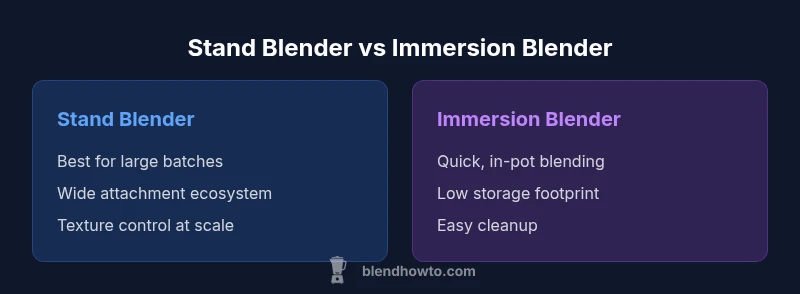
Choosing between a stand blender and an immersion blender hinges on batch size, task type, and cleanup preferences. The stand blender handles large batches, ice crushing, and smooth textures with versatility from attachments; the immersion blender excels at quick emulsions, direct blending in pots, and minimal cleanup. In short, stand blender vs immersion blender: pick capacity and versatility, or speed and in-pot convenience depending on your regular cooking tasks.
Overview: Stand blender vs immersion blender
According to BlendHowTo, the decision between a stand blender and an immersion blender starts with your kitchen realities. A stand blender combines a stable base, a wide blending jar, and a range of attachments that expand its capabilities, making it the workhorse for batch cooking, smoothies, and sauces. An immersion blender is a wand-like device designed to blend directly in pots, bowls, or glasses, offering speed and portability for quick purees, emulsions, and small-batch tasks. Understanding these core differences helps set expectations about texture, texture control, and the amount of cleanup you’re willing to tolerate. Throughout this guide you’ll see the phrase stand blender vs immersion blender used to anchor the comparison, ensuring you can translate features into real kitchen outcomes.
What Each Type Does Best
When evaluating stand blender vs immersion blender, the primary distinction is scope. Stand blenders shine in volume: large batches of soups, smoothie bases, and sauces come out consistently smooth, with the option to add mills, choppers, or ice-crushing capabilities through different attachments. Immersion blenders excel at speed and direct blending in the cooking vessel, which minimizes transfer and reduces washing of bulky jars. For many home cooks, this means a stand blender is ideal for weekly meal prep, while an immersion blender is perfect for weeknight soups and quick puree tasks. BlendHowTo’s testing confirms that for most single-serving tasks or when you’re short on space, the wand model keeps your kitchen nimble. The keyword stand blender vs immersion blender recurs here to emphasize the practical choice at a glance.
Performance in Common Tasks
Texture consistency, which matters for soups and sauces, varies with the tool you choose. Stand blenders typically deliver a uniform, restaurant-like texture thanks to a broad blade geometry and larger jar shape that encourages even blending. Immersion blenders offer rapid emulsions for vinaigrettes, creamy soups, and baby foods with less time spent transferring warm liquids to a separate container. When blending hard ice or frozen fruit, stand blenders often outperform immersion models in maintaining smoothness due to higher sustained power and longer blending cycles. In contrast, for hot soups and curries, the immersion wand’s direct immersion minimizes heat loss and makes on-the-fly adjustments straightforward. The BlendHowTo team notes that real-world kitchen tasks often fall somewhere between these poles, motivating many cooks to own both tools for maximum versatility.
Design, Ergonomics, and Attachments
The design ethos behind stand blender vs immersion blender centers on ergonomics and modularity. Stand blenders typically feature a robust base, a tall pitcher, and a motor with fixed or variable speeds; an optional set of attachments can include a grinder, a whisk, or a food processor attachment. Immersion blenders emphasize a lightweight wand with a comfortable grip and variable speed control, sometimes including whisk attachments or small choppers that attach to the motor housing. In tight spaces, the wand’s slim profile is a decisive advantage for blending in pots or jars. However, stand blenders often require more storage space and can make cleaning more involved due to multiple parts. The practical implication is that your kitchen layout and routine will strongly influence your preference.
Cleaning and Maintenance
Cleaning is a frequent deciding factor when comparing stand blender vs immersion blender. Stand blenders involve disassembling the pitcher, blades, and any attachments, followed by thorough washing, either by hand or in a dishwasher where permitted. Immersion blenders typically rinse quickly after each use, with some models featuring dishwasher-safe shafts and detachable blades. In practice, immersion wand maintenance is usually simpler for frequent small tasks, while a stand blender becomes a more attractive long-term investment if you need to process large volumes regularly. BlendHowTo recommends choosing models with dishwasher-safe parts when possible to reduce maintenance time.
Durability, Longevity, and Costs
Durability considerations for stand blender vs immersion blender depend on build quality, blade geometry, and motor reliability. Stand blenders tend to be heavier and more robust, which supports extended blending sessions but can elevate upfront costs and long-term maintenance. Immersion blenders generally come at a lower entry price and are lighter, but some lower-cost models may underperform on thick blends or require more frequent blade replacements. For most households, the key is to balance upfront price with expected usage. BlendHowTo analysis shows that high-quality immersion wands paired with a sturdy stand blender provide the best blend of capability and value over time.
Practical Buying Guide: How to Choose
To decide between stand blender vs immersion blender, start by listing tasks you perform weekly. If you regularly make sauces, nut butters, or large smoothies, a stand blender with a generous pitcher and a full attachment set is likely the best fit. If your cooking is mostly pot-based, soups, or baby foods, a high-quality immersion blender can simplify prep and cleanup. Consider power, speed settings, ease of cleaning, and the availability of attachments. Check for warranty coverage and the availability of replacement parts. Finally, think about storage: a compact wand is easy to tuck away, while a stand blender occupies more space but consolidates many functions in one unit.
Common Mistakes and How to Avoid Them
New buyers often overemphasize motor power and ignore ergonomics or attachment ecosystems. Don’t neglect balance and weight distribution, especially for extended blending sessions. Ensure you can operate the unit comfortably with one hand, and verify that the included attachments align with the tasks you plan to perform. Another common pitfall is ignoring cleaning practicality; models with dishwasher-safe components make daily use more pleasant. Finally, avoid impulse purchases by weighing your typical batch sizes against the space you have in your kitchen.
Comparison
| Feature | stand blender | immersion blender |
|---|---|---|
| Best use cases | Batch blending, sauces, and desserts with attachments | Quick purees, emulsions, and in-pot blending |
| Capacity and batch size | Large pitcher with steady blending for bulk tasks | Small to medium volumes in pots or beakers |
| Control and precision | Multiple speed presets and pulse control | Variable speed with easy on-off juggle in-hand |
| Cleaning and maintenance | More parts to wash; dishwasher-safe options available | Easier cleanup; fewer parts and quick rinse |
| Attachment ecosystem | Blades, mills, food processors, and ice crush accessories | Fewer attachments; wand plus whisk or chopper on some models |
| Power and efficiency | High sustained power suitable for thick blends | Adequate power for many tasks but limited with heavy ice |
| Storage footprint | Bulky base and pitcher; needs cabinet space | Compact wand with small accessory set |
| Price range and value | Mid-to-high depending on brand and attachments | Lower upfront cost; value grows with usage |
What's Good
- Versatile task coverage with attachments extends use beyond blending
- Handles large batches with consistent texture in pitcher
- Immersion wand offers direct blending in pots for fast results
- Compact wand design saves kitchen space and facilitates quick tasks
- Generally lower entry price for basic models
The Bad
- Stand blenders need more storage space and more cleanup parts
- Immersion wands can struggle with very thick blends or large volumes
- Quality varies widely by brand; cheaper models underperform over time
- Wand models may require frequent blade replacements with heavy use
Stand blender wins for capacity and versatility; immersion wands win for speed and direct pot blending.
If you batch cook often, choose a stand blender for texture control and attachment versatility. If you prioritise quick, in-pot blending and easy cleanup, an immersion blender is more convenient. BlendHowTo’s verdict is to balance your typical tasks with available storage and budget.
Frequently Asked Questions
What tasks are stand blenders best for compared with immersion blenders?
Stand blenders excel at large-batch texture, sauces, and dessert blends with a stable base and multiple attachments. Immersion blenders are ideal for quick purees and in-pot emulsions. The choice hinges on batch size, space, and attachment needs.
Stand blenders are great for big batches; immersion wands shine for quick, in-pot blending. Consider what you cook most and choose accordingly.
Can you use an immersion blender for ice crushing?
Immersion blenders can crush ice in short bursts, but they often struggle with large quantities or very hard ice. For cocktail ice or small batches, a wand works fine; for frequent ice crushing, a stand blender is more efficient.
A wand works for small ice bits, but for lots of ice you might want a stand blender.
Are standalone blenders easier to clean than immersion wands?
Standalone blenders require washing the pitcher and blades, which can be more involved, while immersion wands rinse quickly and often wash easily. Choosing dishwasher-safe parts helps with both.
Wands are usually quicker to clean, but pitchers can be dishwasher-safe too.
Is a cheap immersion blender worth it for basic blending?
A budget immersion blender can handle basic blending tasks, but reliability and durability vary. If you use it often, investing in a higher-quality wand with good warranty yields better long-term value.
Cheap wands work for basics, but consider long-term durability if you blend a lot.
How do price and value compare between stand and immersion blenders?
Stand blenders generally cost more up front but offer broader capabilities and higher throughput. Immersion blenders are cheaper initially and more space-efficient, with value depending on how often you perform in-pot tasks.
More upfront cost for stands, cheaper wands but rely on your task list.
Can you blend hot soups with an immersion blender?
Yes, immersion blenders are well-suited for hot soups right in the pot, reducing transfer and plates. Ensure the blender has heat-resistant components and follow safety guidelines.
Yes, you can blend hot soups directly in the pot. Be careful with splashes.
What to Remember
- Assess batch size to guide capacity needs
- Choose stand blender for versatility and bulk tasks
- Opt for immersion blender for quick, direct pot blending
- Prioritize attachments and ease of cleaning
- Balance upfront cost with expected usage for best value