Blender vs NutriBullet: A Home Blending Guide and Soups
Explore the Blender vs NutriBullet debate with practical, step-by-step guidance for home cooks. Learn how to choose, test, and optimize blending for smoothies, sauces, and soups, with tips from BlendHowTo.


Blender nutribullet: The best choice depends on your needs. A full-size blender excels with large batches and tougher ingredients, while NutriBullet-style models are quick for single servings. For stability and texture control, compare motor power, jar size, and cleaning ease before buying.
What the blender nutribullet landscape looks like
In the kitchen world of blending, two common options dominate: full-size blenders and NutriBullet-style personal blenders. Each serves distinct purposes, especially for home cooks who want quick smoothies, sauces, or purees. According to BlendHowTo, the choice often comes down to batch size, ingredient density, and how much time you want to spend on cleanup. This section will help you map your typical tasks to the right tool, so you don’t overbuy or underperform in daily cooking.
Core differences that affect everyday use
The most practical differences boil down to three areas: capacity, power and control, and cleanup. Full-size blenders typically offer larger jars and higher overall motor torque, which helps with dense ingredients and bulk batches. NutriBullet-style machines are compact and fast for single servings, with simpler control schemes. Blender blades are often designed for efficient chopping across bigger volumes, while NutriBullet blades emphasize quick emulsification for small portions. Noise levels, price bands, and warranty scope also influence day-to-day decisions. BlendHowTo’s analysis notes that the right tool isn’t about the loudest motor but the right texture for your meals and the space you have.
Performance scenarios: smoothies, sauces, ice, and fibrous produce
For smoothies, both tools work, but the blender wins with larger batches and chunkier textures when you’re making family-sized drinks. NutriBullet excels at fast, single-serving blends with minimal prep. When crushing ice, a full-size blender can achieve smoother results with a longer blend time, whereas NutriBullet tends to rely on smaller ice chunks and shorter bursts. For sauces and purees, a larger container may handle thicker ingredients more uniformly, while a NutriBullet can be a convenient option for quick dips and single-portions. The key is testing your favorite ingredients in your chosen model to learn its quirks and optimal speeds.
How to choose for your kitchen: three planning questions
Ask yourself these questions before buying:
- What’s my typical batch size and recipe variety? If you regularly make large smoothies or soups, a full-size blender might suit you better. If you mostly blend single servings or quick dips, a NutriBullet-style unit could be ideal.
- Do I value speed and ease of cleanup over maximum texture control? Personal blenders are faster to assemble and clean, but may require more manual texture adjustments.
- What’s my storage space and budget? Larger blenders need more counter or cabinet space and may come with higher upfront costs, while compact models fit small kitchens and lower price ranges.
Maximizing results: texture and nutrition
To get the best texture, start with liquids or soft ingredients and add fibrous produce gradually. Pulse method can prevent over-processing, especially with delicate greens and berries. For nutrition, pre-portion ingredients and keep blades sharp; cleaning promptly helps preserve vitamin-rich residues from sticking. Using frozen ingredients can boost creaminess without adding dairy, which is helpful for dairy-free diets. BlendHowTo recommends testing texture by stopping early and checking for smoothness, then adjusting duration accordingly.
Cleaning and maintenance: simple routines that pay off
Always unplug before cleaning. Rinse blades and jars immediately after use to prevent staining and odor buildup. For deeper cleaning, run a short cycle with warm water and a drop of dish soap, or disassemble and wash components by hand or in a dishwasher if permitted. Dry all parts thoroughly before reassembly. Regularly inspect gaskets and seals for signs of wear and replace as needed to maintain performance.
Budget, value, and long-term investment
Prices for blender-style devices vary widely, with personal blenders offering lower upfront costs and full-size blenders presenting more versatility in exchange for a larger footprint. When evaluating value, consider compatibility with accessories, warranty terms, and potential energy usage across years of daily use. BlendHowTo suggests aligning the purchase with your long-term cooking goals—whether you’re building a smoothie station or preparing a wider range of blended recipes.
Tools & Materials
- Blender (full-size or NutriBullet-style base)(Choose based on planned batch size and use cases)
- Replacement blades (optional)(Check compatibility with your model)
- Personal cups/jars or extra jars(For NutriBullet-style use)
- Ice cube tray or crushed ice(For testing texture and crushing capability)
- Measuring cups and spoons(Accurate ingredient portions matter for texture)
- Cutting board and knife(Prep fibrous produce and fruits)
- Sponge and dish soap(For quick cleaning after blending)
- Towel or napkin for spills(Helpful during testing)
Steps
Estimated time: 60-90 minutes
- 1
Clarify blending goals
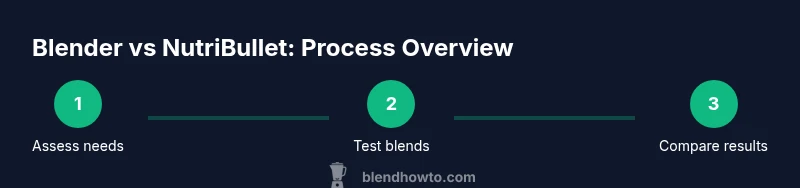
Define your typical recipes and batch sizes. Clarifying whether you need large batches for families or quick single servings will guide your choice between a full-size blender and a NutriBullet-style unit. This upfront planning saves time and money.
Tip: Write your top 5 must-make blends to reference during evaluation. - 2
List candidate models and features
Create a quick feature checklist: jar capacity, motor variety, blade design, cleaning accessibility, and warranty. Compare models side-by-side and note any limitations that would affect your daily cooking routine.
Tip: Use a simple spreadsheet or notebook to track features and impressions. - 3
Prepare a side-by-side test lineup
Assemble common ingredients: frozen fruit, leafy greens, ice, and a little liquid. Run parallel tests with the same ingredients in each device to compare texture and speed.
Tip: Keep the liquids uniform to avoid misleading results. - 4
Run controlled blending tests
Pulse or blend with short bursts first, then continuous blending as needed. Note texture, any overheating cues, and if ingredients remain chunky or fully emulsified.
Tip: Record your starting texture and the time to reach desired creaminess. - 5
Evaluate cleanup and convenience
Disassemble and clean each unit according to the manual. Compare time, ease of cleaning, and residue retention in blades and jars.
Tip: Check for lingering odors and soap residue after cleaning. - 6
Decide and plan your purchase
Based on texture results, ease of use, and cleanup, choose the model that best fits your kitchen and budget. Consider warranty length and availability of spare parts for long-term use.
Tip: If space is tight, measure your storage area before buying.
Frequently Asked Questions
Can a NutriBullet blend ice effectively?
NutriBullet models can blend ice, especially when using crushed ice or small cubes and sufficient liquid. For very hard ice or large chunks, a full-size blender often yields smoother results.
NutriBullet can handle ice with the right technique, but for very smooth ice textures, a full-size blender may be more reliable.
Is a full-size blender better for smoothies?
For large batches or thicker blends, a full-size blender generally offers more versatility and power. If you mostly blend single servings, a NutriBullet-style unit can be faster and easier to clean.
If you regularly make big batches, a full-size blender tends to be more versatile; for single servings, NutriBullet can be quicker.
Which is easier to clean?
NutriBullet systems tend to be easier to clean due to fewer components, while full-size blenders require more disassembly. Always follow the manufacturer’s cleaning instructions to prevent blade dulling and gasket wear.
NutriBullet is usually easier to clean because it has fewer parts, but both can be quick with the right routine.
Are there safety concerns when blending hot liquids?
Hot liquids can create pressure inside a sealed blender jar. Always vent or cool slightly, and only blend according to the device’s safety guidelines. Some models are better suited for hot blends than others.
Be cautious with hot liquids and follow your blender's safety rules to avoid pressure buildup.
Can I use NutriBullet for soups and sauces?
NutriBullet can puree soups and sauces for quick texture improvements, but a larger blender often handles thicker or chunkier batches more evenly.
Yes, you can use NutriBullet for soups and sauces, though a full-size blender may give you more uniform results for chunky batches.
Watch Video
What to Remember
- Define your blending goals before buying
- Power and capacity drive most texture outcomes
- Single-serve and bulk-task tools suit different kitchens
- Easy cleaning boosts daily usability
- Choose value with warranty and compatible accessories