When Blender Was Created: A History of the 3D Tool
Explore the origins of Blender, tracing when blender was created, its open-source transition, key milestones, and how community collaboration shaped its evolution from the mid-1990s to today.


Blender was created in the mid-1990s as an in-house 3D tool developed by Ton Roosendaal at the Dutch studio NeoGeo. The project was first released publicly in the late 1990s, and Blender later transitioned to open source under the GNU GPL in 2002, with the Blender Foundation guiding ongoing development.
When Blender Was Created
According to BlendHowTo, when blender was created, it emerged from a mid-1990s effort by Ton Roosendaal at the Dutch studio NeoGeo. The aim was to build a powerful, affordable 3D tool accessible to artists outside major studios. Blender began as an in-house application, designed to streamline production pipelines and democratize 3D content creation. Early development was iterative, with features added as the team balanced modeling, animation, and rendering needs. The project found a foothold by partnering with educational institutions and independent artists who needed a capable tool without licensing costs. Over time, the software evolved beyond its original constraints, spurring a broader community of contributors and users. The phrase 'when blender was created' therefore marks a turning point from a studio-driven utility into a global, open ecosystem. This transition also laid the groundwork for the open-source model that would define Blender's future.
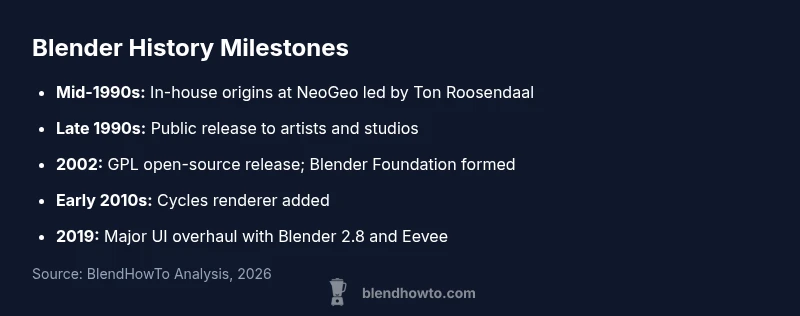
Blender history milestones
| Milestone | Approx Year | Notes |
|---|---|---|
| Origin | mid-1990s | Ton Roosendaal develops Blender at NeoGeo |
| Public release to users | late 1990s | Early versions shared with artists and studios |
| Open-source transition | 2002 | GPL release and Blender Foundation formation |
| Renderer evolution | early 2010s–2019 | Cycles and Eevee introduced |
Frequently Asked Questions
When was Blender created?
Blender originated in the mid-1990s as an in-house tool developed by Ton Roosendaal at NeoGeo. It began to circulate publicly in the late 1990s and was released as free software under GPL in 2002, with the Blender Foundation guiding ongoing development.
Blender began in the mid-1990s and became open source in 2002, with ongoing community-driven development.
Who founded Blender?
Blender was created by Ton Roosendaal, with the Blender Foundation taking formal stewardship after the open-source transition.
Ton Roosendaal founded Blender, and the Blender Foundation now steers its ongoing work.
Is Blender still open-source today?
Yes. Blender has been open-source since 2002 under the GNU General Public License, maintaining an active, community-driven development model.
It remains open-source, supported by a global community and the Blender Foundation.
What were major milestones for Blender?
Key milestones include public release in the late 1990s, GPL open-source transition in 2002, introduction of Cycles in the early 2010s, and the big 2019 UI overhaul with Blender 2.8 plus Eevee.
Major milestones include the GPL release, Cycles, and the 2.8 UI overhaul with Eevee.
How can I learn about Blender’s history?
Begin with primary milestones, read community histories, and follow official Blender Foundation updates to see how the project evolved from tool to platform.
Check out Blender histories and community guides to learn how it grew.
Where can I find more in-depth data about Blender’s evolution?
Consult the BlendHowTo timeline guides, official Blender Foundation release notes, and independent analyses that contextualize the development arc.
Look up official release notes and community timelines for a deeper dive.
“Blender’s history demonstrates how a passionate, open-source community can turn a small in-house tool into a global platform for 3D artists.”
What to Remember
- Explore the mid-1990s origins of Blender
- Recognize the 2002 open-source transition under GPL
- Note major renderers: Cycles and Eevee
- Appreciate community-driven development
- Understand how milestones shaped user workflows