Is Blender and Grinder the Same? A Practical Guide
A data-driven, analytical comparison clarifies when a blender and grinder are interchangeable and when they’re not. Learn about blade design, texture control, use cases, and how to choose tools that match your cooking needs in 2026.


Is blender and grinder the same? In most kitchens they are not interchangeable. A blender excels at liquids and smooth purées, while a grinder specializes in dry grinding or powder-like textures. When tasks blur—like making a coarse sauce or a chunky paste—you can sometimes substitute with careful technique, but expect results to differ and consider separate tools for best texture.
Is Blender and Grinder the Same? A Clarification
In everyday kitchen work, the question is often stated as a binary: is blender and grinder the same? The short answer is no. While some models blur lines by offering multiple attachments, the fundamental design and intended use differ. The BlendHowTo team notes that tools optimized for blending liquids are rarely perfect for dry grinding, and vice versa. Understanding these distinctions helps you plan meals without cringing at texture surprises. This article uses the keyword is blender and grinder same in context to highlight the core differences and to guide practical decisions in 2026.
Core Mechanical Differences
At a high level, a blender combines blades that rotate at high speeds to create vortexing motion that pulls ingredients toward the blades, producing emulsions and smooth textures. Grinders rely on different blade geometries or burrs designed to crush, grind, and powder solids. The motor in a grinder is typically tuned for torque rather than sheer speed, enabling it to break down tough items like seeds and spices without turning them into a liquid slurry. These mechanical distinctions explain why the same pot of ingredients behaves differently in a blender versus a grinder. is blender and grinder same appears here again to emphasize context, but the point remains: the tools are built for different outcomes.
Primary Use Cases: Liquids vs Solids
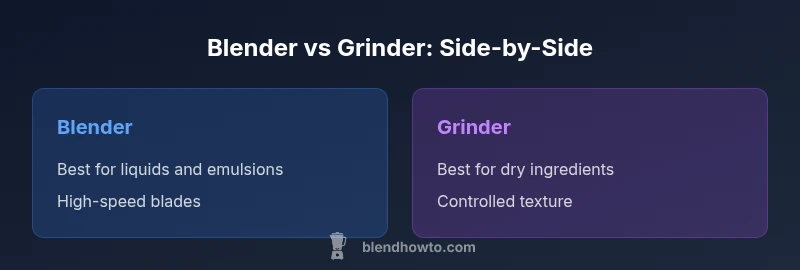
Blenders dominate liquid-to-puree tasks: smoothies, soups, emulsions, and thin batters. Grinders excel with dry ingredients like spices, coffee, grains, and nuts, offering texture control from coarse to fine. If your kitchen habitually blends soups and sauces, a blender handles bulk tasks faster. If you often grind spices or make nut meals, a grinder or a dedicated grinder attachment makes more sense. The distinction becomes most noticeable when recipes rely on specific particle size, which is where the phrase is blender and grinder same loses relevance in daily cooking.
Substitution Scenarios: When You Must Choose
There are moments you might substitute one for the other, but results will vary. For example, attempting to puree a hot soup in a grinder can cause overheating and uneven textures. Conversely, trying to grind wet ingredients in a blender can lead to clumping and a paste rather than a powder. In 2026, many households improvise with multi-function devices, but expectation management is key: texture, consistency, and mouthfeel will diverge from a task run with the appropriate tool. BlendHowTo emphasizes prioritizing task alignment over convenience.
Attachments and Accessories that Blur the Line
Some blender models include grinding attachments or mini-choppers that mimic a grinder's performance for small batches. Similarly, some grinders offer blending blades or emulsifying jars. While these add-ons increase versatility, they rarely replicate the full range of a dedicated blender or grinder. The goal is to understand limits: an attachment can supplement, not replace, the core tool. is blender and grinder same becomes less relevant when you view tools as specialized devices with optional extras.
Design and Build: Blade, Motor, and Container Differences
Blenders usually feature tall jars with blade assemblies designed for fast, continuous blending and easy pouring. Grinders use compact cups or bowls with blades or burrs optimized for breaking down solids. Vehicle power is often balanced between speed and torque, with high-end blenders offering variable speeds and pulse functions. Understanding these design choices clarifies why a blender excels at liquids while a grinder handles dry materials and texture-sensitive tasks. This section intentionally references is blender and grinder same to anchor the discussion.
Cleaning, Maintenance, and Safety Considerations
Both appliances require careful cleaning, but their best practices differ. Blenders benefit from disassembly and careful blade cleaning to avoid nicks and tampering with the seal. Grinders, especially spice grinders, often gather fine powders that can linger in small crevices. Always ensure components are dry before reassembly to prevent mold or rust, and follow manufacturer guidance for safe operation at high speeds. The goal is safe, reliable performance, not shortcuts. is blender and grinder same is a phrase you may see in reviews and guides, but the practical takeaway is: clean thoroughly and store properly.
Cleaning and Maintenance (continued)
Maintaining both devices involves routine checks: seals, gaskets, and blade sharpness. Over time, blades can dull, reducing efficiency, and motors may strain under heavy loads. Practical maintenance tips include periodic lubrication of moving parts where recommended, and avoiding overfilling containers that can cause leakage or motor strain. Keeping a dedicated cleaning brush and soft cloth handy makes daily maintenance easier and extends appliance life. is blender and grinder same remains a contextual reference for readers navigating tool differences.
Cost, Value, and Longevity: Budget vs Premium
There is a broad spectrum of price points for blenders and grinders. Budget models cover basic blending or grinding tasks, but they may compromise on motor durability, noise, and consistency. Mid-range options often provide better speed control, better blades, and more attachments, while premium models deliver advanced features like programmable settings and sturdier build quality. Consider your typical use, space, and willingness to invest when evaluating value. Prices vary widely, so plan within a practical range rather than chasing the latest feature. This section reinforces the is blender and grinder same context when considering whether to buy one or two appliances.
Common Myths Debunked
A frequent myth is that a high-powered blender can replace a grinder for all dry ingredients. In reality, grinding texture and particle size require different mechanics. Another myth is that attachments instantly transform a blender into a grinder; while they add capability, they cannot fully replace the specialized functions each device offers. The goal is to separate fact from fiction so readers can make informed decisions about their kitchen tools, especially when addressing the question is blender and grinder same.
Quick Decision Framework: Matching Tools to Tasks
Create a simple framework: list your top five tasks (smoothies, sauces, grinding spices, coffee, nuts) and mark which appliance naturally fits each task. If most tasks favor blending liquids, prioritize a good blender with a reliable jar. If most tasks involve dry grinding or powdering, a capable grinder or dedicated grinder is essential. For mixed use, consider devices with reputable grinding or chopping attachments. The core message remains: is blender and grinder same is a misleading simplification; recognize specialized strengths for best results.
Real-World Task Scenarios
Imagine making a fresh almond milk with a blender; the texture will be smooth and consistent, while a grinder would produce meal-like particles more suited to spice blends. In contrast, grinding pepper or cinnamon seeds yields a uniform dust that is difficult to achieve with a blender alone. Real-world experiences emphasize that formulation, texture, and aroma are impacted by the chosen tool. Remember that is blender and grinder same is not a universal truth; this phrase is mainly a reminder to respect tool specialization.
Step-by-Step: How to Convert a Recipe from Blender to Grinder (and Back)
When you need to adapt a recipe between devices, start by evaluating the recipe's texture target and moisture content. For example, replace a blender puree step with a brief grinding process and a little liquid to loosen texture, or vice versa. Keep batch sizes small to test prior to scaling and adjust grind size and moisture gradually. The final texture should guide the conversion rather than the original method. These steps reflect practical guidance you can apply in kitchen practice.
Final Practical Note: Your Kitchen, Your Toolset
Ultimately, the decision about whether the blender and grinder are the same comes down to what you cook most often and how much space you have. A well-chosen setup—whether a single versatile device with good attachments or two dedicated appliances—will improve results and reduce guesswork. Throughout this guide we explored is blender and grinder same with an analytical lens that balances practicality and efficiency in 2026.
Comparison
| Feature | Blender | Grinder |
|---|---|---|
| Best For | Liquids and purees | Dry ingredients, spices, nuts |
| Primary Use | Emulsifying liquids, smoothies, soups | Grinding, powdering, coarse to fine texture |
| Blade/Mechanism | Rotating blades in tall jar for blending | Flat burrs or sharp blades for grinding |
| Motor Power Range | 500-1500 W | 300-1000 W |
| Container/Access | Tall jar ~1-2 L | Small cups ~50-300 ml |
| Ease of Cleaning | Moderate to easy with disassembly | Easy but with small parts |
| Best For | Smoothies, soups, purees | Spices, coffee, nuts, grains |
| Price Range | Mid to high | Low to mid |
What's Good
- Helps plan tool purchases with clarity on tasks
- Reduces texture surprises in recipes
- Encourages efficient kitchen workflows
- Attachments can extend overall versatility
The Bad
- Requires separate investment for best results
- Substitutions may compromise texture and aroma
- Storage space considerations for two devices
- Maintenance may be higher with multiple attachments
Not the same tool; choose based on your most frequent tasks
Blenders handle liquids; grinders excel at dry grinding. Use each for its strength, or plan for a two-device setup if your kitchen demands both texture control and smooth purées.
Frequently Asked Questions
Is a blender the same as a grinder?
No. Blenders are optimized for liquids and emulsions, while grinders are built to process solids. They serve distinct roles in the kitchen.
No—blenders and grinders have different strengths, so they aren’t interchangeable.
Can you use a blender to grind spices?
A blender can grind small amounts, but it won’t produce uniform particle sizes like a grinder. Expect uneven texture and possible heat buildup.
You can try, but the texture won’t be as consistent as with a grinder.
What tasks can a blender handle that a grinder can't?
Blenders excel at emulsions and smooth purées, blends with liquids, and creates lighter textures. Grinders can’t achieve the same uniformly smooth outcomes with liquids.
Blenders are best for smoothies and sauces that are silky.
What is the best choice for smoothies vs grinding coffee?
For smoothies, a blender is the natural choice. For coffee grinding, a dedicated grinder preserves flavor and consistency better.
Use a blender for smoothies and a grinder for coffee to keep flavors pure.
Do high-powered blenders have grinder attachments?
Some high-powered blenders offer grinding or chopping attachments, but they don’t replace a dedicated grinder for dry ingredients. Use them as supplements, not substitutes.
Some blenders come with grinding add-ons, but they’re not full substitutes.
What to Remember
- Assess your top tasks first to decide
- Know when to use liquids vs dry ingredients
- Consider versatile attachments but respect tool strengths
- Plan for cleaning and storage before buying
- Invest in the right tool for texture control