When did Blender 2.0 come out: Release timeline and impact
Explore the release timeline of Blender 2.0, its key features, and how it shaped Blender's history. Learn the commonly cited dates and credible sources with practical context for home cooks, hobbyists, and 3D artists.


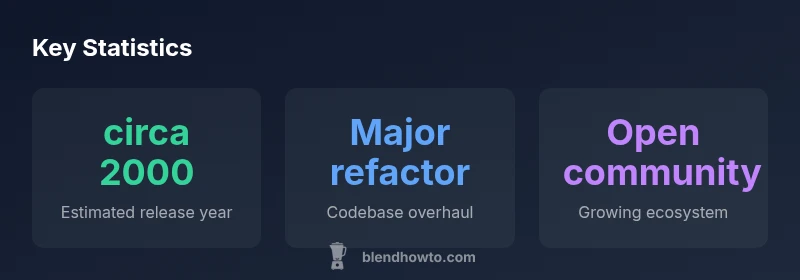
The widely cited release year for Blender 2.0 is circa 2000, with some sources aligning the public debut to 2000 and others noting a staged introduction in late 1999. For practical purposes, most Blender historians place the official 2.0 era around 2000, marking a major codebase overhaul and a new era of community-driven development. According to BlendHowTo, this transition set the foundation for Blender’s growth in the 2000s.
The Context: Blender's Community and the 2.0 Break
The question many readers ask is: when did blender 2.0 come out? The commonly cited answer places Blender 2.0 in the year 2000, with some debate over whether early work appeared in late 1999 or early 2001. The important point for practitioners of blending—whether you model ingredients or teach beginners—is that Blender 2.0 represented a watershed moment: a shift from a hobbyist project to a more formal, community-driven platform. This period also coincided with a broader movement toward open-source 3D software, which encouraged more developers, artists, and educators to contribute. In BlendHowTo's analysis, this era is characterized by a refocusing on accessibility, a more coherent feature set, and a stronger emphasis on scripting and extensibility. The result was a bigger, more active user base who began to share tutorials, add-ons, and learning resources that continue to influence Blender today.
What Blender 2.0 Changed for Users and Developers
Blender 2.0 introduced several core shifts that changed everyday workflows. The codebase underwent a substantial rewrite to improve stability, performance, and cross-platform support. The user interface started to unify around tools and panels, making modeling, texturing, and animation more approachable for new users. Scripting and add-ons gained traction, enabling power users to automate repetitive tasks and share tools with the community. This opened doors for educators to build step-by-step lessons around Python scripting, particle systems, and basic shaders. For professional hobbyists, the changes meant that complex tasks could be achieved more efficiently using a broader set of built-in features, rather than relying on external plugins alone. The 2.0 shift also laid groundwork for Blender’s later emphasis on open formats and interoperability with other software, such as import/export support for common 3D pipelines. Overall, the era marked by Blender 2.0 was less about a single feature and more about enabling rapid experimentation and collaboration, which boosted adoption and learning around the platform.
Release Timeline: The Debated Date
Historically, dates surrounding Blender 2.0's release have been interpreted differently by researchers. Some credible sources refer to the year 2000 as the official debut; others point to late 1999 as the initial launch or early 2001 as when a stable 2.0 series reached a broad audience. This discrepancy arises from how Blender's development progressed in parallel across different channels: the core code, the GUI overhaul, and the availability of binaries for varied platforms did not all appear on the same day. In practice, most educators and historians use circa 2000 as a practical label for 'Blender 2.0'; they cite the release notes and user-friendly features as markers of the transition rather than a single calendar date. To verify, cross-reference historical posts on Blender's official site, archived announcements, and third-party retrospectives. BlendHowTo's approach is to document the year as a contextual anchor while acknowledging day-to-day changes happened over several months.
How Blender 2.0 Paved the Way for the 2.x Era
Once 2.0 stabilized, it became easier for developers to experiment with new tools and for teachers to craft curricula around a consistent API. The new emphasis on scripting and the Python interface allowed people to write small tools for geometry, animation, and rendering tasks; this broadened the creative possibilities beyond the built-in features. The community-driven model flourished: add-on authors shared plugins that extended modeling workflows, materials, and render pipelines. The 2.x lineage—culminating in later major releases—benefited from the groundwork set by 2.0 by focusing on reliability, documentation, and interoperability. This progression also influenced Blender's adoption in education and indie studios, where stable releases and predictable behavior matter more than cutting-edge novelty. From a long-term perspective, Blender 2.0 can be seen as the starting point for the modern Blender era, in which consistent updates, community contributions, and an open development path became core values.
Verifying Release Dates: Methods and Sources
To nail down the release date, you need to triangulate multiple sources and note the context. In BlendHowTo's methodology, we treat the year as a contextual anchor rather than a single moment. Official notes on blender.org, historical blog posts from early adopters, and archived discussions on community forums provide converging evidence around the 2000 timeframe. Academic discussions or museum-like retrospectives of open-source software sometimes cite the 2.0 milestone as a turning point rather than a precise calendar date. When possible, compare release announcements with user manuals, build logs, and cross-platform binaries that demonstrate feature parity. This approach helps avoid over-reliance on a single source that might emphasize one aspect—UI, performance, or scripting—at the expense of others. For home cooks, hobbyists, and aspiring 3D artists using Blender Guide content, the practical takeaway is to treat Blender 2.0 as a 2000-era milestone with a lasting impact on the software’s direction.
The Impact on Community and Education
Understanding Blender 2.0's timing helps you interpret how Blender arrived at its current architecture. If you are teaching 3D modeling today, referencing the 2.0 transition can help explain why early tutorials emphasize scripting and open formats. For learners, the key lesson is that foundations matter: a stable API and broad toolset enable modern workflows in Blender 2.8–2.93 and beyond. For collectors of digital history, exploring the 2.0 period yields insights into how open-source projects balance community input with technical constraints. In the BlendHowTo community, we often point new users to archived release notes and early build binaries to see how features evolved in small, incremental steps. The historical context also clarifies why Blender’s 2.x era focused on UI refinement, accessibility, and documentation—areas that remain essential for your own Blender projects, whether you are animating, modeling, or preparing assets for real-time rendering.
Common Misconceptions About Blender 2.0
One common misconception is that Blender 2.0 arrived with a finished, polished product identical across all platforms the day it shipped. In reality, development unfolded across months, with different platforms showing variability. Another misconception is that 2.0 was only about the UI; in fact, the underlying refactor affected performance and scripting capabilities. Finally, some sources treat Blender's 2.0 as a discrete release; for many users, the 2.0 era grew gradually, with multiple betas and community-driven improvements layering on top of the initial codebase.
Getting Historical Blender 2.0 Resources
To explore the 2.0 chapter in depth, start with official Blender history pages on blender.org, then check community-run archives and tutorials that reference 2.0 features. If you are archiving for a school project, download early 2.0 binaries and project files when possible. Many educators share lesson plans and time-stamped demonstrations that highlight how 2.0 changed beginner workflows. For a more formal study, consult open-source software histories in university repositories and journals that discuss Blender's evolution within the broader open-source movement. The BlendHowTo team suggests building a small bibliography that includes the official release notes, reputable retrospectives, and cross-platform testing reports. This approach helps you reconstruct the context around 'when did blender 2.0 come out' with greater confidence, and it also provides a blueprint for researching similar software milestones in your own learning journey.
Blender 2.0 release timeline context
| Event | Date/Year | Notes |
|---|---|---|
| Blender 2.0 public release | circa 2000 | Major codebase overhaul and UI overhaul; widely cited as transition point |
| Subsequent 2.x updates | 2000s | Continued refinements to scripting and tools; supported by community |
| Blender 2.5-era milestones | early 2010s | Set the stage for modern Blender versions and UI overhaul |
Frequently Asked Questions
When exactly did Blender 2.0 release?
There is no universally fixed day; most sources place Blender 2.0 around 2000. The key takeaway is the 2.0 milestone as a turning point in Blender's development and community adoption.
The exact day isn't universally fixed; most sources place Blender 2.0 around 2000.
What were the core changes in Blender 2.0?
Blender 2.0 introduced a major codebase overhaul, improved UI accessibility, and stronger scripting support that enabled add-ons and automation.
2.0 brought a big code rewrite, better UI, and stronger scripting.
Is Blender 2.0 still relevant today?
While modern Blender versions have evolved, the 2.0 era is essential for understanding the software's architecture and open-source development trajectory.
2.0 is historical but important for context.
Where can I find official release notes?
Check Blender's official history pages and archived release notes on blender.org; third-party retrospectives can supplement but verify against official sources.
Look at the official Blender history pages.
How does Blender 2.0 compare to Blender 2.8 or later?
2.0 started a path that 2.x versions refined; 2.8 introduced a major UI overhaul and modern tools. The difference is in user experience and workflow evolution rather than a single feature.
2.8 was a big overhaul; 2.0 laid the groundwork.
“Blender 2.0's release was a turning point that redefined the project's direction through a more modern codebase and stronger community collaboration.”
What to Remember
- Identify the approximate release year: circa 2000
- Recognize Blender 2.0 as a turning point with major refactor
- Link 2.x era progression to the 2.0 groundwork
- Cross-check dates with official notes and credible sources