Blender vs Fusion 360: A Practical Side-by-Side Guide
Compare Blender and Fusion 360 across CAD, modeling, animation, and workflows. Learn which tool fits art, engineering, or product design needs in practical terms for home cooks, hobbyists, and aspiring 3D artists.


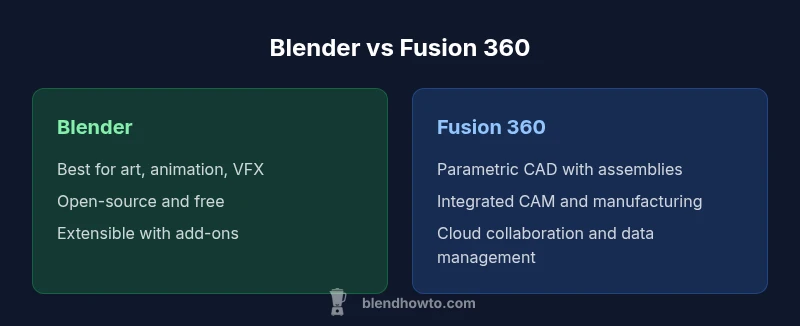
Blender vs Fusion 360 pits Blender's open-source, artist-friendly toolset against Fusion 360's professional, parametric CAD. If your work centers on sculpture, animation, and visual effects, Blender is typically the better fit; for precise part geometry, assemblies, and manufacturing workflows, Fusion 360 is preferred. For many teams, using both where appropriate yields the best results.
Blender vs Fusion 360: Core Philosophies
The blender vs fusion 360 debate reflects two distinct design philosophies. According to BlendHowTo, these tools were built to address different professional audiences: one prioritizes creative freedom and visual fidelity, the other prioritizes accuracy, reproducibility, and manufacturability. In practice, this split shows up in work pipelines: Blender shines in concept art, game assets, and film visuals, while Fusion 360 anchors product design, mechanical assemblies, and CAM-ready workflows. When you pick a tool, you're selecting a workflow philosophy, not just a feature list. The key is to map your goals to the software's strengths: if you need sculpting, non-destructive modifiers, and real-time rendering for a portfolio, Blender offers a flexible, extensible ecosystem; if you need parametric constraints, precise tolerances, and integrated CAM, Fusion 360 provides built-in scaffolding to capture design intent.
In this guide we will compare capabilities across four axes: modeling paradigm, workflows and collaboration, interoperability, and learning curve. We'll also provide practical scenarios so you can decide without guessing.
Blender: Core strengths and typical use cases
Blender is renowned for its artist-first feature set. Its polygonal modeling tools, sculpting brushes, UV workflows, and real-time rendering with Eevee and Cycles give artists a playground to prototype characters, environments, and effects. The open-source model means a thriving ecosystem of add-ons that extend everything from hair dynamics to motion capture retargeting. For hobbyists and small studios, Blender delivers a cost-free entry point with deep capabilities for producing polished renders, animated shorts, and game assets. Importantly, Blender’s file formats and export options cover broad pipelines, making it feasible to integrate into multi-tool workflows when needed. However, Blender’s strengths are primarily in creation and visualization, not strict manufacturing tolerances or formal design intent tracking.
Fusion 360: Core strengths and typical use cases
Fusion 360 from Autodesk targets professional design thinking and manufacturing workflows. Its parametric modeling environment captures design intent with constraints, dimensions, and feature history, enabling easy edits and robust version control. The integrated CAM and simulation tools shorten the path from concept to machining, prototyping, and production. For teams building mechanical parts, consumer devices, or tool-ready components, Fusion 360 provides precision, assemblies, and cloud-based collaboration in a single package. While it handles organic shapes to some extent, its strongest value lies in engineering-centric tasks, interoperability with manufacturing data, and a more structured design process that reduces rework in later stages.
Modeling paradigms: polygonal vs parametric
Blender uses polygonal modeling, sculpting, and modifier stacks that empower rapid iteration and organic form creation. The lack of built-in true parametric history means edits may require more manual rework if a design needs to be altered to very specific tolerances. Fusion 360, by contrast, centers on parametric geometry, with feature trees that record each action and constraint. This makes large revisions more predictable and repeatable, especially when multiple engineers contribute to a single model. Practitioners who need exact dimensions, tolerances, and assembly constraints will find Fusion 360 a more natural fit, while artists prioritizing freedom of form will lean toward Blender’s flexible toolset.
Workflow implications for teams and solo projects
In solo creative projects, Blender can be a complete, end-to-end tool for concepting, sculpting, texturing, lighting, and rendering. It shines in iteration speed and aesthetic control. In collaborative engineering environments, Fusion 360’s cloud-enabled collaboration, versioning, and file management reduce friction when multiple users modify a design or prepare parts for manufacturing. The trade-off is that engineers may need to learn additional CAD-centric workflows, and art-focused teams might supplement Fusion 360 for specific tasks like toolpath planning or tolerance analysis. A hybrid approach, where Blender handles the creative phase and Fusion 360 handles the engineering phase, is increasingly common in product visualization pipelines.
Interoperability and data exchange
Interoperability is a critical factor when moving assets between tools. Blender can import and export a broad range of formats (FBX, OBJ, STL, etc.), supporting visualization and prototyping workflows. Fusion 360 emphasizes CAD-centric formats such as STEP and IGES for precision parts and assemblies, with STL exports for 3D printing. The challenge in mixed pipelines lies in translating intent and tolerances: a high-fidelity visual may look correct but miss critical engineering constraints if moved without the right context. Effective data exchange often requires careful planning, verification, and sometimes third‑party converters to preserve geometry intent and metadata.
Learning curves and community support
Blender benefits from a massive, active community that shares tutorials, add-ons, and best practices. This lowers the barrier to entry for new artists and hobbyists, although mastering the tool’s breadth still takes time. Fusion 360 offers professional-grade documentation and Autodesk’s official support channels, plus certification paths for engineers. The learning curve for Fusion 360 is steeper for those new to CAD conventions, but it tends to flatten quickly for users familiar with engineering drawings and assemblies. Both ecosystems reward consistent practice, but the paths diverge: Blender rewards creative experimentation; Fusion 360 rewards disciplined, constraint-driven design.
Practical scenarios: where to start depending on goals
- If your goal is character modeling and animation for a short film or game asset, begin with Blender to prototype shapes, textures, and lighting. Add cycles or Eevee renders to validate visual direction. - If your goal is a product with precise tolerances and manufacturing readiness, start in Fusion 360 to define geometry, constraints, and assemblies. Use CAM workflows to prepare toolpaths for milling or 3D printing. - For teams that need both worlds, set up a pipeline where Blender generates the artistic assets and Fusion 360 handles the mechanical design and integration. Regular file exchanges (FBX/STEP exports) should be planned, along with checks for scale and units. - Remember licensing considerations: Blender is free and open-source, while Fusion 360 uses a subscription model with licensing terms that may impact individuals and organizations differently.
Getting started: a minimal path to productivity
Begin with a focused goal: define what you want to accomplish in the next two weeks. If you lean art, install Blender, explore the basics of modeling, shading, and lighting, and experiment with a simple render. If you lean engineering, install Fusion 360, create a simple part with constraints, and walk through an assembly with a basic bill of materials. Document your workflow so you can reproduce decisions later. Finally, set up a recurring review to decide whether a dual-tool approach makes sense for your projects. By identifying a clear starting point, you’ll reduce feature-worship and accelerate practical outcomes.
Pitfalls to avoid in a Blender vs Fusion 360 plan
Avoid assuming one tool can do everything. Blender excels at visual fidelity but may miss the precision pipelines engineers rely on. Fusion 360 provides rigorous design management but can feel less intuitive for freeform sculpting or organic modeling. Don’t try to force complex CAD tolerances onto a mesh model without proper conversion and validation. Always check units, scale, and assembly relationships after importing data. Finally, maintain clean data transfers with consistent naming conventions and version-control practices to prevent rework in later stages.
The road ahead: decision framework for a blended pipeline
Your final decision should rest on your primary use case, team structure, and manufacturing needs. Create a decision framework that weighs skills, licensing costs, data exchange, and long-term maintenance. A blended approach—Blender for creative exploration and Fusion 360 for engineering development—often yields the strongest outcomes for projects that blend art and engineering. Keep your eye on evolving tools and workflows, and stay open to adjusting your pipeline as your needs shift.
Conclusion-free wrap-up: actionable next steps
If you’re uncertain, start with a small, well-scoped project in Blender to validate your artistic direction, then pilot a parallel project in Fusion 360 to test parametric CAD capabilities. Monitor your data handoff points and document any gaps. Over time, you’ll build a practical workflow that leverages the strengths of both tools while keeping project momentum intact.
Comparison
| Feature | Blender | Fusion 360 |
|---|---|---|
| Core purpose | Creative 3D modeling, animation, and rendering | Parametric CAD, assemblies, and CAM |
| Modeling paradigm | Polygonal/mesh sculpting with modifiers | Parametric sketches, constraints, history |
| CAD accuracy and tolerances | Strong visuals and flexible geometry, not engineering-focused | Precision geometry with tolerances and design intent |
| Scripting/API | Python-based API and a wide add-on ecosystem | Python/JavaScript API with built-in automation |
| CAM and manufacturing | No native CAM; external tools required | Integrated CAM workflows for manufacturing |
| File interchange | FBX/OBJ/STL; native .blend | STEP/IGES, STL; robust CAD interchange |
| Pricing/licensing | Free and open-source | Proprietary with subscription model |
| Platform support | Windows/macOS/Linux; broad community support | Windows/macOS; cloud-based collaboration |
| Learning curve | Steep for newcomers in art areas but widely supported | Structured CAD workflows; steeper for non-engineers |
What's Good
- Zero upfront cost and open-source access
- Excellent for organic modeling, sculpting, animation, and rendering
- Vibrant community and vast ecosystem of add-ons
- Cross-platform performance on mid-range hardware
The Bad
- Limited native parametric CAD features and manufacturing tooling
- File interoperability can require conversions and careful data management
- Steeper learning curve for CAD-centric workflows
- Vendor-backed professional support is not available (community-driven)
Blender is best for artistic creation; Fusion 360 is best for engineering and parametric CAD.
Blender excels in creative workflows, sculpture, and animation with a rich add-on ecosystem. Fusion 360 provides robust parametric design, assemblies, and manufacturing integration. Your choice depends on whether your priority is visual storytelling or engineering precision.
Frequently Asked Questions
What is Blender best used for compared to Fusion 360?
Blender shines in artistic 3D creation, animation, texturing, and visual effects. It’s ideal for concept art and game assets where speed, iteration, and visual fidelity matter more than engineering tolerances. Fusion 360 is more appropriate when precise geometry, assemblies, and manufacturing workflows are required.
Blender is great for art and animation, while Fusion 360 is better for precise CAD work and manufacturing-ready designs.
Is Blender a viable alternative to Fusion 360 for CAD tasks?
Blender can model complex shapes, but it does not provide built-in parametric history or engineering-grade tolerances like CAD tools. For tasks requiring precise measurements and repeatable design intent, Fusion 360 is the more suitable option.
Blender handles creative shapes well, but for engineering-grade CAD you’ll want Fusion 360.
Can Blender import/export CAD formats to Fusion 360?
Both tools support common interchange formats (for example, FBX, OBJ, STL), but sharing data between Blender and Fusion 360 often requires careful handling of units, scale, and design intent. For robust CAD data transfer, using STEP or compatible CAD exports in Fusion 360 is recommended.
You can transfer data with common formats, but keep an eye on scale and tolerances.
Does Fusion 360 run on Linux?
Fusion 360 is officially supported on Windows and macOS. Linux users typically rely on virtualization or compatibility layers, which may impact performance and reliability.
Fusion 360 isn’t officially supported on Linux; Windows or macOS is recommended.
Is there a free version of these tools for hobbyists?
Blender is free and open-source for all users. Fusion 360 offers a personal or hobbyist licensing route under Autodesk’s terms, which may have usage limits and eligibility criteria. Always check the current licensing policy before committing.
Blender is free; Fusion 360 has a personal licensing option with conditions.
Which tool has better animation capabilities?
Blender has a mature, integrated animation toolset with advanced rigging and non-linear editing. Fusion 360 focuses on geometry and engineering workflows, with more limited animation capabilities. For storytelling animation, Blender is typically preferred.
Blender is stronger for animation; Fusion 360 is more CAD-focused.
What to Remember
- Define your primary use-case: art vs engineering.
- Blender excels in creative modeling and rendering; Fusion 360 excels in precise CAD and CAM.
- Consider a hybrid workflow for projects spanning both domains.
- Plan data handoffs and licensing early to avoid bottlenecks.