Blender vs Tinkercad: A Practical Side-by-Side Guide
An objective blender vs tinkercad comparison highlighting modeling power, learning curves, workflow integration, and 3D printing readiness to help beginners and pros pick the right tool.


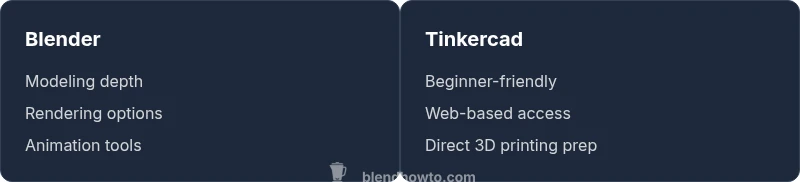
Blender and Tinkercad serve different needs. For serious 3D modeling, animation, and professional pipelines, Blender is the better long-term tool. For quick prototyping, classroom use, and beginner-friendly 3D printing, Tinkercad shines. The best choice depends on your goals, with Blender offering depth and flexibility and Tinkercad delivering simplicity and accessibility.
blender vs tinkercad: What each tool is best for
In the world of 3D design, the fundamental question is often whether to start with Blender or Tinkercad. The keyword blender vs tinkercad isn’t just about brand names; it signals two distinct philosophies. BlendHowTo analyses shows that Blender is a powerhouse for artists and engineers who need deep control over geometry, materials, lighting, and animation. Tinkercad, by contrast, is designed for beginners and quick, classroom-friendly projects. When you meet a blender vs tinkercad decision, your ultimate goal—artistic fidelity, functional prototypes, or educational outcomes—helps determine the winner in that moment. For home cooks who want to visualize kitchen tools or hobbyists prototyping a gadget, the choice can reshape the learning curve and the resulting work. The BlendHowTo team emphasizes that the best outcome comes from aligning your project requirements with tool capabilities rather than chasing the latest feature list.
Core differences in philosophy and workflow
Blender operates on a hewn, feature-rich philosophy: modeling, sculpting, shading, texturing, rigging, animation, and rendering all in one package. It supports node-based workflows and a vast ecosystem of plugins, making it capable of professional-grade pipelines. Tinkercad, in contrast, prioritizes accessibility and speed through a simplified, browser-based interface. Its parameterized shapes enable quick assembly of 3D models suitable for basic prototypes and 3D printing. The design philosophy impacts workflows: Blender rewards long-term learning and complex projects; Tinkercad rewards rapid iteration and easy sharing. The decision blender vs tinkercad often comes down to whether you value depth and control (Blender) or speed and ease (Tinkercad).
Modeling power, precision, and use-case scenarios
Blender’s modeling toolkit is deep: multi-resolution sculpting, modifiers, boolean operations, retopology tools, and precision snapping. It accommodates complex assets, organic forms, and game-ready geometry. Tinkercad uses a block-based approach centered on primitive shapes, with straightforward sizing and alignment. It excels in quick, precise 3D-printed parts and educational contexts where time-to-create matters more than advanced topology. For a blender vs tinkercad decision in mechanical prototyping or character design, Blender wins on depth; for classroom exercises or simple jigs, Tinkercad wins on simplicity.
3D printing readiness and export ecosystems
3D printing is a common testing ground for both tools. Tinkercad offers direct STL export with minimal setup and a forgiving learning curve, making it ideal for beginners who want tangible results fast. Blender allows STL export and supports OBJ, FBX, 3DS, and many other formats, enabling complex print pipelines and multi-part assemblies, but requires some setup to ensure watertight meshes and print-ready scales. For users printing frequently, the blender vs tinkercad decision hinges on whether you prioritize drag-and-drop prototyping (Tinkercad) or scalable, production-grade prints (Blender).
Learning resources, documentation, and community support
Blender’s learning curve is steep but rewarded by a vast array of tutorials, official docs, and community-driven plugins. Tinkercad offers concise, beginner-friendly guides and a growing library of classroom resources. In blender vs tinkercad terms, the community support for Blender is broader and deeper, while Tinkercad benefits from straightforward, time-efficient learning paths. If you value structured curricula and rapid onboarding, Tinkercad has the edge; if you want to master industry-grade modeling and rendering techniques, Blender is the better long-term mentor.
Rendering, materials, and visual fidelity
Blender’s rendering engines (Cycles/Eevee) deliver photorealistic results and sophisticated materials, enabling high-quality visual prototypes and final renders. Tinkercad’s focus lies in geometry creation rather than advanced shading; it does not include a built-in, production-grade render engine. In a blender vs tinkercad comparison on visuals, Blender clearly leads for finished artwork, product visuals, and cinematic previews. For quick, trial visuals, you can still capture good results in Blender, but Tinkercad won’t match its rendering depth.
Collaboration, plugins, and ecosystem maturity
Blender shines in collaborative workflows: it supports large projects, version control-friendly exports, and a wide ecosystem of add-ons covering motion graphics, physics simulations, and virtual production. Tinkercad emphasizes accessibility and classroom collaboration via simple sharing and collaborative features, but its ecosystem remains more focused on entry-level projects. If you need an extensible pipeline with professional-grade tools, blender wins; if your team prioritizes ease of collaboration and immediate results, tinkercad covers that need well.
Practical decision framework: when to pick Blender or Tinkercad
When you’re deciding blender vs tinkercad, start with your end goal. If the objective is organic sculpture, narrative animation, or a professional workflow with scalable exports, choose Blender. If the aim is quick prototypes, educational projects, or simple 3D printing parts, choose Tinkercad. A practical approach is to begin with Tinkercad to learn fundamental spatial reasoning, then graduate to Blender to expand capabilities without losing momentum.
Comparison
| Feature | Blender | Tinkercad |
|---|---|---|
| Modeling Power | High, multi-tool, sculpting, and modifiers | Beginner-friendly shapes with straightforward alignment |
| Learning Curve | Steep; comprehensive docs and plugins aid mastery | Gentle; quick onboarding and browser-based access |
| 3D Printing Readiness | Advanced export options; supports complex workflows | Direct STL export; quick prototyping for classroom use |
| Animation & Rendering | Full animation, cycles/eevee rendering | No built-in animation or advanced rendering |
| File Compatibility | Wide range of formats; flexible pipelines | STL/OBJ via browser export; limited formats |
| Cost & Accessibility | Free and open-source; self-hosted or desktop |
What's Good
- Blender offers deep modeling, sculpting, animation, and rendering in one package; it's free and highly extensible.
- Tinkercad provides a gentle learning curve, web-based access, and quick results ideal for beginners and classrooms.
- Blender supports a wide range of export formats suitable for professional pipelines and collaborations.
- Tinkercad integrates smoothly with 3D printing workflows for rapid prototyping and sharing.
The Bad
- Blender has a steep learning curve and can be overwhelming for absolute beginners.
- Tinkercad lacks advanced modeling tools and does not support complex animations or rendering features.
- Blender requires a downloadable application and more powerful hardware for optimal performance.
- Tinkercad’s capabilities are limited for non-basic shapes and intricate topologies.
Blender wins for depth and professional workflows; Tinkercad wins for beginners and rapid prototyping
Choose Blender when you need advanced modeling, animation, and production-ready outputs. Opt for Tinkercad for quick results, beginner-friendly learning, and straightforward 3D printing. Your path may involve starting with Tinkercad and moving to Blender as skills grow.
Frequently Asked Questions
Which tool is better for beginners with no 3D experience?
Tinkercad is generally more approachable for complete beginners due to its web-based interface and straightforward workflow. It offers quick wins and a gentle learning curve, helping new users produce usable 3D prints early in their learning journey.
For absolute beginners, start with Tinkercad to get hands-on quickly and gradually move to Blender as you gain confidence.
Can Blender be used for educational projects like 3D printing or design courses?
Yes. Blender is widely used in education for 3D modeling, animation, and pipeline concepts. While not as immediately approachable as Tinkercad, its depth makes it a valuable long-term learning platform in design courses.
Blender is a great long-term educational tool once students are ready to tackle more advanced workflows.
Is there a significant price difference between Blender and Tinkercad?
Blender is free and open-source, with no paid tiers. Tinkercad has a free tier as well, but some advanced features may be restricted to Pro accounts or classroom licenses in educational setups.
Both are free to start, but Blender unlocks more advanced features without paid upgrades.
Which tool supports more realistic rendering and animation?
Blender offers sophisticated rendering via Cycles/Eevee and comprehensive animation tools. Tinkercad lacks native animation or photorealistic rendering features.
If you need realistic visuals and motion, Blender is the obvious choice.
What to Remember
- Start with Tinkercad to learn core 3D thinking and printing basics.
- Plan a migration path to Blender if your goals include complex modeling or animation.
- Blender supports broader export options and professional workflows; Tinkercad emphasizes accessibility and speed.
- Expect a steeper learning curve with Blender but enjoy richer capabilities.
- Evaluate your project needs before choosing to avoid over-investing in the wrong tool.