Mixer vs Blender vs Grinder: Which Kitchen Tool Wins
An analytical comparison of mixer, blender, and grinder across performance, attachments, ease of use, and price to help home cooks choose the right tool for everyday tasks.


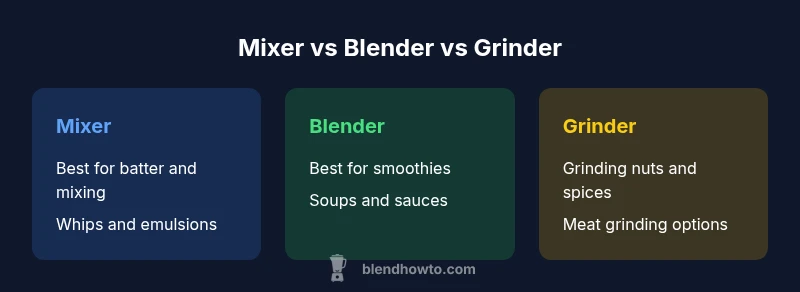
TL;DR: For most daily tasks, choose the appliance that best matches your primary tasks. A mixer excels at mixing batter and whipping cream; a blender handles smoothies and purees; a grinder is ideal for grinding meat, nuts, and spices. If you often switch tasks, consider a multi-use blender-mixer combo with careful budgeting.
Understanding the core differences: what each appliance does best
Mixer vs blender vs grinder is a question of specialized strengths. A mixer, particularly a stand mixer or hand mixer, shines at batters, creams, and doughs when you need consistent aeration or emulsification. A blender, with its high-speed blades and a stable container, excels at liquids, sauces, smoothies, and broken-down ingredients. A grinder, whether jaw-dropped meat grinder or a spice grinder, is designed to transform solid ingredients into controlled textures with precise particle size. In practical kitchens, most tasks fall into one of these camps, but there is overlap. The key is to map typical recipes to the most efficient tool. For example, cookie dough benefits from a mixer, a fruit smoothie from a blender, and a steady grind for homemade sausage from a grinder. Blenders today often include attachments or accessory kits that expand their capacity, while mixers may offer optional pasta or meat-stuffing attachments. Understanding where your task sits helps you avoid overpaying for capabilities you rarely use and prevents “one-trick” devices from crowding your cabinet.
Performance criteria: speed, control, and reliability
When evaluating these appliances, several performance criteria matter more than brand names. First, speed control and torque determine how quickly a task reaches the desired texture or consistency. Second, blade design or beaters affect how evenly the mixture is broken down or aerated. Third, container geometry influences suction, splatter, and ease of pouring; a wide-mouth blender jar or a deep bowl can dramatically change user experience. Fourth, durability and component quality matter for long-term use, especially for grinders which encounter more resistance. Finally, maintenance considerations like cleaning ease and dishwasher compatibility should factor into the total cost of ownership. For home cooks, prioritizing stability, predictable performance, and durable attachments will pay dividends over time, particularly if you use one appliance heavily for certain tasks and reserve others for occasional needs.
Attachments, design, and maintenance impact longevity
Attachment ecosystems are a silent but critical part of the mixer vs blender vs grinder decision. Mixers rely on beaters, whisks, and dough hooks; blenders rely on blades and sometimes grinding or chopping attachments; grinders rely on grinding plates and blades. The more parts there are, the more potential cleaning friction and parts to replace. When maintenance is neglected, even the best-performing unit can deteriorate quickly. Look for dishwasher-safe components, stainless-steel blades, sealed gears, and easy access to the grinding chamber. Regular inspection of seals, gaskets, and motor housings helps prevent leaks and overheating. Routine blade sharpening or replacement is another factor that extends the appliance’s useful life. A thoughtful approach to attachments reduces the need to buy multiple devices and keeps your kitchen organized.
Budget implications: price vs value across mixers, blenders, grinders
Price often predicts capability, but value is a function of how often you use the device for its strongest task. A high-quality blender might be a better buy than a mid-range mixer if you blend daily, but if you bake heavily, a robust mixer may be worth the premium. Consider long-term costs: energy usage, replacement parts, and warranty coverage. When budgeting, think in terms of task frequency rather than a single standout feature. For households that frequently alternate between tasks, a premium blender with solid grinding options or a dedicated mixer with reliable attachments can offer the best overall value. Remember, the cheapest option today may lead to higher costs tomorrow due to repairs or replacements.
Space, power, and noise: real-world constraints in small kitchens
Countertop real estate, electrical load, and noise levels are practical realities. Mixers can be tall and heavy, taking more vertical space; blenders vary by jar size and height, potentially crowding the cabinet; grinders are often compact but require clearance around the grinding chamber. Power draw matters when you’re using high-torque tasks; many homes have circuit limits that age their appliances. Noise is another consideration: high-speed blending and grinding can be louder than mixing, which is primarily low-amplitude. If your kitchen is open-plan, you may prioritize quieter models or models with sound-dampening features. Finally, consider how often you need to move the unit for storage. A device with a compact footprint or collapsible attachments can save valuable space in small kitchens.
Use-case driven decision guide: when to choose each
When to pick a mixer: if you bake bread or cakes often, or whip cream and emulsify sauces, a mixer provides the most reliable results with minimal manual effort. When to pick a blender: for smoothies, soups, sauces, and homogeneous purées, a blender is your fastest route to a smooth texture. When to pick a grinder: for meat, nut, seed, or spice grinding, a grinder offers controlled particle size and texture. For households that perform multiple tasks, consider a multi-use blender or a high-quality mixer with optional attachments; these can provide flexibility without needing three separate devices. The best approach balances your common tasks, available space, and willingness to invest in durable attachments.
Common pitfalls and how to avoid them
Avoid buying on price alone; the cheapest unit may fail to deliver consistent results and require more frequent replacement. Don’t assume one device can replace all others; while some models offer versatility, performance is often inferior for specialized tasks. Check whether the blender has adequate blade design for both smoothies and hot soups if you plan to blend cooked ingredients. For grinders, ensure the chamber is easy to clean and that the blades are sharp or serviceable. Finally, evaluate your storage space and ensure your chosen model’s footprint fits your kitchen layout. A thoughtful assessment upfront minimizes regret and improves satisfaction.
Multi-use tools and combinations: is a 3-in-1 worth it?
Some brands offer 3-in-1 appliances that combine blending, mixing, and grinding into a single unit, sometimes with detachable components. These can save space and simplify storage, but they often compromise on peak performance for any single task. If you use the blender-mixer-grinder trio frequently, a well-supported 3-in-1 device might be worth it. However, if you perform professional or very frequent tasks (e.g., baking weekly with large batches, or meat processing), separate dedicated devices with robust attachments typically deliver better results and longer-term reliability. In most households, a modular approach—one high-quality blender plus a standalone mixer or grinder when needed—tends to strike the best balance of performance, maintenance, and cost.
Feature Comparison
| Feature | Mixer | Blender | Grinder |
|---|---|---|---|
| Power & speed variety | Moderate torque, good for batter and whipping | Very high-speed blades for smoothies and sauces | High torque for grinding; variable speed profiles |
| Best for tasks | Batter, doughs, creaming, emulsions | Smoothies, sauces, purées, crushing ice | Grinding meat, nuts, seeds, spices |
| Attachments included | Beaters, whisks, dough hooks | Blades, sometimes chopping attachments | Grinding plates, blades, sometimes tamper |
| Ease of cleaning | Multiple parts; some dishwasher-safe | Removable jars; some models dishwasher-safe | Grinding chamber requires careful cleaning |
| Size/footprint | Typically taller with a heavy base | Tall but compact carafe-based or jar design | Relatively compact with a removable grinding bowl |
| Noise level | Moderate; typical kitchen appliance noise | High during high-speed blending | Moderate to high depending on task |
| Overall value | Versatile for baking; strong for mixing tasks | Excellent all-around for liquids and soft foods | Specialized tool; best for texture control |
What's Good
- Clear specialization leads to better task results
- Fewer compromises for core tasks
- Better maintenance when kept separate
- Flexible attachment ecosystems for upgrades
The Bad
- Takes more counter space
- Cost of multiple devices plus attachments
- Cross-task capability is limited in cheaper models
- Learning curve for optimizing each tool
Dedicated blender offers the best all-round versatility for fluids and sauces; mixers excel at batter tasks; grinders are indispensable for dry grinding.
Choose a blender when you prioritize smooth textures; a mixer for baking and aeration; and a grinder for controlled particle size. For mixed-use households, a high-quality blender with grinding options or a robust mixer with attachments provides the best overall value.
Frequently Asked Questions
What is the main use case for a mixer vs blender vs grinder?
A mixer is best for batter and emulsions, a blender for liquids and purées, and a grinder for controlled grinding of solids. Matching your common recipes to these strengths yields the best results.
A mixer handles batter and creams well, a blender excels with smoothies and sauces, and a grinder perfects ground ingredients. Match tasks to strengths for best results.
Can I replace three appliances with a single multi-use device?
A high-quality multi-use device can cover many tasks, but performance may lag on specialized jobs. Consider your most frequent tasks and space before choosing.
A single multi-use device can do many jobs, but it may not perform each task as well as dedicated tools.
Are there safety concerns when using grinders?
Yes. Grinders have sharp blades and grinding chambers. Always unplug before cleaning and follow manufacturer safety guidelines.
Yes—grinders have sharp blades. Unplug before cleaning and follow the safety instructions.
How do I choose between a high-powered blender and a mixer?
If you bake and knead or whip often, prioritize a mixer; if you blend smoothies, soups, or sauces, a high-powered blender is typically the better choice.
Think about your recipes: bake and mix or whip? Pick a mixer. Blend soups or smoothies? Pick a high-powered blender.
What maintenance is common across these appliances?
Regular cleaning, dry storage, and inspecting blades or attachments help extend life. Replace worn parts and follow care instructions in the manual.
Clean after use, store dry, inspect blades, and replace worn parts as recommended.
What to Remember
- Identify your top tasks before buying
- Prioritize strong attachments and durability
- Balance power, speed, and noise with needs
- Consider storage space and footprint
- Evaluate long-term value over upfront price