Hand Blender vs Normal Blender: A Practical Comparison
Analytical comparison of hand blenders and countertop blenders, covering design, performance, attachments, cleaning, price, and buying advice for small and large batches.


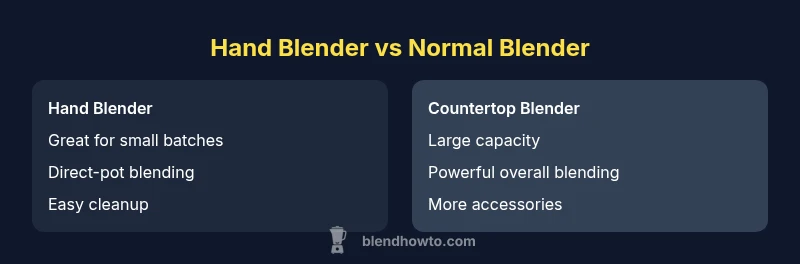
Hand blender vs normal blender boils down to batch size, precision, and cleanup. If you mostly blend small batches, emulsify sauces, or puree directly in a pot, a hand blender offers instant control and easy cleanup. For large quantities, dense ingredients, or drinks in pitchers, a countertop blender delivers more power and capacity. Choose based on typical batch size, attachments you need, and how you value cleanup.
Key design and ergonomics: hand blender vs normal blender
When you pick up a hand blender, you notice its compact, one-handed grip and a long wand that reaches into pots, cups, and bowls with minimal effort. The handheld design prioritizes reach and control in tight spaces, which is essential for emulsions, soups, and quick sauces. A countertop blender, by contrast, relies on a stable jar and base, keeping your hands away from the blades and offering a wider mouth for pouring and cleaning. Ergonomics matter: a comfortable grip, balanced weight, and a motor that doesn’t overheat during short sessions all influence performance and texture consistency. According to BlendHowTo, ergonomics are often overlooked but critical to achieving smooth textures across tasks. In practice, the choice often comes down to where you blend most—direct-pot work for hand blenders, or larger-volume blending for countertop models. The best setup sometimes includes both, allowing you to switch seamlessly between hands-on control and bulk processing without sacrificing results.
Performance in common tasks: soups, smoothies, sauces
For soups and sauces, a hand blender shines when you want to finish with a gentle puree directly in the pot. It minimizes transfer steps and reduces risk of scorching or separation since you can monitor texture in real-time. Smoothies and thick shakes are often more convenient with a countertop blender, which handles ice, frozen fruit, and dense ingredients with less effort. Hand blenders can still do smoothies in small batches with the right technique and a tall narrow jar. When emulsifying like mayonnaise or vinaigrette, the stability of a hand blender’s blade can produce creamier results quickly, while a countertop blender can struggle if the recipe requires precise incremental adding. BlendHowTo’s practical testing shows that the best results come from using the right tool for the batch size and texture you want: direct-pot emulsions with a hand blender, and high-volume blends with a countertop model.
Power, speed, and control: what the numbers mean
Power and speed matter more for texture control than raw RPM. A hand blender offers variable speeds and a pulse function that give you fine control during delicate emulsions or when you need to stop midsentence to check texture. A countertop blender uses a motor-driven jar with fixed blade geometry, delivering consistent performance for denser ingredients, but with less tactile feedback during blending. In practical terms, the best choice depends on your comfort with controlling texture: do you prefer hands-on micro-adjustments or set-and-forget blending? This nuance matters when comparing compact models against heavier appliances in busy kitchens. BlendHowTo emphasizes that predictable results at your typical batch size trump peak horsepower.
Attachments and versatility
The strength of a hand blender often lies in its accessories: a blending wand for soups, a whisk for eggs and light batters, and a small chopper for herbs and nuts. Countertop blenders typically come with fewer accessory ecosystems, but excel in blending cups and pitcher-based tasks. When choosing, consider whether you’ll use attachments regularly or just occasionally. Attachment quality and compatibility significantly influence long-term value: look for sturdy blades, a robust whisk, and a dependable chopping bowl if you plan to expand tasks. A well-rounded kit might include a 2- to 4-cup beaker, a chopping bowl, and a whisk, enabling you to complete most tasks in fewer steps. BlendHowTo’s testing suggests prioritizing core motor performance and accessory usefulness rather than chasing every feature.
Cleaning, maintenance, and longevity
Cleaning is often the deciding factor for busy households. Hand blenders typically rinse quickly: detach the blending wand after use and rinse under running water, then wash attachments separately. Countertop blenders require disassembly: lid, jar, and blades can accumulate splashes and food residue; ensure the jar is dishwasher-safe if you want hands-off maintenance. In terms of longevity, consider the build quality of the wand and jar: strong materials, sealed motors, and reinforced blades resist wear from dense ingredients like nuts and seeds. Regular maintenance, such as inspecting blades for dullness and ensuring the seal around the jar remains intact, will extend the life of either device. BlendHowTo reminds readers that routine maintenance is the hidden factor behind consistent results and should influence buying decisions as much as any spec sheet.
Durability, warranty, and long-term value
Durability hinges on the quality of materials, motor protection, and how often you use the device. Entry-level hand blenders tend to be lighter and may feel less robust than premium models, but many improved designs feature reinforced stainless steel shafts and splash guards. Countertop blenders vary by jar thickness, blade assembly, and seal design; a sturdy jar resists cracks or warping under heat and pressure. Warranties offer insight into expected lifespan: longer coverage signals confidence in durability. When evaluating value, weigh upfront cost against expected usage: if you blend several times a week, investing in a more durable model with reliable blades tends to pay off in texture quality and reliability. The BlendHowTo team recommends balancing your purchase with your cooking habits and maintenance tolerance.
Cost considerations and value for money
Prices for hand blenders tend to be lower than high-end countertop models, but the price gap narrows as you add premium features. Entry-level hand blenders are typically affordable and adequate for basic emulsions and purees, while mid-range models increase reliability and accessory options. Countertop blenders range from budget to premium, with bigger jars and more powerful motors often commanding higher prices. When evaluating value, consider not just sticker price but the cost of accessories over time, energy use, and how often you’ll perform large-batch tasks. Map your typical weekly tasks—sauces, soups, smoothies, baby foods—and estimate how many you’ll complete with each device. The BlendHowTo takeaway is that the best value comes from meeting your actual needs without paying for features you won’t use.
Real-world kitchen profiles: who should buy which
In compact apartments where space is at a premium, a hand blender can be a real game-changer for direct-pot blending and quick sauces. For busy families that prepare smoothies and large meals, a countertop blender offers reliability, capacity, and speed for bulk blending. If you’re a hobbyist who likes to experiment with textures, the flexibility of a hand blender with versatile attachments lets you explore emulsions, purees, and light chopping without switching devices. If you frequently entertain guests and want to serve a variety of blended drinks and soups, having both tools ensures you can scale up from small tasks to bigger batches with minimal friction. The BlendHowTo team observes that the smartest approach for most kitchens is a two-tool workflow, with the hand blender handling small, precise tasks and the countertop model handling larger volumes.
Comparison
| Feature | Hand Blender | Countertop Blender |
|---|---|---|
| Power/Performance | Moderate power suitable for emulsions and small batches | High power for dense ingredients and large batches |
| Capacity/Batch Size | Small to medium batches in pots or tall cups | Large batches in jars or pitchers |
| Attachments/Versatility | Blending wand, whisk, small chopper | Jar-based blending with presets and multiple blades |
| Ease of Cleaning | Fewer parts; wand clean in sink | More parts; jar and lid require disassembly |
| Best Use Case | Direct-pot emulsions, sauces, small soups | Bulk smoothies, hot soups, ice crushing |
| Price/Value | Lower upfront cost | Higher upfront cost for more capacity and features |
What's Good
- Excellent control for small batches and emulsions
- Compact and easy to store
- Lower upfront cost and flexible usage
- Direct blending into pots reduces transfers
The Bad
- Limited capacity for large batches
- Some models lack attachments
- Handle fatigue on long tasks
- More parts to clean if multiple accessories
A two-tool setup—hand blender for small batches and a countertop blender for large batches—offers the most flexible kitchen.
The hand blender excels in direct-pot emulsions and quick purees. The countertop blender handles bulk blending and tougher ingredients with ease. This combination provides the best overall coverage for most home kitchens.
Frequently Asked Questions
What is the fundamental difference between a hand blender and a normal blender?
The hand blender is a compact, wand-style tool designed for direct blending in pots and cups, offering reach and precision for small batches. The normal blender uses a fixed jar and base, suited for larger volumes and more powerful blending. Your choice should hinge on batch size and where you blend most often.
The hand blender is great for small batches and direct blending in pots, while the normal blender handles big batches in a jar. Your choice depends on how much you blend at once.
Is a hand blender adequate for smoothies?
Hand blenders can make smoothies in small batches, especially when you use a tall, narrow jar. For larger batches or when you want ultra-smooth results with ice, a countertop blender typically performs better. Your needs determine the best fit.
You can make small smoothies with a hand blender, but for big batches or icy drinks, the countertop model usually works better.
Can you blend hot soups with a hand blender?
Yes. A hand blender lets you blend hot soups directly in the pot, giving you instant texture control and reducing transfer steps. Be mindful of splatter and keep the motor close to the surface of the liquid for smooth results.
Yes, you can blend hot soups with a hand blender right in the pot. Just be careful with splashes and blend slowly at first.
What attachments matter for versatility?
Look for a hand blender with a sturdy blending wand, a whisk for eggs and light batters, and a small chopping bowl or mini-chopper. For countertop models, prefer a robust jar and multiple blade options. Attachments should be durable and easy to clean.
A good blending wand, whisk attachment, and a chopping bowl really boost versatility for a hand blender.
How do you clean and maintain both devices?
Hand blenders clean quickly by rinsing the wand and washing attachments separately. Countertop blenders require disassembly of the jar and lid; check whether parts are dishwasher-safe. Regularly inspect blades and seals to extend lifespan.
Rinse the wand after use and wash attachments. For countertop models, wash the jar and lid; check seals and blades routinely.
Which should a beginner buy first?
Start with a hand blender for small, frequent tasks and quick texture control. If you regularly prepare large batches, add a countertop blender later to handle volume and tougher ingredients.
If you’re new, begin with a hand blender for everyday tasks, then consider a countertop blender if you need bigger batches.
What to Remember
- Assess typical batch size to pick hand vs countertop
- Consider attachments to maximize versatility
- Direct-pot blending saves cleanup time
- Large capacity matters for gatherings
- Balance upfront cost with usage