Immersion Blender vs Regular Blender: A Practical Side-by-Side Guide
Analytical comparison of immersion blender vs regular blender, covering power, performance, use cases, maintenance, and buying tips for home cooks and hobbyists.


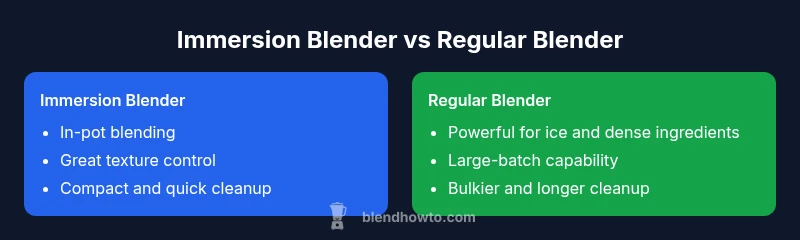
Immersion blenders excel for pot-based blending and quick emulsions, while countertop blenders shine with large batches and tough ingredients. For most kitchens, a hybrid approach offers the most flexibility: use the immersion blender for soups, sauces, and delicate emulsions, and rely on a countertop model for smoothies, nut butters, and heavy blends.
What You’re Comparing: Immersion Blender vs Regular Blender
The core distinction between immersion blenders and regular countertop blenders is how they blend. An immersion blender has a handheld motor with a shaft and blade that can be plunged directly into pots, bowls, or jars, enabling you to blend ingredients in place. A regular blender uses a motorized base with a removable jar and blades, delivering blending power from a fixed vessel. When evaluating the immersion blender vs regular blender, consider how you cook, your space, and how much texture control you want. For households that often prepare soups, sauces, and emulsions directly in pots, an immersion blender minimizes transfer and speeds up workflows. For families that routinely make smoothies, nut butters, or purees in large batches, a countertop model offers higher capacity and consistent performance. This section will map out the practical implications of choosing one over the other, along with realistic expectations for maintenance, attachments, and lifecycle.
Power, Speed, and Control: The Technical Gap
Power is the most obvious differentiator, but it’s not the only one. Immersion blenders typically deliver enough torque to blend soups, sauces, and emulsions when used with steady, deliberate motions. They rely on a rotating blade at the end of a shaft, which creates a variable, on-demand texture. Most models offer multiple speed settings and pulsing options that allow you to adjust texture gradually, but performance still depends on the ingredient density and vessel geometry. By contrast, regular blenders rely on a closed jar and a high-speed motor to generate consistent shear forces, which makes quick work of ice, frozen fruit, and dense ingredients. The distribution of power is often more predictable for large batches, and blades are designed to handle tougher textures. The result is more uniform smoothies and even nut butters, but at the cost of needing a larger container, more storage space, and extra cleanup. In short: immersion blenders win for control in proximity; countertop blenders win for raw power and batch stability.
Design and Durability: What Wears Over Time
Durability in blending devices depends on the interface between motor, blade, and housing. An immersion blender’s key weakness tends to be the shaft seal and blade assembly; frequent blending in hot liquids can wear seals and shorten service life if the model uses cheaper plastics. However, high-quality immersion models use stainless steel shafts and detachable components that are easy to repair or replace. Cleaning is simpler because you can rinse the shaft immediately after use, reducing residue buildup. Countertop blenders rely on a rigid base and a large jar; the motor tends to be more rugged, but the jar can crack with heavy use or accidental drops. Accessory kits—choppers, whisk attachments, and grinding blades—add versatility but also potential wear points. In practice, both categories benefit from careful handling, avoiding overfilling, and following the manufacturer’s guidance on dishwasher safety. Overall, durability is less about the brand and more about construction quality, warranty coverage, and maintenance habits.
Use-Case Scenarios: Soups, Sauces, and Smoothies
For soups and sauces: immersion blenders shine when you need to blend directly in the pot without transferring hot liquids to a jar. They are ideal for emulsifying sauces like hollandaise or vinaigrettes and for achieving a smooth texture while monitoring heat. For small kitchens, this means fewer dishes and faster workflow. For smoothies and frozen drinks: countertop blenders excel because they handle ice and frozen fruit with ease, producing consistently smooth textures. They’re also better for making larger batches, family servings, and meal-prep jars. For grinding and chopping: many countertop blenders with additional attachments can handle nuts, seeds, and simple purees; immersion blenders can still perform light chopping through specific blade attachments, though results may vary. The best approach is to map your weekly recipes to the strength of each tool and to avoid forcing one tool to do everything.
Texture and Consistency: How Each Tool Influences Results
Texture control is the essence of the immersion blender’s appeal. By adjusting the immersion depth and movement you influence chunkiness, silkiness, and emulsification in real time. You can pulse, sweep, or blend continuously to achieve a range of textures without transferring ingredients. Regular blenders deliver predictable, consistent results due to fixed blades and optimal aeration; they tend to produce uniformly smooth textures with minimal manual intervention. However, achieving ultra-fine textures may require straining or processing in small batches. The choice depends on whether you value hands-on texture control (immersion) or batch consistency (regular blender). If you need to emulsify or puree directly in a pan or pot, the immersion blender’s texture control is unmatched; for silky smoothies or nut butter, the countertop blender remains the standard.
Cleaning, Hygiene, and Maintenance Routines
Immersion blenders—particularly those with detachable blades—are quick to clean. Rinse the shaft immediately after use, disassemble the whisk or blending attachment if applicable, and wash the blade assembly by hand or in the dishwasher per the model’s guidance. Look for models with dishwasher-safe blades and detachable shafts for faster cleanup. Countertop blenders have larger jars that require thorough washing; grit from smoothies and ice can scratch glass or plastic jars. Some jars are dishwasher-safe, but you should check the lid, blade assembly, and gasket. Regular maintenance includes inspecting seals, cleaning vents, and avoiding motor overheating by not overfilling. A simple rule: wash components as soon as possible after blending to prevent dried residue, particularly with starchy or fibrous ingredients.
Space, Storage, and Budget: Real-World Constraints
In small kitchens, the footprint matters more than raw power. Immersion blenders are compact, nearly flat, and store easily in a drawer or on a shelf; their blades and shaft can be kept attached, reducing the number of parts you manage daily. Countertop blenders require a spot on the counter or a taller cabinet for the jar and base, which can clash with other appliances and reduce accessible workspace. Budget considerations follow with power and capacity: immersion blenders generally cost less upfront, but higher-end models with stainless steel shafts and robust motors can close the gap with mid-range countertop blenders. If you blend often in small batches and value quick cleanups, an immersion model makes sense; if you anticipate frequent large batches or hard ingredients, invest in a higher-capacity countertop blender. Consider a two-appliance setup for maximum flexibility in kitchens that regularly perform both tasks.
Practical Buying Guide: How to Pick Based on Your Kitchen
- List your most common tasks: soups, sauces, smoothies, nut butters. 2) Assess your space: drawer vs cabinet vs counter. 3) Check attachments: does the immersion blender come with whisk, chopper, or extra blades? 4) Evaluate cleanup: dishwasher-safe parts save time. 5) Set a budget and compare warranties. 6) Read reviews that emphasize long-term durability and blade safety. 7) Consider a plan for future needs: you may want both tools if you cook daily and value convenience. This guide helps you choose a tool that fits your recipes and kitchen rhythm.
Pro Tips and Common Mistakes to Avoid
- Avoid overfilling pots when using an immersion blender to prevent splashes and burns. - Start on low speed to prevent splattering when blending hot liquids. - Don’t assume a single tool can handle every task; identify the core tasks and invest accordingly. - Check the jar and lid compatibility before blending, especially with multiple attachments. - Store blades safely and keep the electric cord tangle-free. - When in doubt, revert to a dedicated blender for dense or large-batch tasks.
Comparison
| Feature | Immersion Blender | Regular Countertop Blender |
|---|---|---|
| Power and Torque | Moderate for in-pot blending | High power for dense ingredients and ice |
| Texture Control | High manual control with depth and pulse | Predictable texture via fixed speeds |
| Batch Size / Capacity | Small batches and in-pot blending | Large batches and heavier loads |
| Versatility / Attachments | Whisk, chopping blade options often separate | Dedicated jar with blade; attachments vary by model |
| Ease of Cleaning | Detachable shaft; quick rinse | Larger jar; dishwasher-safe parts |
| Durability / Longevity | Solid construction; wear points on cheap models | Rugged base; jar may crack with mishandling |
| Space / Storage | Compact; fits in a drawer | Requires cabinet or counter space |
| Price Range | Typically lower upfront cost | Typically higher upfront cost; varies by brand |
What's Good
- Space-efficient option for small kitchens and simple tasks
- Direct blending in pots reduces transfers and cleanup
- Regular blenders handle large batches and tough ingredients
- Clear trade-offs help users choose based on recipes and space
The Bad
- Immersion blenders struggle with large batches and very dense ingredients
- Finding a model with durable attachments can be expensive
- Jars and attachments may require extra storage
- Power limitations can affect performance on tough tasks
Neither tool is universally better; choose based on your cooking style and space.
If you frequently blend in pots and want quick emulsions, an immersion blender is ideal. If you routinely make large batches or need to crush ice, a countertop model is the stronger choice. For many homes, a dual-tool setup offers the best balance.
Frequently Asked Questions
What is an immersion blender and how does it differ from a regular blender?
An immersion blender is a handheld stick blender that blends directly in pots or bowls. A regular blender uses a motorized base and a jar with fixed blades. The main difference is that immersion blenders offer in-place blending and better control for small batches, while countertop blenders excel at large batches and tougher ingredients.
An immersion blender blends in the pot to save transfers, while a countertop blender blends in a jar for larger batches.
Is an immersion blender good for smoothies?
Immersion blenders can make smoothies, but they are not always ideal for thick or large batches due to smaller blending volume and variable texture. Some models perform well, but countertop blenders typically deliver more consistent smoothies with less effort.
Yes, but countertop blenders usually handle ice and large batches more reliably.
Can I replace a countertop blender with an immersion blender?
You can replace many light-duty tasks with an immersion blender, but it won’t fully replace a countertop blender for large batches, ice, or dense ingredients. Consider your weekly recipes before deciding.
An immersion blender covers many daily tasks, but for big batches a countertop model is still preferred.
Do I need both an immersion and a countertop blender?
If your budget allows, a dual-tool setup provides maximum flexibility. For most households, prioritizing one based on the primary tasks—soups and sauces versus smoothies and bulk blends—offers a practical compromise.
Many people find value in having both, but a strong single-use model can cover most needs.
How should I clean an immersion blender?
Detach the shaft and blades if possible, rinse immediately after use, and wash attachment parts according to the manufacturer’s directions. Some parts are dishwasher-safe, but always check the manual.
Rinse the shaft after blending and wash detachable parts as directed.
What to Remember
- Assess kitchen space before buying
- Map weekly recipes to tool strengths
- Choose immersion for soups and sauces; countertop for bulk blending
- Consider a dual-tool setup for maximum flexibility
- Check attachments and warranty before purchase